Home » Posts tagged 'W. Tatarkiewicz'
Tag Archives: W. Tatarkiewicz
Talks on W. Tatarkiewicz’s Lectures on Greek Philosophy
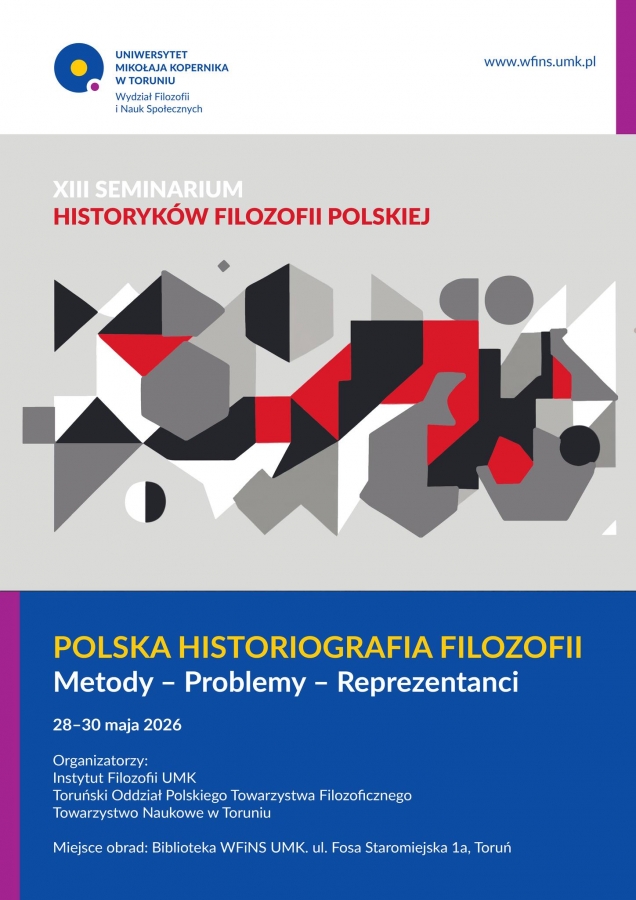
A series of conferences called Seminars of Historians of Polish Philosophy continues and develops. The latest edition (the 13th) was organised in Toruń by the Institute of Philosophy of the Nicolaus Copernicus University on May 28th-30th, 2026. The title of the meeting was Polish Historiography of Philosophy. Methods – Problems – Representatives. The members of Ancient Φilosophy Reception research group were obviously present there. It should be only briefly mentioned here that the 12th edition of the Seminar took place in May 2025 in Zielona Góra, and the initiative came from AΦR.
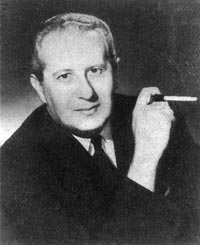
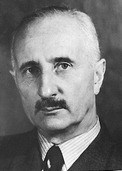
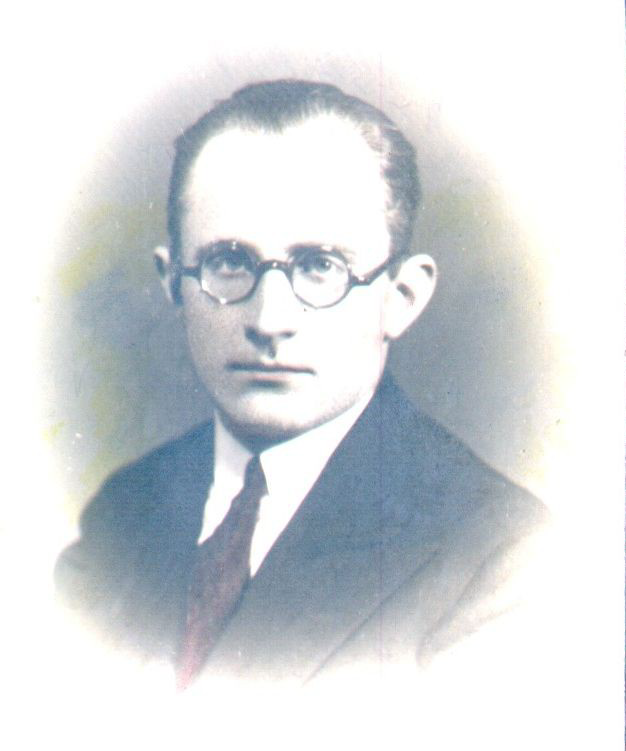
Those were Tomasz Mróz and Adrian Habura who represented Institute of Philosophy (UZ). Both their papers were presented in the panel New Sources for the History of Polish Philosophy, and both were focused on various aspects of the same archival material. This material cosisted of excerpts, reports and notes taken by Bohdan Zawadzki (1902-1966, photo on the right) from lectures delivered in Warsaw in the early 20’s of the 20th century by Władysław Tatarkiewicz (1886-1980). They remained unknown before Habura’s short research visit in Vilnius.
The paper by T. Mróz was titled Bohdan Zawadzki’s reports from Władysław Tatarkiewicz’s lectures on Greek philosophy. Mróz made a general presentation of Zawadzki as a student of Władysław Witwicki (1878-1948) in Warsaw and a professor in Vilnius, and his relations to Tatarkiewicz. Then he focused on the manuscript materials and the representation of Plato in them. His conclusion was that even a preliminary analysis of Zawadzki’s notes, especially in parts devoted to Plato, demonstrates that Tatarkiewicz as a lecturer of Greek philosophy was still influenced by his studies in Marburg and he had provided his students with much richer material than he later included in volume I of his History of Philosophy.
A. Habura, in his paper titled Two images of Aristotle in Władysław Tatarkiewicz’s works in the light of Bohdan Zawadzki’s notes, examined a more detailed issue related to Zawadzki’s manuscripts. A starting point of his paper was a distinction between the two “images” of Aristotle that Tatarkiewicz developed before the WWII. The first was the result of his doctoral studies in Marburg (1910), while the second was included in his History of Philosophy (1931). An analysis of these two “images” leads to the conclusion that, although they are formally different, they do not differ so much in the content. Zawadzki’s manuscripts from Tatarkiewicz’s lectures are valuable in this case, because they allow to demonstrate that in the 1920s, while writing his History of Philosophy, Tatarkiewicz’s studies on Aristotle were more developed than they appeared until now.
Participation of both scholars in the Seminar was sponsored from the funds of “Small Grant” (UZ).
Erasmus+ Teaching Visits in Vilnius Continue
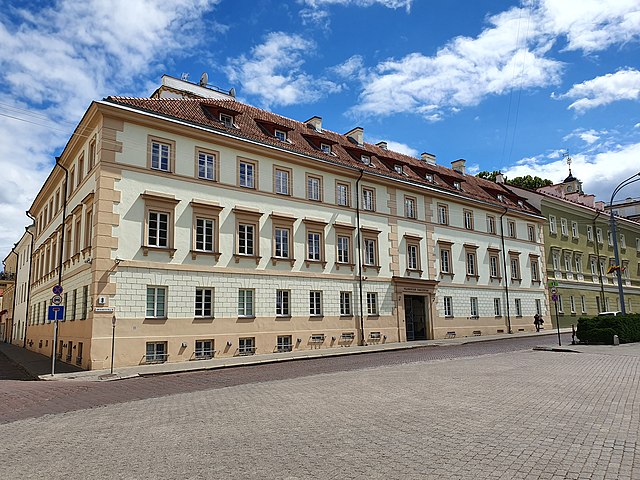
In May, 11th-15th, 2026, Tomasz Mróz enjoyed his fifth Erasmus+ teaching visit in Faculty of Philosophy, Vilnius University.
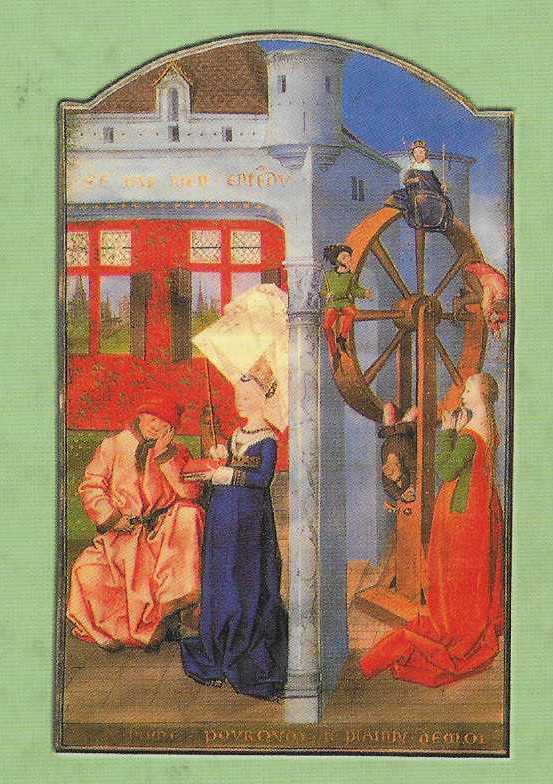
One of the lectures was focused on discussing various problems related to historiography of philosophy, using the method and structure of the History of Philosophy by Władysław Tatarkiewicz (1886-1980), especially in regard to ancient philosophers. An additional material for discussion was provided by the Lithuanian edition of this three-volume book (2001) with covers – contrary to Polish editions – decorated with various images. The front cover of vol. I, for example, depicts Boethius – what students were able to discover with only little help! – in his consoling dialogue with Philosophy herself, and the wheel of Fortune, an important argument for a philosophers not to let a hard lot get them down.
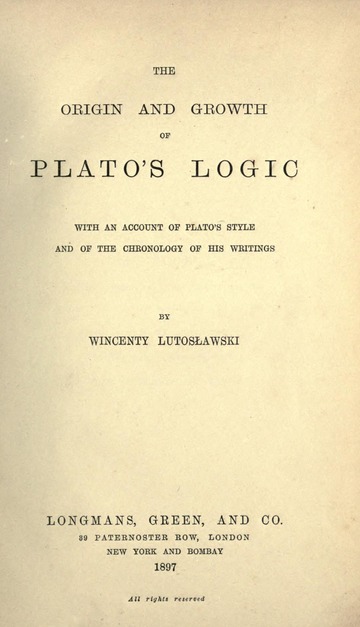
Another lecture related to the history of ancient philosophy scholarship was devoted to Wincenty Lutosławski (1863-1954), a renowned researcher of Plato, and the Vilnius period of his academic career. A decade spent in Vilnius was by Lutosławski considered a disappointment with his colleague professors and low number of students. He was able, however, to promote a successful Ph.D. student interested in Plato, Benedykt Woyczyński (1895-1927), initiate correspondence with notable persons, not only philosophers, and – last, but not least – work on his idea of a historical development of metaphysics, which was his focus until his ultimate years.
This lecture was an open event and it was advertised here.
A. Habura’s Research Stay in Vilnius
We have already informed that the members of the Ancient Φilosophy Reception research group received a “Small Grant” from the Deputy Rector for Science and International Cooperation of the University of Zielona Góra. The aim of the AΦR team is to pursue research on the notes by Bohdan Zawadzki (1902-1966) from Władysław Tatarkiewicz’s (1886-1980) lectures on the philosophy of the Greeks. Now, we are glad to announce that the work is progressing.
The first phase of the research plan, that is, preliminary analysis of the manuscripts, has just been completed. It was thanks to the works of Adrian Habura, who travelled to Vilnius in May 2026 to assess the value of Zawadzki’s manuscripts and to identify the most significant issues that were emphasised by both, Zawadzki, the student, and Tatarkiewicz, the lecturing professor.

The next steps in the research plan include studies of the most important problems related to Tatarkiewicz’s lectures, as they were rendered by Zawadzki. The results will be presented in near future as conference or seminar papers and academic articles.
The Third Small Grant from the University of Zielona Góra

Prof. Justyna Patalas-Maliszewska, the Deputy Rector for Science and International Cooperation of the University of Zielona Góra, home institution of the AΦR, awarded Tomasz Mróz and Adrian Habura with a “Small Grant” (17th edition). These internal grants are distributed by the Rector annually among those researchers of UZ, who have submitted their proposals to the National Science Centre (NCN), received positive assessements from the experts, yet finally have not been granted funding.
The aim of the “Small Grant” for AΦR is to conduct preliminary research on extensive notes taken by Bohdan Zawadzki (1902-1966), later professor of psychology, during the lectures of Władysław Tatarkiewicz (1886-1980) on the philosophy of the Greeks, which were held at the University of Warsaw in the early twenties of the 20th century. Zawadzki’s manuscript is kept in one of the libraries in Vilnius.
The proposal received highest possible notes and funding will be spent on archival research and attending a conference.
The Second Doctoral Degree by a Member of AΦR Team
On April 14th, 2026, a public defense of Adrian Habura’s doctoral thesis took place in the Institute of Philosophy, University of Zielona Góra (UZ). The title of his dissertation was Aristotle as a Research Material and Source of Inspirations of Władysław Tatarkiewicz (1886-1980). The whole event was chaired by prof. Justyna Kroczak. At the start of the curriculum, the candidate was presented by the supervisor, Prof. Tomasz Mróz, who gave an overview of the candidate’s research and teaching experience, emphasised Habura’s work in a previous research project on S. Lisiecki, and his successful collaboration with prof. Jonas Čiurlionis of Vilnius University, an auxiliary supervisor of the dissertation.
Habura then took the floor and presented the main points of his thesis. His dissertation aimed to answer two questions: 1) how did Tatarkiewicz interpret Aristotle’s philosophy? And 2) how did Aristotle inspire him in his original philosophical reflections? Habura applied Juliusz Domański’s distinction between the researchers and the users of ancient heritage, which helped him to define clearly the conditions of reception process. According to Domański, reception must be preceded by acknowledging and positive evaluation of the subject of study. Habura argued that Tatarkiewicz had met both of these conditions.
To answer the questions of the thesis, Habura focused on chronology of Tatarkiewicz’s life and work and on philosophical problems related to the reception of Aristotle, and applied biographical and comparative methods. His analyses demonstrated that Tatarkiewicz, during his long and fruitful life, developed several interpretations of Aristotle. Therefore, Habura examined relations between these interpretations.
Tatarkiewicz himself stated that during his life, he had developed two “images”, two interpretations of Aristotle, and spoke about him in two different ways. However, as Habura argued, they were not contradictory, but rather complementary. Regarding Aristotle’s research methods, philosophical approach, and philosophical ideas, Tatarkiewicz did not change his position in his later works; he broadened his analyses to include various aspects of Aristotle’s philosophy (from metaphysics to aesthetics). For this reason, Habura concluded that it was fully justified to treat Tatarkiewicz’s interpretations as parts of one coherent image of Aristotle.
From Tatarkiewicz’s earliest works on Aristotle to his final writings, he consistently regarded the Stagirite’s philosophy as pluralistic and teleological. As comparative analyses demonstrated, Tatarkiewicz’s own philosophical thinking could be attributed with these two adjectives as well, because they describe accurately his position in epistemology, methodology, ethics, and aesthetics.
The dissertation was assessed by three reviewers, they were prof. Marian Wesoły (The Jacob of Paradies Academy in Gorzów Wielkopolski / Adam Mickiewicz University in Poznań ), prof. Przemysław Paczkowski (University of Rzeszów), and prof. Ryszard Wiśniewski (Jan Długosz University in Częstochowa / Nicolaus Copernicus University in Toruń). It should be remarked that prof. Wiśniewski, in 1976, was himself an author of a doctoral dissertation on Tatarkiewicz. All the reviewers arrived in Zielona Góra to present their positive assessments of the dissertation and ask a couple of questions. They were concerned with a very detailed character of Habura’s account of Tatarkiewicz’s career. Removing some minor parts could have given, as a result, a thinner volume and clearer argument. The discussion, that followed, focused on originality of Tatarkiewicz’s philosophy, on the attempt to position him against the 20th century interpreters of Aristotle, and on a lacking chapter on Tatarkiewicz in Enrico Berti’s book Aristotele nel Novecento (1992), that could have been written, had Berti known the works of the Polish author. Moreover, prof. Wiśniewski, who knew Tatarkiewicz personally, shared some memories of the philosopher with the audience.
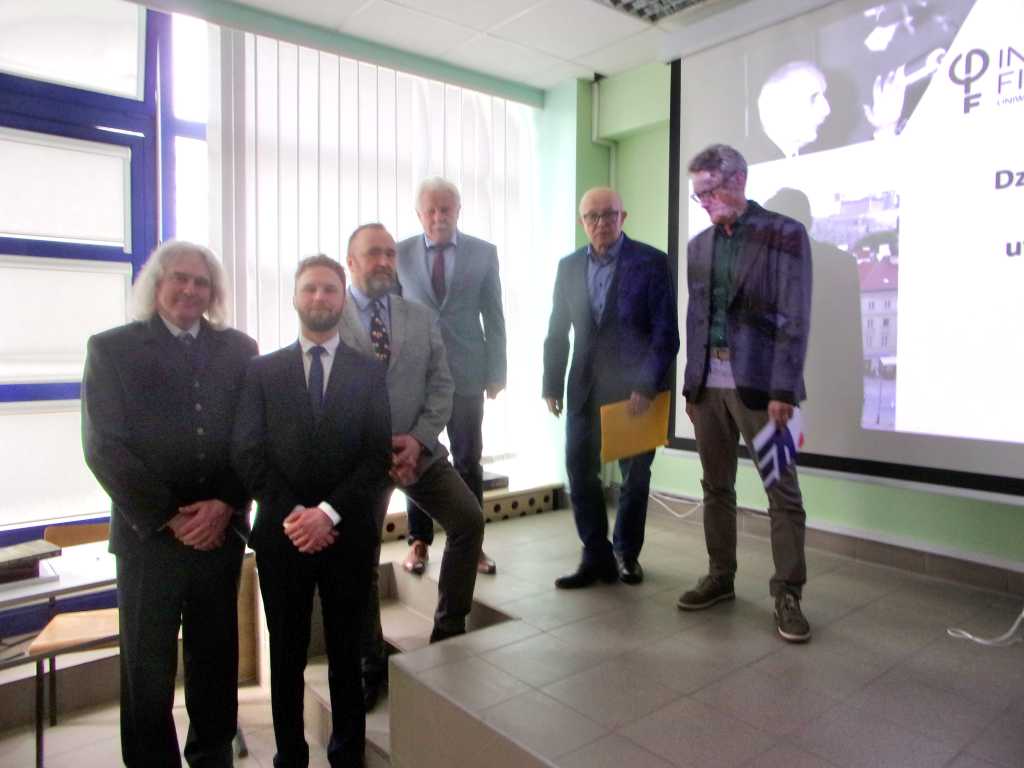
Finally, after hearing the reviews, questions and answers, the commission decided to award A. Habura with a doctoral degree cum laude. His dissertation, no doubt, has broadened the knowledge of the Polish reception of Aristotle and of Tatarkiewicz himself.
Dear Doctor Habura!
Good luck with your research plans!
Philosophy in Zielona Góra. An Anniversary
This year, Institute of Philosophy, University of Zielona Góra (UZ), where Ancient Φilosophy Reception research group is affiliated, celebrates its 30th anniversary. Among the variety of events, there was a conference on 23rd-24th October, devoted to the problem of co-operation in its various relations to theory, history and philosophical practice. AΦR’s history at UZ is obviously much shorter, but two of its representatives actively participated in the conference.

Mariam Sargsyan was the first of them. In her presentation she discussed the results of her doctoral studies at UZ and her dissertation, successfully defended earlier this year. She focused on analyses of Henryk Jakubanis’ (1879-1949) historical-philosophical legacy, which consists of three main parts: 1) his work on Empedocles and its methodology; 2) Plato in his (partly unpublished) writings; 3) his views on ancient and modern ways of doing philosophy. Moreover, Sargsyan presented the conclusions of her research on intellectual genealogy of Jakubanis’ thought.
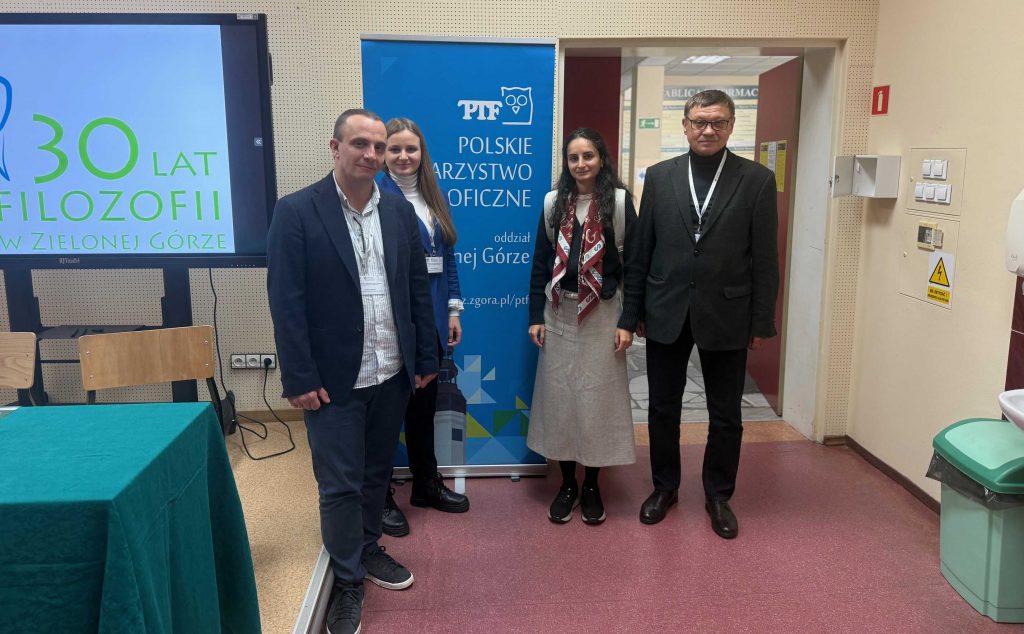
What was even more significant was the fact that Ukrainian participants (see the photo above) of the conference, who work at the National University of Kyiv, attended Sargsyan’s presentation on Jakubanis, who had studied and worked in Kyiv a century ago. They were very interested in her results and provided valuable feedback that could be helpful in improving the text of her doctoral thesis before it is published. The discussion between them demonstrated how important it is to confront different points of view on one subject which is researched by scholars from different countries, applying various methods and interested in different aspects of the history of philosophy.
The second conference participant from AΦR was Adrian Habura who delivered a paper on Władysław Tatarkiewicz (1886-1980) and his reflection on social aspects of human happiness. Habura discussed Tatarkiewicz’s definition of happiness and his understanding of human life, then he examined the role of the others in individual happiness and the links between human individual and society in their relations to happiness. In his paper Habura developed a general view on the role of society in Tatarkiewicz’s philosophical and ethical considerations contained in his book Analysis of Happiness.
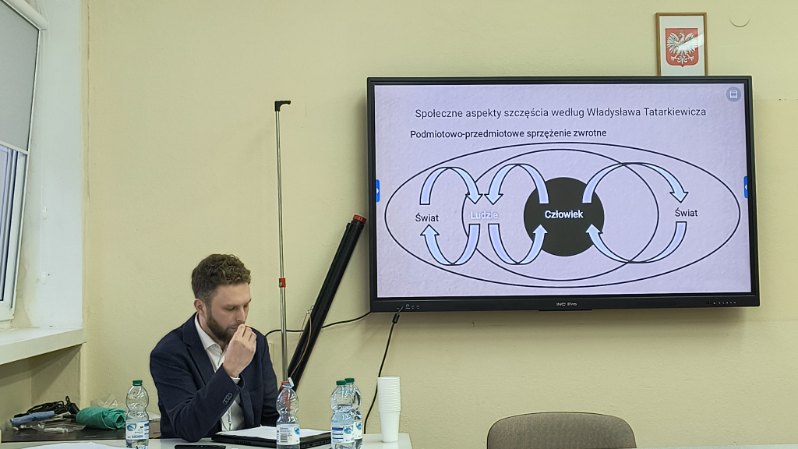
Although Habura’s paper was not directly devoted to the reception of ancient philosophy in Tatarkiewicz’s writings, the following discussion allowed him to address this issue. He highlighted some similarities and differences between Aristotle’s and Tatarkiewicz’s understandings of happiness and convincingly demonstrated how Aristotle could have inspired ethical investigations of this Polish philosopher, whose doctoral thesis on Aristotle was composed under supervision of the Marburg neo-Kantians.
Ancient Φilosophy Reception at the 12th Seminar of Historians of Polish Philosophy

Seminar of Historians of Polish Philosophy (SHPPh) is a cyclical academic event held at various universities in Poland since its first edition in Warsaw in 2006. In 2025 (May 19th-20th), it was for the first time at the University of Zielona Góra (UZ) where Polish researchers of their native philosophical traditions gathered. Central topic of this edition of SHPPh was the problem of classical thinkers and epigons in the development of Polish thought. Detailed programme of the whole event can be downloaded here.
The seminar was also an opportunity to celebrate the second edition of the book Classics of Polish Philosophy by Ryszard Palacz, an essential figure for historians of philosophy at UZ, and a researcher of reception of Greek philosophy in medieaval thought, about whose passing we have informed in the autumn of 2024. Full program of the event can be downloaded here and a brief report (in Polish) on the UZ’s website can be found here (with a photo gallery). The seminar was accompanied by an exhibition devoted to Professor Palacz and many speakers referred to his work and his understanding of classical Polish philosophers.

Two AΦR group members delivered their papers during the SHPPh. Tomasz Mróz talked about Bohdan Kieszkowski (1903-1997) and about Polish and international disputes on his works on Florentine Platonism.
In the thirties in Poland Kieszkowski was engaged in a dispute with Marian Heitzman (1899-1964), who accused him of underestimating the influences of medieval neoplatonism on Ficino. Heitzman and Kieszkowski, two scholars of one generation, two researchers of Renaissance Platonism, represented two different academic centres, conservative Cracow and more progressive Warsaw, and their polemical texts were published separately in philosophical journals in Cracow (Heitzman) and Warsaw (Kieszkowski). Kieszkowski, naturally, considered Heitzman’s position to be an overestimation of medieval influences on Renaissance’s thought and labelled it as ‘medievalism’. On international niveau a polemic against Kieszkowski’s work came from a Portuguese scholar, José Vitorino de Pina Martins (1920-2010), who praised Kieszkowski’s scholarship, yet spared no words of criticism against Kieszkowski’s edition of Pico della Mirandola’s Conclusiones (Geneve 1973).
Adrian Habura’s talk smoothly concluded the whole conference focusing, on the one hand, on a paper titled Four Understandings of Classicism by Władysław Tatarkiewicz (1886-1980), and on the other hand, on Palacz’s (1935-2024) arguments for including Tatarkiewicz among the classics of Polish philosophy.
Habura analysed Tatarkiewicz’s notion of classicism and supplemented Palacz’s arguments for including Tatarkiewicz among the classics, demonstrating that not only his History of Philosophy, History of Aesthetics, and History of Six Ideas, that is, basically historical studies, but also his Analysis of Happiness, the original philosophical work by Tatarkiewicz, bears the mark of classic. Ethical considerations in the Analysis of Happiness, noticeably influenced by Aristotle, not to mention Tatarkiewicz’s doctoral degree from Marburg on a thesis devoted to Aristotle, allowed Habura to highlight an additional aspect of Tatarkiewicz as a classic, for he was not only a classic among Polish philosophers, but also a classic in another understanding: as a follower or – to use the term proposed by Juliusz Domański – a user of Aristotelian philosophy. And it was Aristotle whom Tatarkiewicz himself regarded as the most classical among all the classical philosophers of ancient Greece.
Recent commentaries