Home » Posts tagged 'happiness'
Tag Archives: happiness
Philosophy in Zielona Góra. An Anniversary
This year, Institute of Philosophy, University of Zielona Góra (UZ), where Ancient Φilosophy Reception research group is affiliated, celebrates its 30th anniversary. Among the variety of events, there was a conference on 23rd-24th October, devoted to the problem of co-operation in its various relations to theory, history and philosophical practice. AΦR’s history at UZ is obviously much shorter, but two of its representatives actively participated in the conference.

Mariam Sargsyan was the first of them. In her presentation she discussed the results of her doctoral studies at UZ and her dissertation, successfully defended earlier this year. She focused on analyses of Henryk Jakubanis’ (1879-1949) historical-philosophical legacy, which consists of three main parts: 1) his work on Empedocles and its methodology; 2) Plato in his (partly unpublished) writings; 3) his views on ancient and modern ways of doing philosophy. Moreover, Sargsyan presented the conclusions of her research on intellectual genealogy of Jakubanis’ thought.
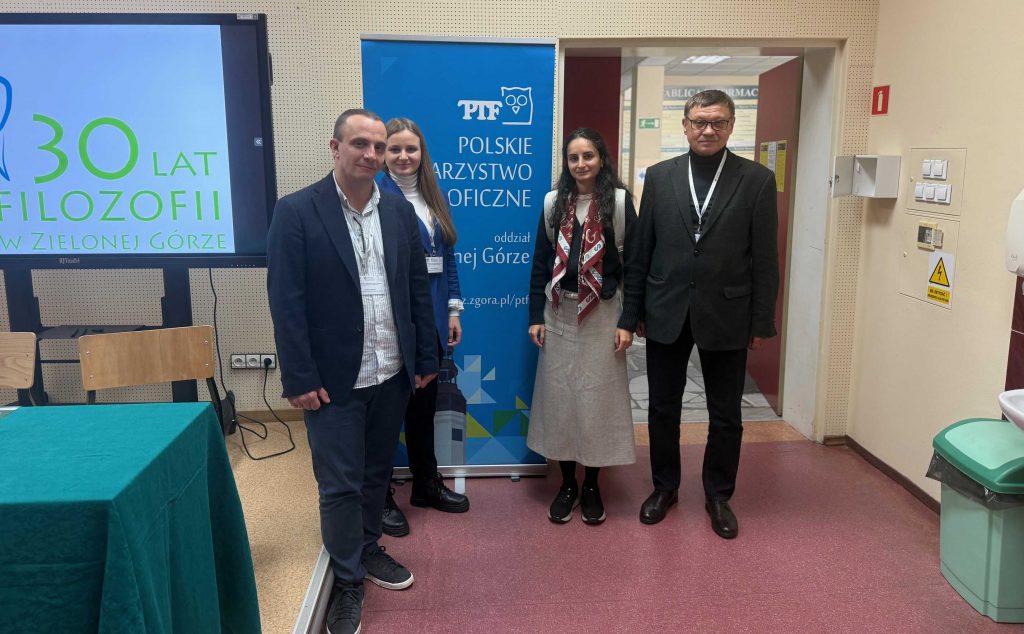
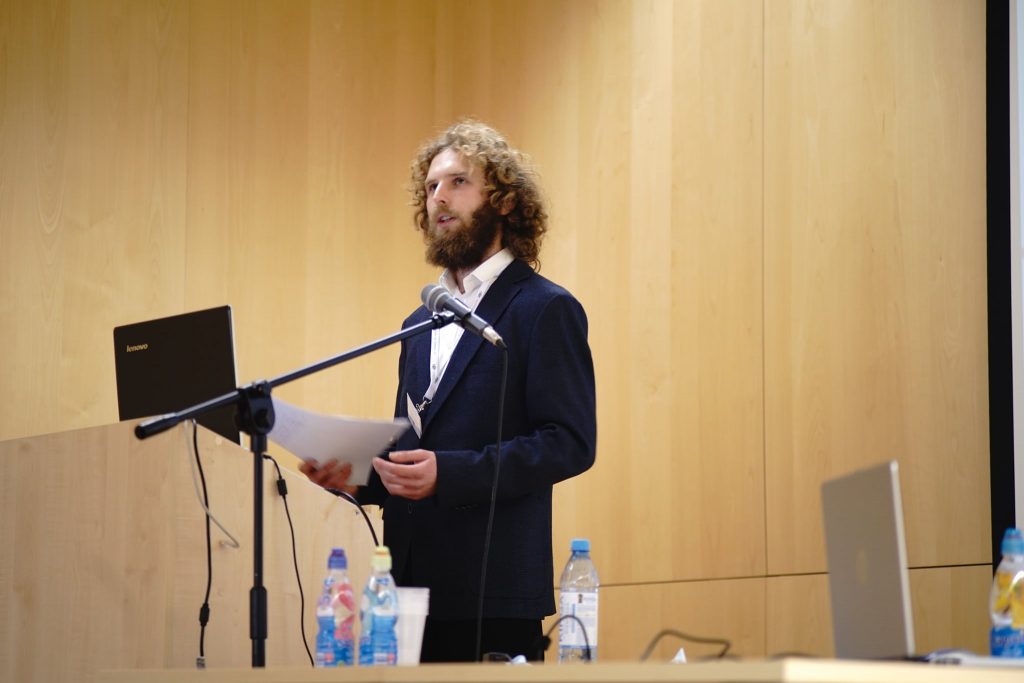
What was even more significant was the fact that Ukrainian participants (see the photo above) of the conference, who work at the National University of Kyiv, attended Sargsyan’s presentation on Jakubanis, who had studied and worked in Kyiv a century ago. They were very interested in her results and provided valuable feedback that could be helpful in improving the text of her doctoral thesis before it is published. The discussion between them demonstrated how important it is to confront different points of view on one subject which is researched by scholars from different countries, applying various methods and interested in different aspects of the history of philosophy.
The second conference participant from AΦR was Adrian Habura who delivered a paper on Władysław Tatarkiewicz (1886-1980) and his reflection on social aspects of human happiness. Habura discussed Tatarkiewicz’s definition of happiness and his understanding of human life, then he examined the role of the others in individual happiness and the links between human individual and society in their relations to happiness. In his paper Habura developed a general view on the role of society in Tatarkiewicz’s philosophical and ethical considerations contained in his book Analysis of Happiness.
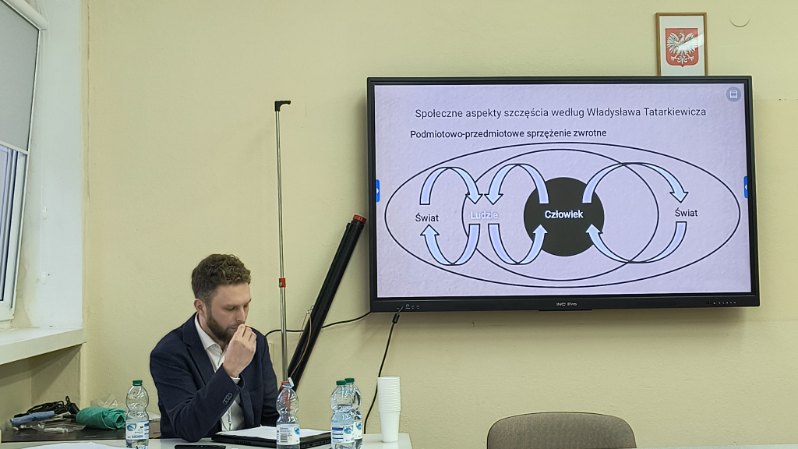
Although Habura’s paper was not directly devoted to the reception of ancient philosophy in Tatarkiewicz’s writings, the following discussion allowed him to address this issue. He highlighted some similarities and differences between Aristotle’s and Tatarkiewicz’s understandings of happiness and convincingly demonstrated how Aristotle could have inspired ethical investigations of this Polish philosopher, whose doctoral thesis on Aristotle was composed under supervision of the Marburg neo-Kantians.
Ancient Φilosophy Reception at the 12th Seminar of Historians of Polish Philosophy

Seminar of Historians of Polish Philosophy (SHPPh) is a cyclical academic event held at various universities in Poland since its first edition in Warsaw in 2006. In 2025 (May 19th-20th), it was for the first time at the University of Zielona Góra (UZ) where Polish researchers of their native philosophical traditions gathered. Central topic of this edition of SHPPh was the problem of classical thinkers and epigons in the development of Polish thought. Detailed programme of the whole event can be downloaded here.
The seminar was also an opportunity to celebrate the second edition of the book Classics of Polish Philosophy by Ryszard Palacz, an essential figure for historians of philosophy at UZ, and a researcher of reception of Greek philosophy in medieaval thought, about whose passing we have informed in the autumn of 2024. Full program of the event can be downloaded here and a brief report (in Polish) on the UZ’s website can be found here (with a photo gallery). The seminar was accompanied by an exhibition devoted to Professor Palacz and many speakers referred to his work and his understanding of classical Polish philosophers.

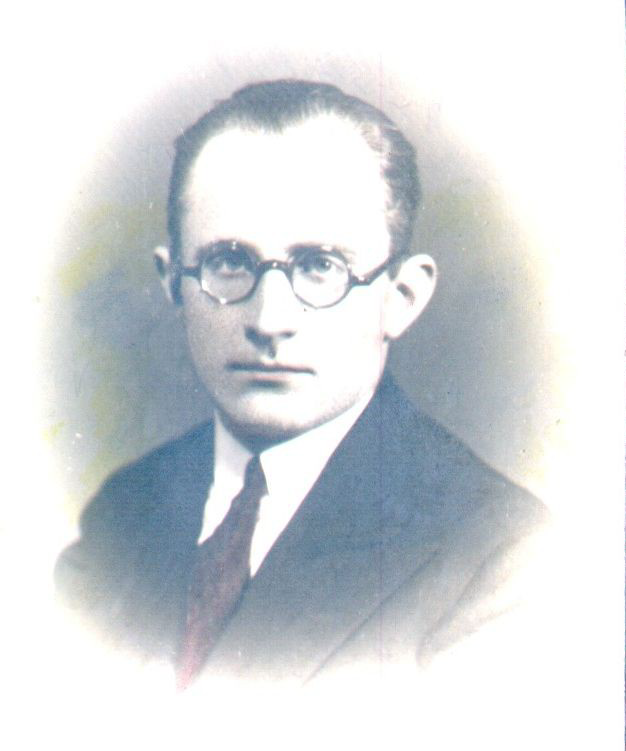
Two AΦR group members delivered their papers during the SHPPh. Tomasz Mróz talked about Bohdan Kieszkowski (1903-1997) and about Polish and international disputes on his works on Florentine Platonism.
In the thirties in Poland Kieszkowski was engaged in a dispute with Marian Heitzman (1899-1964), who accused him of underestimating the influences of medieval neoplatonism on Ficino. Heitzman and Kieszkowski, two scholars of one generation, two researchers of Renaissance Platonism, represented two different academic centres, conservative Cracow and more progressive Warsaw, and their polemical texts were published separately in philosophical journals in Cracow (Heitzman) and Warsaw (Kieszkowski). Kieszkowski, naturally, considered Heitzman’s position to be an overestimation of medieval influences on Renaissance’s thought and labelled it as ‘medievalism’. On international niveau a polemic against Kieszkowski’s work came from a Portuguese scholar, José Vitorino de Pina Martins (1920-2010), who praised Kieszkowski’s scholarship, yet spared no words of criticism against Kieszkowski’s edition of Pico della Mirandola’s Conclusiones (Geneve 1973).
Adrian Habura’s talk smoothly concluded the whole conference focusing, on the one hand, on a paper titled Four Understandings of Classicism by Władysław Tatarkiewicz (1886-1980), and on the other hand, on Palacz’s (1935-2024) arguments for including Tatarkiewicz among the classics of Polish philosophy.
Habura analysed Tatarkiewicz’s notion of classicism and supplemented Palacz’s arguments for including Tatarkiewicz among the classics, demonstrating that not only his History of Philosophy, History of Aesthetics, and History of Six Ideas, that is, basically historical studies, but also his Analysis of Happiness, the original philosophical work by Tatarkiewicz, bears the mark of classic. Ethical considerations in the Analysis of Happiness, noticeably influenced by Aristotle, not to mention Tatarkiewicz’s doctoral degree from Marburg on a thesis devoted to Aristotle, allowed Habura to highlight an additional aspect of Tatarkiewicz as a classic, for he was not only a classic among Polish philosophers, but also a classic in another understanding: as a follower or – to use the term proposed by Juliusz Domański – a user of Aristotelian philosophy. And it was Aristotle whom Tatarkiewicz himself regarded as the most classical among all the classical philosophers of ancient Greece.
AΦR at the 11th Seminar of the Historians of Polish Philosophy in Częstochowa
Seminar of the Historians of Polish Philosophy is a cyclic academic meeting which gathers philosophers and historians of philosophy who focus on the history of philosophy in Poland. 11th edition of this seminar was held in Częstochowa at Philosophy Department of Jan Długosz University on May 15th-16th, 2023, and it was focused, not surprisingly, on the topics of war and peace.

Two AΦR members delivered their papers there. Adrian Habura’s paper was not directly devoted to the reception of ancient philosophy, for he focused on the first edition of Władysław Tatarkiewicz’s (1886-1980) work O szczęściu [Analysis of Happiness] (1947), and took an attempt to analyse the content of the book and search for the topics related to war issues to determine possible origin of each chapter, that is, to divide the chapers into two groups: those composed by Tatarkiewicz before the outbreak of the World War II and those compose after it.
Tomasz Mróz, in turn, presented a largely unknown biography of a 20th century Polish researcher of Florentine neo-Platonism. His presentation had a long title: Bohdan Kieszkowski (1904-1997): a Researcher of Renaissance neo-Platonism and His Career Destroyed by the War (with the materials collected by Professor Czesław Głombik).
Kieszkowski published his works in Polish, Italian and French, and edited Conclusiones by Giovanni Pico della Mirandola (Geneve 1973). His opus vitae was the book Platonizm renesansowy [Renaissance Platonism] (Warszawa 1935), subsequently published in Italian as Studi sul platonismo del rinascimento in Italia (Firenze 1936). His studies were discussed mostly in Poland, Italy, France and Spain, but existing sources allowed only to reconstruct his biography to the first years after the World War II.
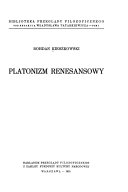
Materials collected by prof. C. Głombik (1935-2022) from family archives shed some light on Kieszkowski’s life on an exile in France. He was meeting there his former supervisor from the University of Warsaw, W. Tatarkiewicz, who was able to visit Paris several times in the sixties and considered Kieszkowski to be his best student. The letters from Tatarkiewicz to Kieszkowski’s sister, Wanda, reveal the facts concerning the details of a difficult life of a scholar on the exile. To Tatarkiewicz’s disappointed Kieszkowski was considering a turn in his focus from Renaissance studies to military history, yet he was very compassionate about his former student because he was aware of Kieszkowski’s physical and psychological limitations, resulting from his war and after war experiences. His legs, for example, were severely injured by German air raids already in 1939, he narrowly avoided amputation and throughout his life he experienced the negative effects of this until the end of his life. Communication between Tatarkiewicz and Kieszkowski was also affected by the fact that the former’s hearing was impaired and the latter spoke very quietly, as if he was afraid that someone could overhear them. Nevertheless, Kieszkowski’s works on Renaissance Platonism won recognition in the academic world and it is an interesting task to research their reception and impact.
Two Members of AΦR at the Second Congress of Polish Philosophy
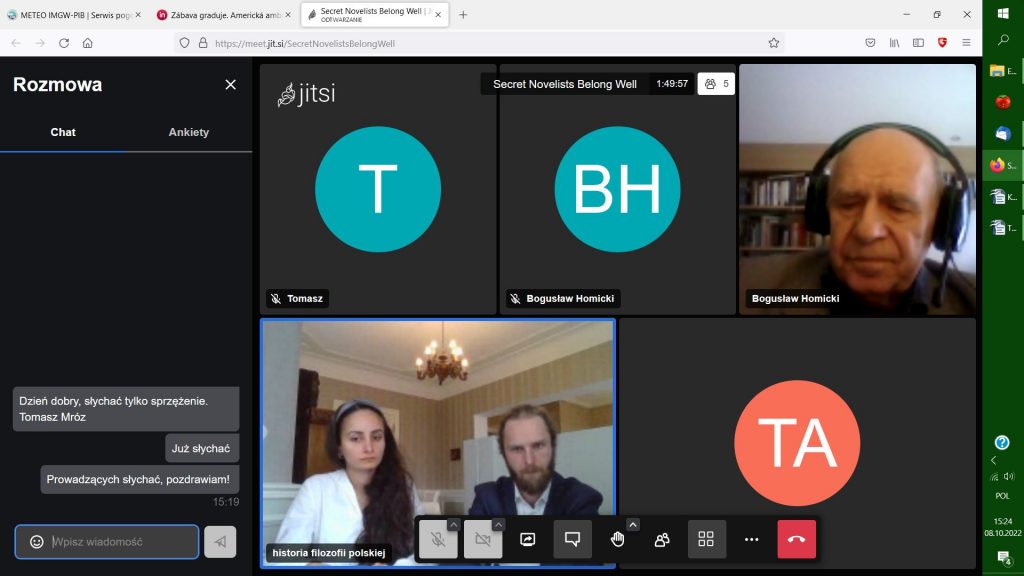
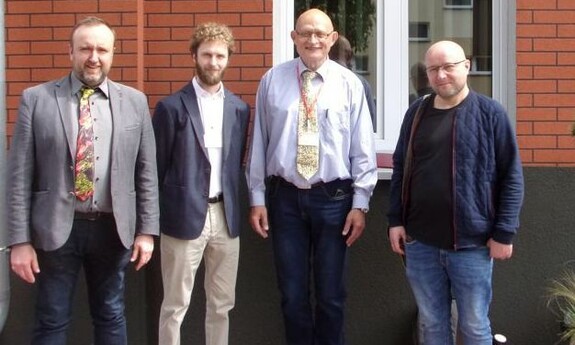
On October 7th-10th 2022 the Second Congress of Polish Philosophy took place in the Palace in Orla. Congress was held both on site and online. The organising institution of the Congress was the Chair of Philosophy (Department of History, University of Opole). The aim of this event was to research and develop Polish philosophical traditions. AΦR group members delivered their papers in the section devoted to the history of Polish philosophy.
The first lecture by an AΦR group member was titled Władysław Tatarkiewicz between Good and Happiness and was delivered by Adrian Habura. His paper was focused on axiological and ethical investigations of Tatarkiewicz in the years 1919-1947, and especially on his inaugural lecture On the Dual Understanding of Moral Act, which was delivered in October 1919 at the Stefan Batory University in Vilnius. Habura’s aim was to sketch the lines of development in Tatarkiewicz’s ethical investigations from the Good, as a topic of his postdoctoral dissertation (1919), to the happiness, from the book Analysis of Happiness (1947).
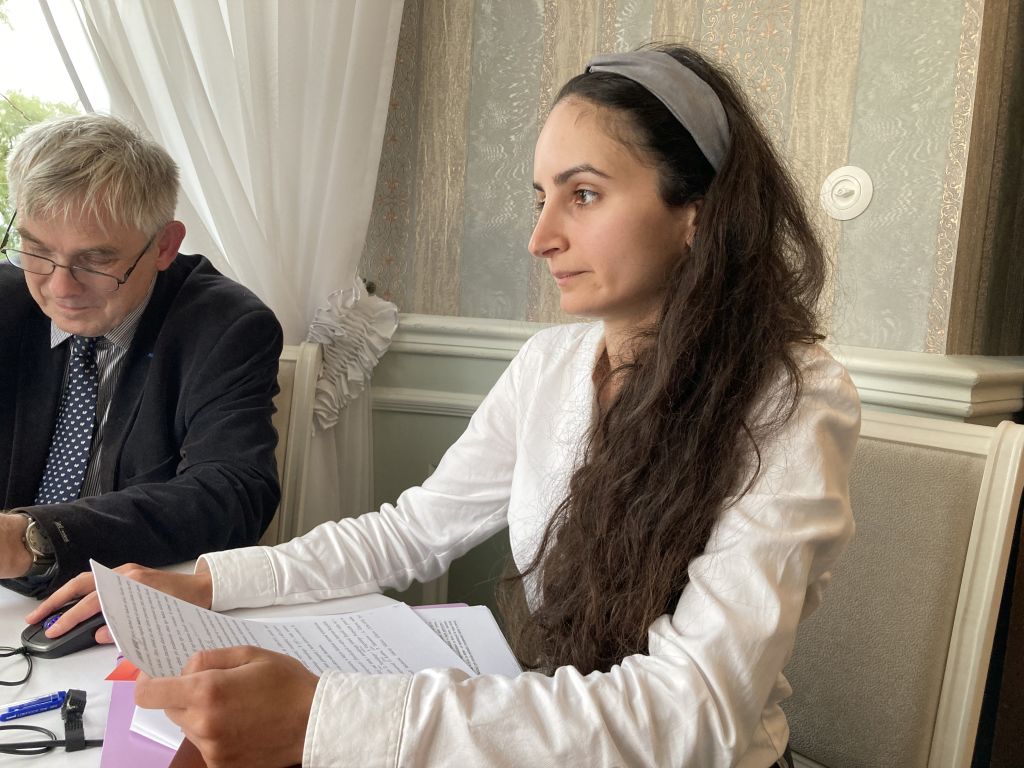
It was, however, only the second paper by an AΦR group member, which was devoted to the reception of ancient philosophy. It was Mariam Sargsyan’s presentation on Henryk Jakubanis, a Polish historian of Greek philosophy. The presentation’s title was Henryk Jakubanis (1879-1949) – a historian of Greek philosophy between Kyiv and Lublin.
The intellectual biography of this historian of philosophy is usually divided into two periods: Kyiv (1897-1922) and Lublin (1922-1949). The aim of Sargsyan’s paper was to present vita of Jakubanis considering both periods of his life and work. Lublin period is quite well known to Polish authors, but the significance of the Kyiv period remains unclear. In Lublin, Jakubanis headed the Department of Classical Philology and then the Department of Philosophy at the University of Lublin, which later became the Catholic University of Lublin.
It was, however, the Kyiv period which was the productive part of Jakubanis’ life, because in Kyiv he wrote his most important works: a book on Empedocles, consisting of a historical and philosophical study and a translation of the collected fragments of this thinker into Russian. Moreover, a series of articles on the significance of ancient philosophy, on the history of syllogism and on the relations between the ideas of Plato and Schiller, were composed by Jakubans in Kyiv. Sargsyan’s paper presented unknown facts from the biography of this historian of philosophy and discussed his works from the Kyiv period, which are usually barely mentioned.
Delivering their papers at the Congress was an important experience for both young researchers and it helped them develop their skills, not to mention social advantages of face to face scholarly meetings.
Ancient Philosophy in Academic Curriculum of Władysław Tatarkiewicz
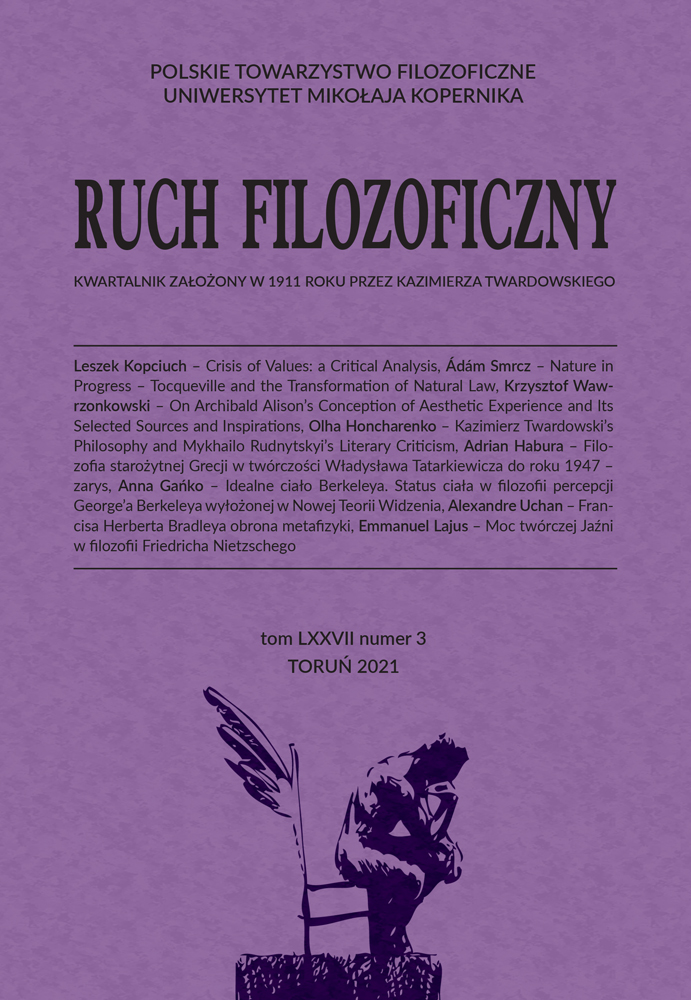
A paper by Adrian Habura, discussing Władysław Tatarkiewicz’s (1886-1980) works on ancient philosophy, which had been published by him by 1947, was published in “Ruch Filozoficzny” (vol. 77, 2021, iss. 3), the second oldest Polish philosophical journal. The paper is structured chronologically and presents results of careful sifting of all Tatarkiewicz’s works published before 1947.
Władysław Tatarkiewicz was a historian of philosophy and a philosopher, who studied ancient Greek philosophy throughout his entire research career. It is not surprising to say that he considered ancient philosophy to be the foundation of European philosophy. Furthermore, his original philosophical works indicate that the investigations of ancient Greeks were his major inspiration. The aim of this article is to provide an outline of those of Tatarkiewicz’s works in which Greek philosophy was explored by him as a topic of his historical research or used as the source of inspiration for his original philosophical reflection. The analysis of Tatarkiewicz’s works that were focused on Greek philosophy is related to Tatarkiewicz’s methodology. All this taken together allows to give a preliminary answer to the question of the significance of ancient Greek philosophy for his philosophical development and for philosophy in Poland in general.
Habura traces Tatarkiewicz’s academic biography back to his Ph.D. thesis from Marburg, which was devoted to Aristotle – and later reviewed by D. Ross – and Aristotelian inspirations in his subsequent paper on Weltansichten. One of the results of Tatarkiewicz’s stay in Marburg was his research on Plato, largely inspired by his Marburg teachers, Paul Natorp and Hermann Cohen. Later works by Tatarkiewicz in ethics, including his habilitation thesis, reveal his continuous direct and indirect references to Greek philosophers. In 1931 two volumes of his History of Philosophy saw the light of day, his opus magnum in historiography of philosophy, including, obviously, chapters on the Greeks, and in 1947 his treatise On Happiness appeared, with numerous references to ancient ethical systems.
This paper offers not only a mere report of Tatarkiewicz’s references to the ancients, but moreover, Habura succeeded in indicating connection between Tatarkiewicz’s historical interest in ancient philosophy and his own original research in philosophy and ethics.
Full paper in Polish is available on the journal’s website here.
On W. Tatarkiewicz’s (Mis)fortunes
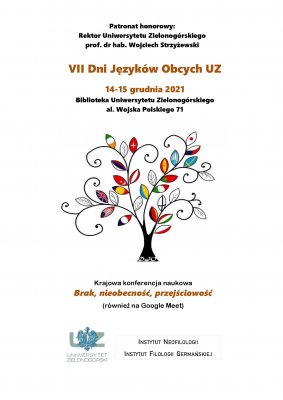
The Days of Foreign Languages took place again at the University of Zielona Góra, and it was their VIIth edition. Their general topic this year, that is, lack, absence, deficiency, violence, exclusion etc., did not come as a surprise in current circumstances.
Two members of AΦR group took part in this event. Mariam Sargsyan delivered a paper in Russian on various metaphors with which the notion of “consciousness” is described, but it was Adrian Habura whose presentation was devoted to the reception of ancient philosophy.
His paper discussed the problem of happiness and well-being in Władysław Tatarkiewicz’s (1886-1880) life and his autobiographical notes, esp. the chapter titled Beneficial misfortunes (Korzystne niepowodzenia). Habura confronted it with Tatarkiewicz’s treatise Analysis of Happiness and some other of his ethical writings. He attempted to demonstrate that Tatarkiewicz, almost like a Homeric hero, many times in his life turned his misfortunes into success, and how Aristotle’s philosophy and Tatarkiewicz’s own research on Aristotle – from his Ph.D. thesis in Marburg to mature works in Warsaw – helped him develop his attitude to the problems of human life in general, and how his theory of happiness was rooted in Greek philosophy, above all in Aristotle.
AΦR at Classical Studies Workshop in Greece
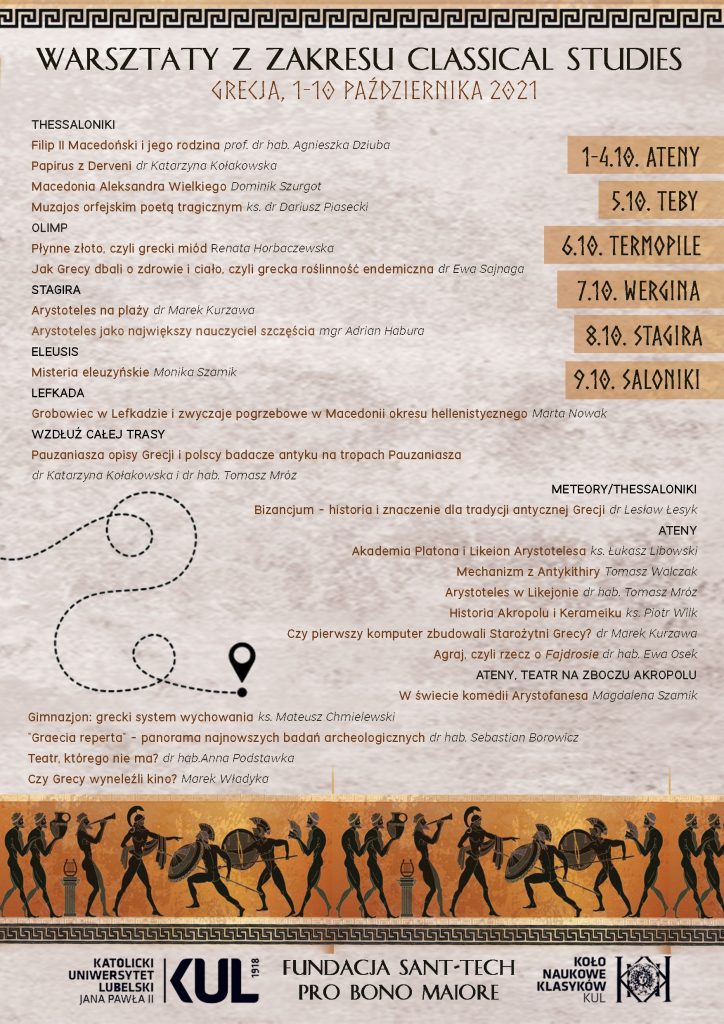
Two members of AΦR Group, together with an AΦR friend, took part in Classical Studies Workshop in Greece. This tour event took place in the first ten days of October and was organised by The Sant-Tech Foundation in co-operation with Catholic University of Lublin (KUL).
It was an unforgettable tour of Greece from Athens to Thessaloniki, including Delphi, Marathon, Meteora, Pella, Stageira and many more places of archeological interest, many of which being extremely important for philosophers and historians of philosophy, e.g. Plato’s Academy, Aristotle’s Lycaeum, ancient Stageira or Nymphaeum in Mieza. The whole stay and the journey were carefully planned by Katarzyna Kołakowska and Lesław Lesyk (both of KUL and Sant-Tech Foundation), who smoothly adapted the workshop’s schedule to unexpected conditions.
The chronological order of the papers delivered by participants from Zielona Góra is: 1) Was the First Computer Designed by the Greeks? (M. Kurzawa, at the footsteps of the National Archaeological Museum of Athens; third from the left in the photo below). The speaker focused on the history of research on the Antikythera mechanism, which is preserved in this Museum, and its unbelievable construction. 2) Aristotle in the Lycaeum (T. Mróz, in the archeological site of… Aristotle’s Lycaeum; first on the right) discussed briefly the excavations in this location and presented the outlines of the history of the Philosopher’s school.
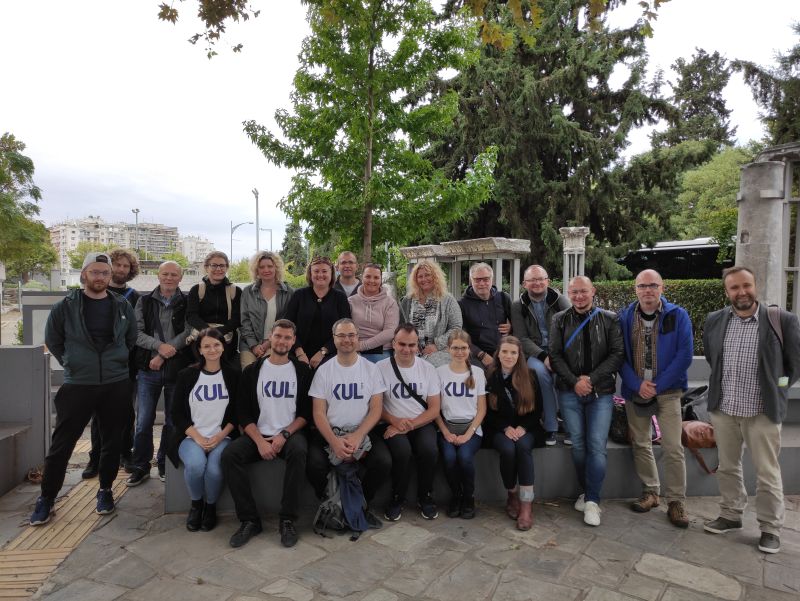
Due to unfavourable weather conditions the following presentations were delivered en route to Thessaloniki, that is, on the bus: 3) Aristotle on the Beach (M. Kurzawa) was a paper devoted to Aristotle’s works in natural sciences and focused on his anecdotal scientific curiosity which gave rise to his theories, which still amaze us to this day. 4) Aristotle as the Greatest Teacher of Happiness (A. Habura; second from the left in the photo). The speaker presented the most essential Aristotle’s instructions on achieving happiness from the Nicomachean Ethics and highlighted their universal character, which was additionally substantiated by the studies of W. Tatarkiewicz, a recognised Polish historian of philosophy and ethician, on the same subject. 5) Polish Historians of Philosophy and Classics Scholars on Their Journeys to Greece (T. Mróz). This was rather a loose speech than academic paper and it presented three Polish scholars (W. Dzieduszycki, T. Sinko, W. Witwicki) and their memories of visiting historical places, some of which at the times of their journeys looked differently then they do today, and their observations on modern Greeks, which in turn appear sometimes to tally with today’s impressions of Greece.
Recent commentaries