Home » Posts tagged '2025' (Page 2)
Tag Archives: 2025
A Successful Project Proposal in Vilnius!
We are very glad to announce that the project proposal submitted by doc. dr Jonas Čiurlionis of Vilnius University to Research Council of Lithuania turned out to be successful! The title of the project in Lithuanian is Antikinės filosofijos recepcija XX a. Vilniaus universitete what translates into English as Reception of Ancient Philosophy in the 20th century Vilnius University.

Project will be pursued at the Faculty of Philosophy, Vilnius University (FsF VU), in 2025-2029. The scope of the project covers reception of ancient philosophy among scholars of Vilnius University, starting with the interwar, Polish period of its history, followed by the Soviet times after the World War II, concluding with research on ancient philosophy in free Republic of Lithuania.
The plan of the project includes organising a mid-term seminar meeting in Zielona Góra, an international conference in Vilnius, not to mention conference presentations and journal papers by all the three researchers employed in the project. And they are doc. dr Jonas Čiurlionis, Ph.D., head of the project and senior researcher, dr Mindaugas Stoškus, Ph.D., researcher, both of FsF VU, accompanied by dr hab. Tomasz Mróz, Ph.D., as senior researcher (UZ).
Oral History Team in the Summer
Summer ’25 has come to an end, the work of “Oral History and Classics” International Research Team ended formally in December ’24, but the co-operation on the final results of the project is still going on. The members of the team met in Jan Kadeřábek’s studio in Dymokury, Czech Republic. J. Kadeřábek – Czech film director without whose participation it would have been impossible to shoot all the interviews with classics’ scholars, including three in Poland (M. Wesoły, B. Dembiński, B. Brzuska) – invited Jaroslav Daneš and Tomasz Mróz to do some work together on English subtitles to the first of the Polish interviews – with professor Marian Wesoły.
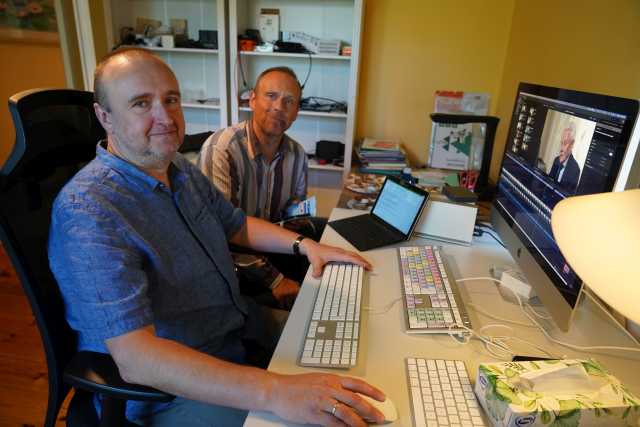
J. Kadeřábek and his wife, Veronika, own a gardening facility in Dymokury, Dymopark, including cactusarium and place for social and family events. More important for the project, however, is his studio with all the equipment and software for professional film edition. It was there that J. Daneš and T. Mróz worked to make the interview with prof. Wesoły available for international audiences. Hopefully, it will be posted in the internet soon and the rest of the interviews will follow.
The First Doctoral Degree by a Member of AΦR Team
On June 24th, 2025, a public defense of Mariam Sargsyan’s (Մարիամ Սարգսյան) doctoral thesis took place in the Institute of Philosophy, University of Zielona Góra (UZ). The title of her dissertation was Henryk Jakubanis (1879–1949) as a Researcher of Ancient Philosophy and Its Reception. The whole event was chaired by prof. Jacek Uglik and it proceeded in accordance with a regular schedule. At the start he curriculum of the candidate was presented by the supervisor, T. Mróz, who stressed the fact that M. Sargsyan was the first international student in the Doctoral School for Humanities and Social Sciences, and the only beneficiary of the research project NCN Preludium bis (with T. Mróz as a PI) and NAWA Preludium bis in the history of UZ.

Then M. Sargsyan took the floor and delineated the main points of her thesis which aimed at providing a synthetic study of H. Jakubanis as a researcher of ancient philosophy. Her study included a discussion of less-known aspects of H. Jakubanis’ life and work, in particular his academic positions in Kyiv; an analysis of his interpretations of selected Greek philosophers (Empedocles and Plato); and an examination of his methods etc.
A particular emphasis was put on the significance of his national sentiments and identity in motivating his decisions and shaping his career path; and on his contribution to the development of research in ancient philosophy and promotion of Polish culture in Kyiv in the early 20th century and subsequently in Lublin during the interwar period. The second part of the presentation was focused on H. Jakubanis scholarly achievements. His works were divided into three groups: 1) a monograph and translation of Empedocles (1906); 2) various studies on Plato and reception of Platonism, including an incomplete manuscript of his final university thesis (1900); 3) works promoting the value of ancient philosophy for general audiences, not only scholars, in the modern age.
One of the most significant results of Sargsyan’s dissertation was an identification three key influences in Jakubanis’ intellectual genealogy. They were: 1) his supervisor, Alexei Gilarov (1856-1938), whose role in forming Jakubanis’ biographical-genetic method and his interpretation of Plato was crucial; 2) Tadeusz Zieliński (1859-1944) and his conviction in the importance of the ancient legacy for modern culture; 3) the works by Eduard Zeller (1814-1908), which exerted impact on Jakubanis’ views on Empedocles and Plato.

On the whole, as Sargsyan’s dissertation demonstrates, Jakubanis was a historian of ancient thought, with a good background in classical languages, whose primary goal as a lecturer and scholar was to promote ancient thought. Contrary to his methods that can be considered today as outdated, his translation of Empedocles’ fragments still circulates in the Russian-speaking world and seems to be his lasting contribution to disseminating Greek philosophy.
The dissertation was assessed by three reviewers, they were prof. Zbigniew Nerczuk (Nicolaus Copernicus University in Toruń), prof. Steffen Huber (Jagiellonian University), and prof. Wiesława Sajdek (Jan Długosz University in Częstochowa). They all were present to read out loud their positive reviews and ask a couple of questions. They were particularly concerned with some ambiguities in Sargsyan’s account of Jakubanis’ career and academic titles he had obtained, since not all the documents have been preserved. Another key issue concerned some lacking points in broader historical and philosophical context of Jakubanis’ views, as Sargsyan preferred to focus on the direct impact exerted on him by the scholars he had referred to or collaborated with.

Finally, after hearing the reviews, questions and answers, the commission decided to award M. Sargsyan with a doctoral degree cum laude. Her dissertation has, no doubt, broadened and deepend the knowledge of the reception of ancient philosophy in Central and Eastern Europe in general, and of Henryk Jakubanis, a scholar writing on history of philosophy, who left his mark on the intellectual life in Poland, Ukraine and Russia, in particular.
After her successful doctoral defence M. Sargsyan returned to Armenia, her homeland, but we all hope here for further collaboration and for funding opportunities to publish her dissertation.
Dear Doctor Sargsyan!
Good luck with your research plans and see you back soon!
Renaissance Platonism in Polish Debates at the symposium in Saint Louis, MO
In June (9th-11th) 2025, Saint Louis University (Saint Louis, Missouri) held the Twelfth Annual Symposium for Medieval and Renaissance Studies (SMRS). This year’s optional theme was Synthesis and Reconciliation.

Symposium gathered over a hundred of scholars debating on various aspects of mediaeval and Renaissance studies, but only a couple of papers were devoted to philosophy or historiographical discussions. A booklet including a plentiful schedule, all the sessions, papers etc. can be downloaded here. Tomasz Mróz’s paper was delivered during a session titled Studying Renaissance Literature and Philosophy Through New Eyes. Mróz’s attendance at the SMRS was funded through a “Small Grant” scheme from his home institution, University of Zielona Góra, and his presentation was devoted to Bohdan Kieszkowski: Florentine Platonism between Ideology and World War II: The Case of Bogdan Kieszkowski (1904-1997).
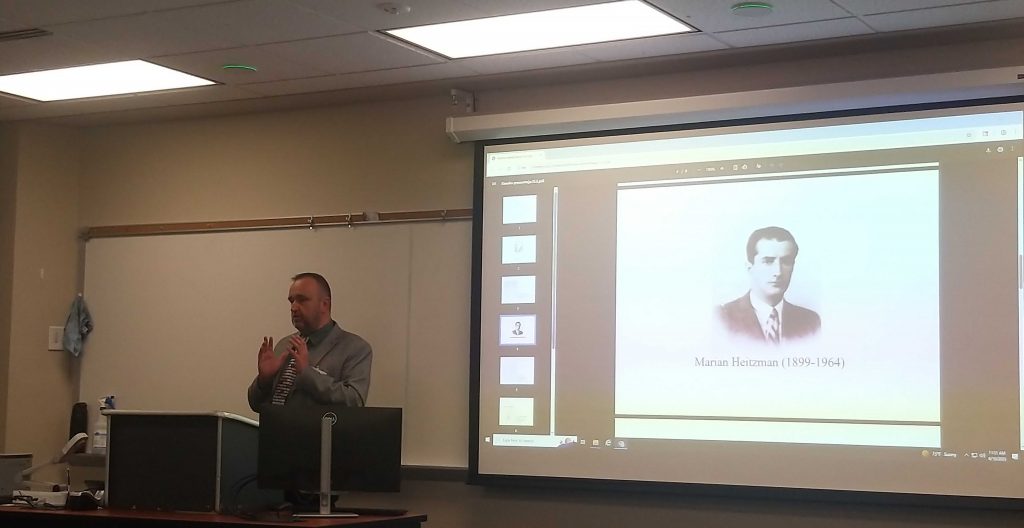
It was for the first time that Kieszkowski’s life and works were presented to international audience. Mróz discussed his biography, including successful beginnings of his academic career in interwar Poland and his later difficult life on the exile in Paris, as well as various hypotheses regarding undocumented period of his life directly following the war. Philosophical part of the paper focused on Kieszkowski’s dispute with Marian Heitzman (1899-1964), who accused him of underestimating the influences of mediaeval neoplatonism on Ficino and it was the role of mediaeval philosophy in forming Renaissance Platonism that turned them against each other. After the war, in 1973, Kieszkowski managed to publish the edition of Pico della Mirandola’s Conclusiones (Geneve 1973). This book was based on the materials he had been able to collect and study in various European libraries before the war and thus his work was far from perfection. Reviews of this book emphasised insufficient accuracy in editing the original Pico’s text, yet his scholarship and experience in Renaissance philosophy were assessed as indisputable. The most eminent and meticulous critic of this late Kieszkowski’s work was a Portuguese scholar, José Vitorino de Pina Martins (1920-2010).
A dozen of scholars attended the session and the questions from the audience were concerned both with biographical and philosophical parts of the paper, that is, with Kieszkowski’s later life on exile as a possible consequence of a PTSD resulting from his serious bullet wounds and subsequent disabilities, and with the connection between the developments of neo-Scholasticism in Poland and Europe and resulting appreciation of the role of mediaeval culture and philosophy.
Ancient Φilosophy Reception at the 12th Seminar of Historians of Polish Philosophy

Seminar of Historians of Polish Philosophy (SHPPh) is a cyclical academic event held at various universities in Poland since its first edition in Warsaw in 2006. In 2025 (May 19th-20th), it was for the first time at the University of Zielona Góra (UZ) where Polish researchers of their native philosophical traditions gathered. Central topic of this edition of SHPPh was the problem of classical thinkers and epigons in the development of Polish thought. Detailed programme of the whole event can be downloaded here.
The seminar was also an opportunity to celebrate the second edition of the book Classics of Polish Philosophy by Ryszard Palacz, an essential figure for historians of philosophy at UZ, and a researcher of reception of Greek philosophy in medieaval thought, about whose passing we have informed in the autumn of 2024. Full program of the event can be downloaded here and a brief report (in Polish) on the UZ’s website can be found here (with a photo gallery). The seminar was accompanied by an exhibition devoted to Professor Palacz and many speakers referred to his work and his understanding of classical Polish philosophers.

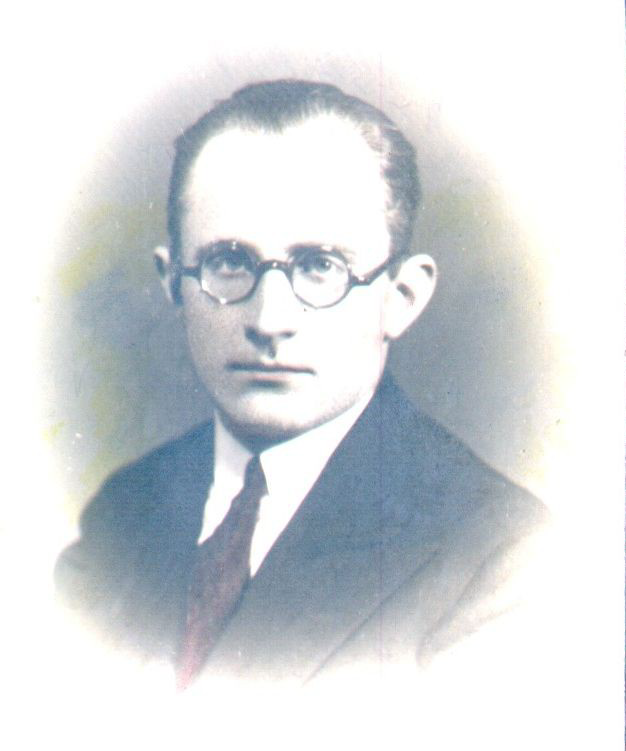
Two AΦR group members delivered their papers during the SHPPh. Tomasz Mróz talked about Bohdan Kieszkowski (1903-1997) and about Polish and international disputes on his works on Florentine Platonism.
In the thirties in Poland Kieszkowski was engaged in a dispute with Marian Heitzman (1899-1964), who accused him of underestimating the influences of medieval neoplatonism on Ficino. Heitzman and Kieszkowski, two scholars of one generation, two researchers of Renaissance Platonism, represented two different academic centres, conservative Cracow and more progressive Warsaw, and their polemical texts were published separately in philosophical journals in Cracow (Heitzman) and Warsaw (Kieszkowski). Kieszkowski, naturally, considered Heitzman’s position to be an overestimation of medieval influences on Renaissance’s thought and labelled it as ‘medievalism’. On international niveau a polemic against Kieszkowski’s work came from a Portuguese scholar, José Vitorino de Pina Martins (1920-2010), who praised Kieszkowski’s scholarship, yet spared no words of criticism against Kieszkowski’s edition of Pico della Mirandola’s Conclusiones (Geneve 1973).
Adrian Habura’s talk smoothly concluded the whole conference focusing, on the one hand, on a paper titled Four Understandings of Classicism by Władysław Tatarkiewicz (1886-1980), and on the other hand, on Palacz’s (1935-2024) arguments for including Tatarkiewicz among the classics of Polish philosophy.
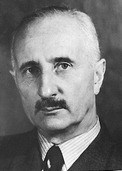
Habura analysed Tatarkiewicz’s notion of classicism and supplemented Palacz’s arguments for including Tatarkiewicz among the classics, demonstrating that not only his History of Philosophy, History of Aesthetics, and History of Six Ideas, that is, basically historical studies, but also his Analysis of Happiness, the original philosophical work by Tatarkiewicz, bears the mark of classic. Ethical considerations in the Analysis of Happiness, noticeably influenced by Aristotle, not to mention Tatarkiewicz’s doctoral degree from Marburg on a thesis devoted to Aristotle, allowed Habura to highlight an additional aspect of Tatarkiewicz as a classic, for he was not only a classic among Polish philosophers, but also a classic in another understanding: as a follower or – to use the term proposed by Juliusz Domański – a user of Aristotelian philosophy. And it was Aristotle whom Tatarkiewicz himself regarded as the most classical among all the classical philosophers of ancient Greece.
Neverending Story of… Plato in Poland
This time it was at the University of Hradec Králové where the word about Plato reception in Poland was spread. Tomasz Mróz, among his activities in accordance with Erasmus+ Teaching Assignment, delivered a talk on political aspects of Plato reception in Poland. The focus was, naturally, on Plato’s Republic and on the connections between the interpretations of Plato’s political philosophy and the political situation of Poland from the 19th century to the post World War II era. This talk was delivered for international students enrolled in a course: Ancient Greek Democracy and Its Legacy taught in UHK by professor Jaroslav Daneš, with whom AΦR research group has successfully co-operated for many years.
The topics covered in this talk included a brief overview of how political situation of Poland changed and how various researchers of Plato interpreted his political ideas. The lecture started with Bolesław Limanowski (1835-1935), an advocate of socialism, who used Plato’s ideas as an evidence that socialism had been present in European thought from its very beginning. The next was Wojciech Dzieduszycki (1848-1909), a conservative politician, who ridiculed gender equality and socialism as political phantasies. Wincenty Lutosławski (1863-1954) considered totalitarian character of Plato’s polis as a natural consequence of his idealism, but after the World War II emphasised Plato’s evolution and his affinity to Christianity. Stefan Pawlicki (1839-1916), a Christian thinker rejected the connection between socialism and Plato, but praised the idea of preventive censorship. At the dawn of Polish independence after World War I Eugeniusz Jarra (1881-1973) welcomed the idea that social promotion or demotion in the state should depend on personal capabilities, and that the elites should no longer consist of the members of aristocracy but of the most gifted individuals. After World War II, in the Stalinist period, the criticism of Plato stemmed from various premises. Tadeusz Kroński (1907-1958), on the one hand, a Marxist thinker, considered Plato’s political philosophy as an aristocratic reaction to democratic changes in Athens, and in general as an expression of obscurantism and religiosity. Władysław Witwicki (1878-1948), on the other hand, was apparently critical towards Plato’s political project, assessing it as a monastery, concentration camp and a totalitarian state, but actually it was a criticism in disguise of the then political system.
In spite of the fact that the history of Poland or Polish philosophy was completely new for the members of the audience, their questions and remarks demonstrated that they were able to see the relations between the views of Plato’s interpreters and their interpretations of Plato’s Republic. Moreover, as usually, the discussion was the evidence that more general issues related to Plato’s legacy remain topical and stimulating as, for example, the chronology of Plato’s dialogues or reliability of image of Socrates.
H. Jakubanis’ Empedocles in OA
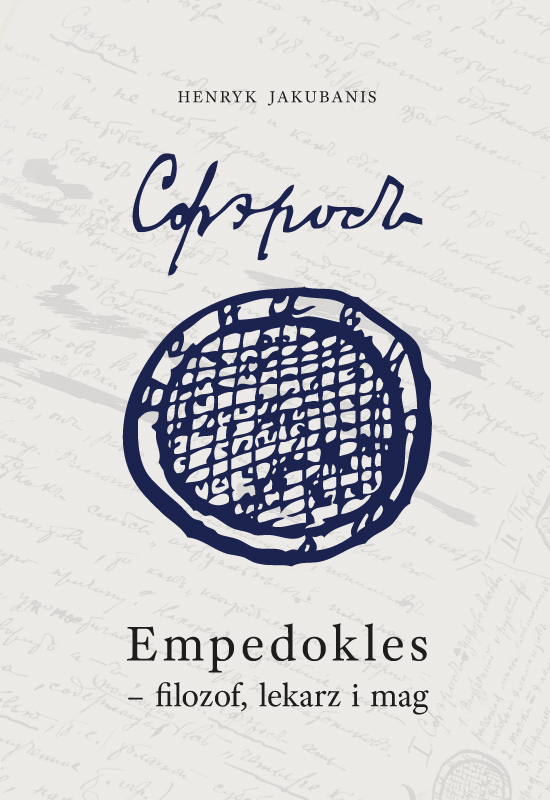
Last year we announced publishing Polish translation of a Russian study by Henryk Jakubanis (1879-1949), originally published in Kyiv over a century ago, Empedocles: a Philosopher, a Doctor and a Magus, therefore there is no need to repeat all the information here. Suffice to say that the text was translated by Mariam Sargsyan and Adrian Habura, and the whole volume ends with an afterword by Katarzyna Kołakowska, a contemporary Polish expert on Empedocles.
The book can be purchased on the publisher’s website here. We are now, however, glad to inform that it is available in OA, via online repository of the University of Zielona Góra.
Recent commentaries