Home » Posts tagged 'Empedocles'
Tag Archives: Empedocles
Philosophy in Zielona Góra. An Anniversary
This year, Institute of Philosophy, University of Zielona Góra (UZ), where Ancient Φilosophy Reception research group is affiliated, celebrates its 30th anniversary. Among the variety of events, there was a conference on 23rd-24th October, devoted to the problem of co-operation in its various relations to theory, history and philosophical practice. AΦR’s history at UZ is obviously much shorter, but two of its representatives actively participated in the conference.

Mariam Sargsyan was the first of them. In her presentation she discussed the results of her doctoral studies at UZ and her dissertation, successfully defended earlier this year. She focused on analyses of Henryk Jakubanis’ (1879-1949) historical-philosophical legacy, which consists of three main parts: 1) his work on Empedocles and its methodology; 2) Plato in his (partly unpublished) writings; 3) his views on ancient and modern ways of doing philosophy. Moreover, Sargsyan presented the conclusions of her research on intellectual genealogy of Jakubanis’ thought.
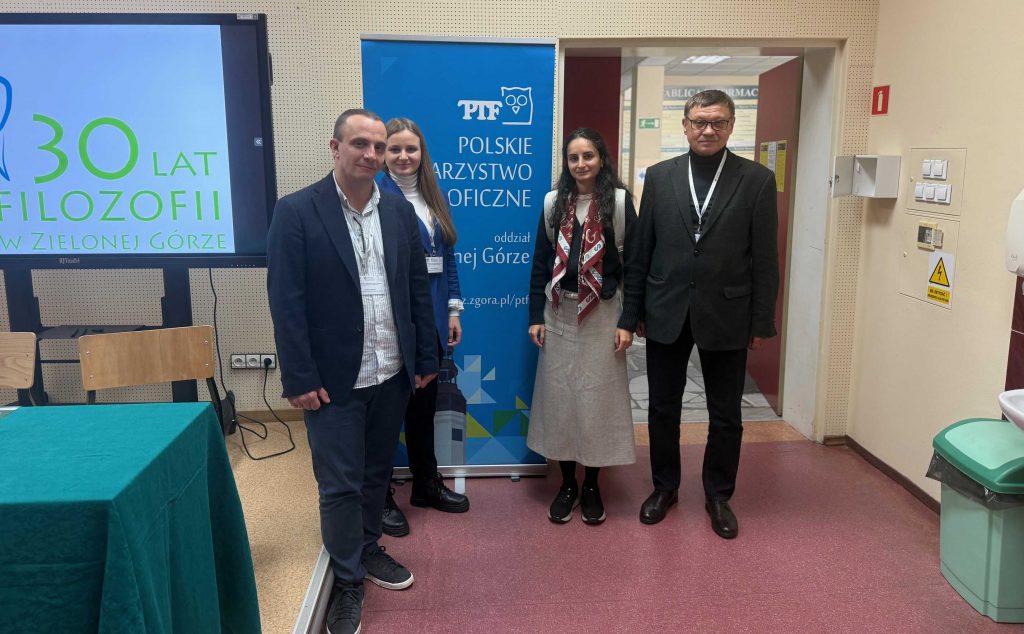
What was even more significant was the fact that Ukrainian participants (see the photo above) of the conference, who work at the National University of Kyiv, attended Sargsyan’s presentation on Jakubanis, who had studied and worked in Kyiv a century ago. They were very interested in her results and provided valuable feedback that could be helpful in improving the text of her doctoral thesis before it is published. The discussion between them demonstrated how important it is to confront different points of view on one subject which is researched by scholars from different countries, applying various methods and interested in different aspects of the history of philosophy.
The second conference participant from AΦR was Adrian Habura who delivered a paper on Władysław Tatarkiewicz (1886-1980) and his reflection on social aspects of human happiness. Habura discussed Tatarkiewicz’s definition of happiness and his understanding of human life, then he examined the role of the others in individual happiness and the links between human individual and society in their relations to happiness. In his paper Habura developed a general view on the role of society in Tatarkiewicz’s philosophical and ethical considerations contained in his book Analysis of Happiness.
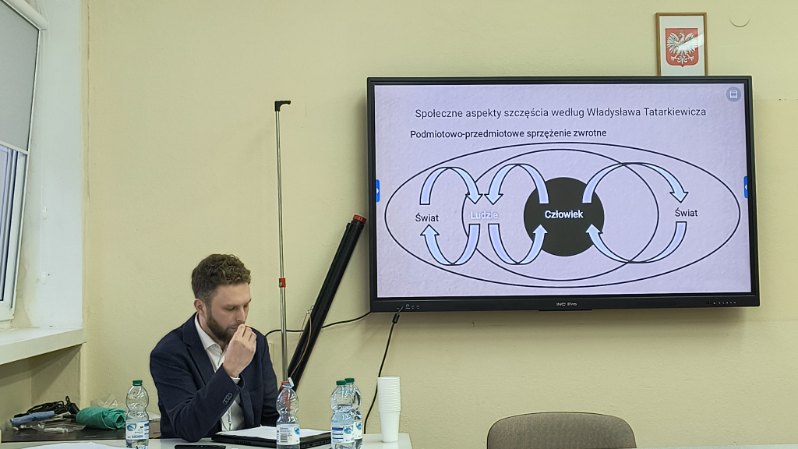
Although Habura’s paper was not directly devoted to the reception of ancient philosophy in Tatarkiewicz’s writings, the following discussion allowed him to address this issue. He highlighted some similarities and differences between Aristotle’s and Tatarkiewicz’s understandings of happiness and convincingly demonstrated how Aristotle could have inspired ethical investigations of this Polish philosopher, whose doctoral thesis on Aristotle was composed under supervision of the Marburg neo-Kantians.
The First Doctoral Degree by a Member of AΦR Team
On June 24th, 2025, a public defense of Mariam Sargsyan’s (Մարիամ Սարգսյան) doctoral thesis took place in the Institute of Philosophy, University of Zielona Góra (UZ). The title of her dissertation was Henryk Jakubanis (1879–1949) as a Researcher of Ancient Philosophy and Its Reception. The whole event was chaired by prof. Jacek Uglik and it proceeded in accordance with a regular schedule. At the start he curriculum of the candidate was presented by the supervisor, T. Mróz, who stressed the fact that M. Sargsyan was the first international student in the Doctoral School for Humanities and Social Sciences, and the only beneficiary of the research project NCN Preludium bis (with T. Mróz as a PI) and NAWA Preludium bis in the history of UZ.

Then M. Sargsyan took the floor and delineated the main points of her thesis which aimed at providing a synthetic study of H. Jakubanis as a researcher of ancient philosophy. Her study included a discussion of less-known aspects of H. Jakubanis’ life and work, in particular his academic positions in Kyiv; an analysis of his interpretations of selected Greek philosophers (Empedocles and Plato); and an examination of his methods etc.
A particular emphasis was put on the significance of his national sentiments and identity in motivating his decisions and shaping his career path; and on his contribution to the development of research in ancient philosophy and promotion of Polish culture in Kyiv in the early 20th century and subsequently in Lublin during the interwar period. The second part of the presentation was focused on H. Jakubanis scholarly achievements. His works were divided into three groups: 1) a monograph and translation of Empedocles (1906); 2) various studies on Plato and reception of Platonism, including an incomplete manuscript of his final university thesis (1900); 3) works promoting the value of ancient philosophy for general audiences, not only scholars, in the modern age.
One of the most significant results of Sargsyan’s dissertation was an identification three key influences in Jakubanis’ intellectual genealogy. They were: 1) his supervisor, Alexei Gilarov (1856-1938), whose role in forming Jakubanis’ biographical-genetic method and his interpretation of Plato was crucial; 2) Tadeusz Zieliński (1859-1944) and his conviction in the importance of the ancient legacy for modern culture; 3) the works by Eduard Zeller (1814-1908), which exerted impact on Jakubanis’ views on Empedocles and Plato.

On the whole, as Sargsyan’s dissertation demonstrates, Jakubanis was a historian of ancient thought, with a good background in classical languages, whose primary goal as a lecturer and scholar was to promote ancient thought. Contrary to his methods that can be considered today as outdated, his translation of Empedocles’ fragments still circulates in the Russian-speaking world and seems to be his lasting contribution to disseminating Greek philosophy.
The dissertation was assessed by three reviewers, they were prof. Zbigniew Nerczuk (Nicolaus Copernicus University in Toruń), prof. Steffen Huber (Jagiellonian University), and prof. Wiesława Sajdek (Jan Długosz University in Częstochowa). They all were present to read out loud their positive reviews and ask a couple of questions. They were particularly concerned with some ambiguities in Sargsyan’s account of Jakubanis’ career and academic titles he had obtained, since not all the documents have been preserved. Another key issue concerned some lacking points in broader historical and philosophical context of Jakubanis’ views, as Sargsyan preferred to focus on the direct impact exerted on him by the scholars he had referred to or collaborated with.

Finally, after hearing the reviews, questions and answers, the commission decided to award M. Sargsyan with a doctoral degree cum laude. Her dissertation has, no doubt, broadened and deepend the knowledge of the reception of ancient philosophy in Central and Eastern Europe in general, and of Henryk Jakubanis, a scholar writing on history of philosophy, who left his mark on the intellectual life in Poland, Ukraine and Russia, in particular.
After her successful doctoral defence M. Sargsyan returned to Armenia, her homeland, but we all hope here for further collaboration and for funding opportunities to publish her dissertation.
Dear Doctor Sargsyan!
Good luck with your research plans and see you back soon!
H. Jakubanis’ Empedocles in OA
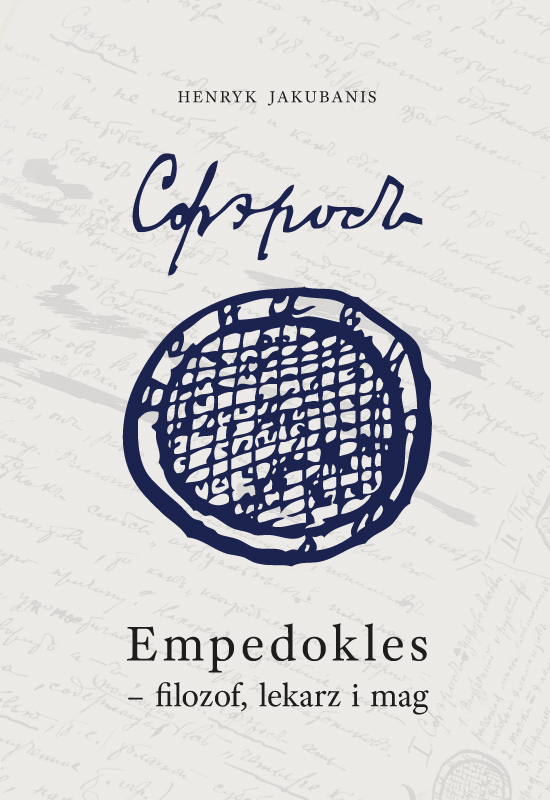
Last year we announced publishing Polish translation of a Russian study by Henryk Jakubanis (1879-1949), originally published in Kyiv over a century ago, Empedocles: a Philosopher, a Doctor and a Magus, therefore there is no need to repeat all the information here. Suffice to say that the text was translated by Mariam Sargsyan and Adrian Habura, and the whole volume ends with an afterword by Katarzyna Kołakowska, a contemporary Polish expert on Empedocles.
The book can be purchased on the publisher’s website here. We are now, however, glad to inform that it is available in OA, via online repository of the University of Zielona Góra.
Henryk Jakubanis and His Kyiv Years
Henryk Jakubanis (1879-1949), his life and intellectual legacy, have been in recent years the topic of research pursued by Mariam Sargsyan. In one of her papers, titled Henryka Jakubanisa (1879-1949) kijowski okres życia i twórczości historycznofilozoficznej (H. Jakubanis’ Kyiv Period of Life and Work in the History of Philosophy), she presented Jakubanis’ Kyiv years as fundamental and formative period of his intellectual biography. Her study has been published in Polish and can be downloaded here.
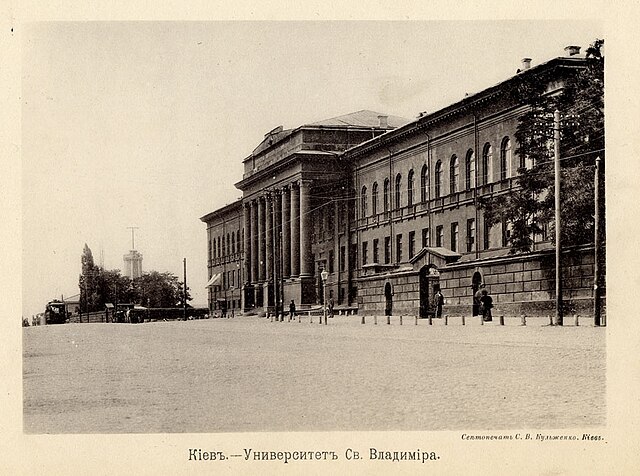
Kyiv period of Jakubanis’ life deserved a separate presentation, because our knowledge of his early career was far from satisfactory, not to mention some inaccurate or even false informations. M. Sargsyan was the first researcher who used Jakubanis’ documents from the University Library of the Catholic University of Lublin to such an extent, what was necessary to complete her task.
To present the life and academic activity of Jakubanis (on the right) in the Kyiv period in full, Sargsyan starts with his childhood and gymnasium education. Moreover, the history and philosophical traditions in the Saint Vladimir Imperial University of Kyiv are briefly sketched with an emphasis on Jakubanis’ study curriculum, the beginnings of his academic career and the personality of his supervisor, professor Alexei Gilarov. He was the professor who exerted the most significant impact on Jakubanis’ early works in the history of Greek philosophy.
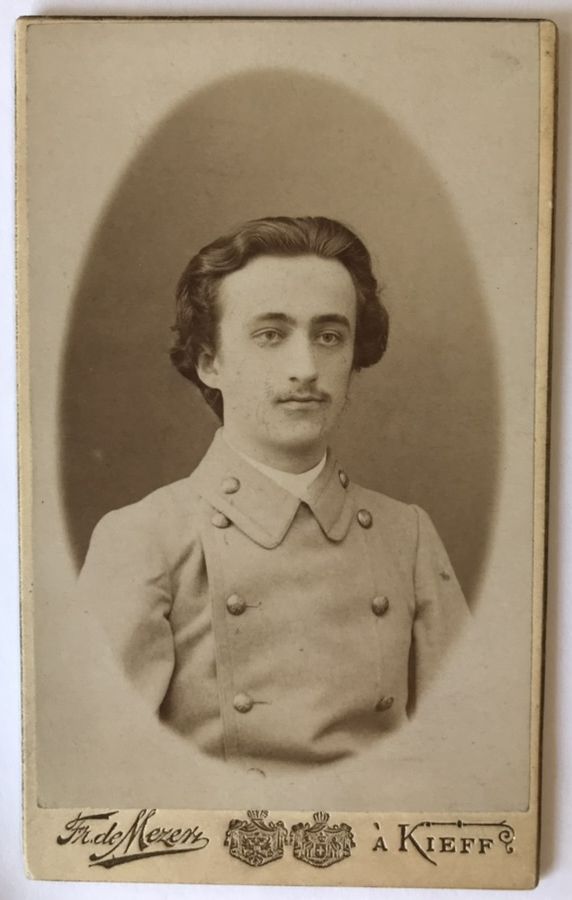
To conclude, it was in Kyiv where Jakubanis’ career as a teacher of classics and a researcher in the history of ancient philosophy started. Some of his achievements from this period are still of significance in the Russian-speaking world, for he is still remembered as the author of a work on Empedocles and one of the pioneers in translating fragments of this ancient thinker into Russian.
AΦR at the 3rd Congress on Polish Philosophy
The 3rd Congress on Polish Philosophy took place in October (18th-20th) in the Rydzyna Palace. It gathered scholars interested in researching the tradition of Polish philosophy and developing it. Two members of the Ancient Φilosophy Reception research group took part in this philosophical event: Adrian Habura – online, and Tomasz Mróz – onsite. The first of them spoke about the concept of love in the works of Władysław Tatarkiewicz (1886-1980), while the latter – on the history of studies on the reception of ancient philosophy in Poland.
Mróz’s paper was directly concerned with problems related to the reception of ancient philosophy and started with quotes of diverse opinions of two eminent Polish researchers in the history of Greek philosophy, that is, Stefan Pawlicki (1839-1916) and Wincenty Lutosławski (1863-1954). Lutosławski, when composing his works on Plato, searched for Polish authors and their studies to provide references to them, while Pawlicki paid no interest to the works of his compatriots on Greek philosophy.
In more recent decades it was Izydora Dąmbska (1904-1983), a philosopher and historian of philosophy, who published a study on the reception of Plato in Poland (1972), but nowadays many books and papers on this topic were published by the members of the AΦR research group. Concluding his talk Mróz briefly presented research projects of the members of the AΦR and the books they had published, to start with the latest one:
Henryk Jakubanis, Empedokles – filozof, lekarz i mag: Przyczynek do jego zrozumienia i oceny (Empedocles: a Philosopher, a Doctor and a Magus. Materials for Understanding and Assessing Him), transl. from Russian and ed. Mariam Sargsyan, A. Habura, Wydawnictwo Marek Derewiecki, Kęty 2024, 104 pp. (Studies and Texts in the History of Reception of Ancient Philosophy, vol. 3).
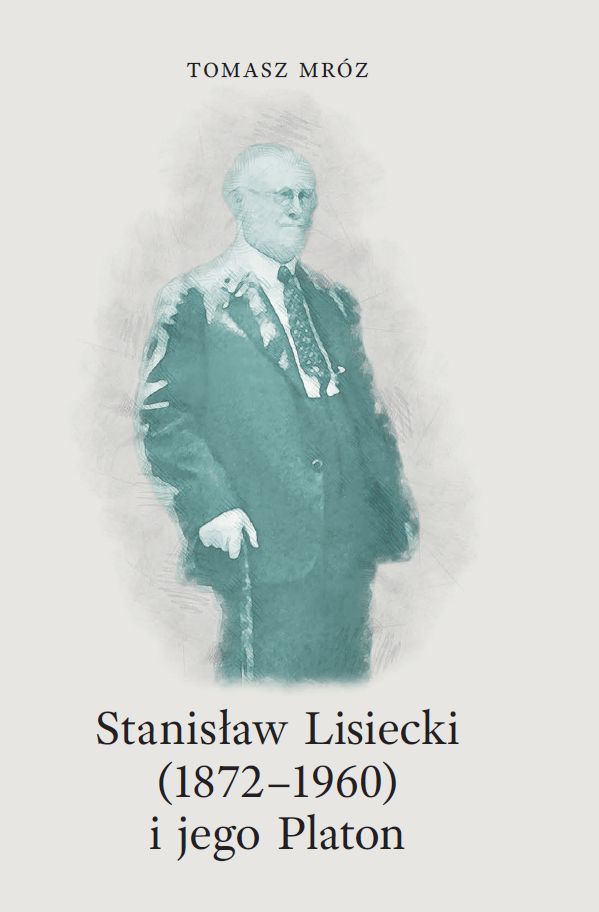
T. Mróz, Stanisław Lisiecki (1872-1960) i jego Platon (Stanisław Lisiecki (1872-1960) and His Plato), Wydawnictwo Marek Derewiecki, Kęty 2022, 150 pp. (Studies and Texts in the History of Reception of Ancient Philosophy, vol. 2).
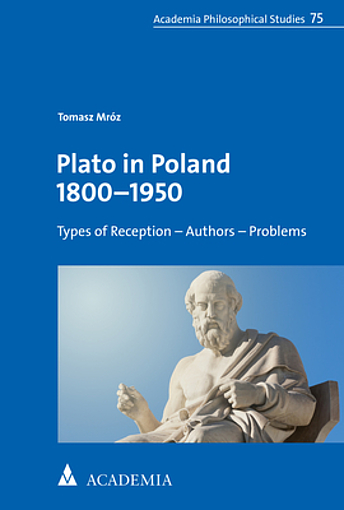
T. Mróz, Plato in Poland 1800-1950: Types of Reception – Authors – Problems, Academia Verlag / Nomos Verlagsgesellschaft, Baden Baden 2021, 480 pp. (Academia Philosophical Studies, vol. 75).
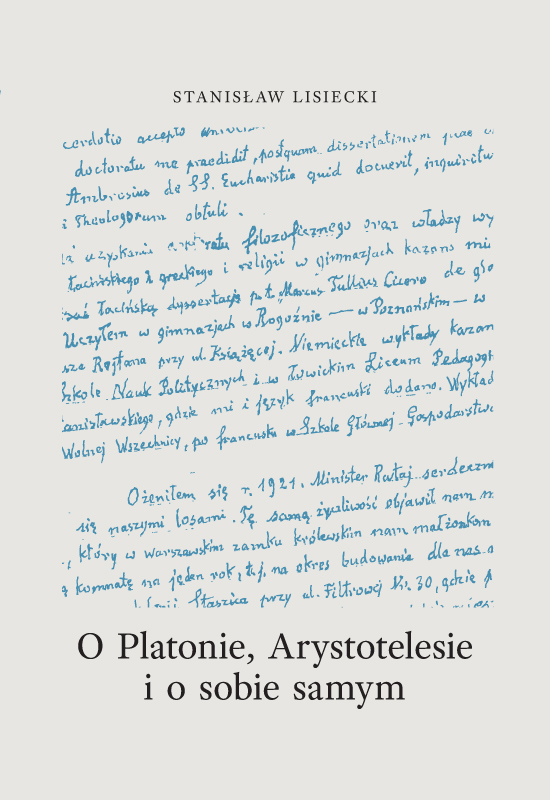
S. Lisiecki, O Platonie, Arystotelesie i o sobie samym (On Plato, Aristotle and on Himself), ed. T. Mróz, Wydawnictwo Marek Derewiecki, Kęty 2021, 367 pp. (Studies and Texts in the History of Reception of Ancient Philosophy, vol. 1).
and some earlier ones…
Henryk Jakubanis and His Empedocles
Empedocles: a Philosopher, a Doctor and a Magus. Materials for Understanding and Assessing Him.
It was the title of the most important work by H. Jakubanis (1879-1949)
originally published in Kyiv in 1906.
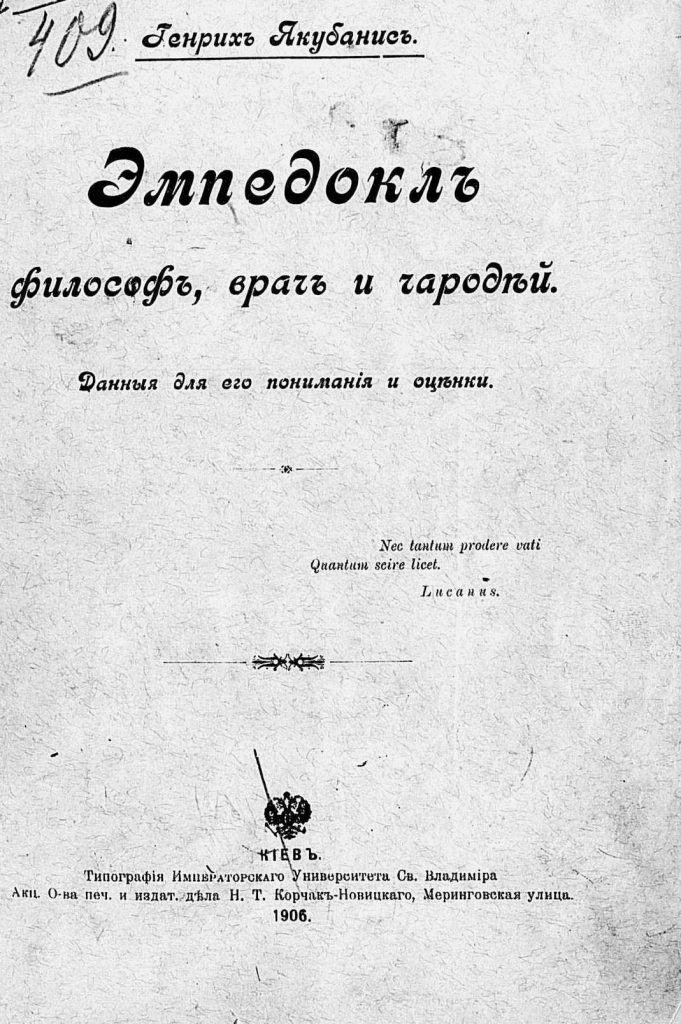
At the time of publishing this book the author was a young, 27 years old, lecturer and researcher at the St. Vladimir Imperial University of Kyiv. His area of competence and interest was established, it was ancient literature and philosophy with an emphasis on Greek philosophers. This volume consisted of two main parts: 1) Introductory presentation of Empedocles’ life, Sicilian society, culture etc., and finally – the sources of his philosophical thought. 2) Translations of the remaining fragments of Empedocles in verse and prose, with philological commentaries. It is the Jakubanis’ translation of the philosopher’s texts that won him recognition in the Russian-speaking world. Suffice to say that it is still in circulation today.
Jakubanis’s Empedocles had to wait for over a century to become finally available to Polish reading audiences. Until now this work had only been listed in bibliographies with no hint regarding its content. Two young Ph.D. students and researchers of AΦR group, Mariam Sargsyan and Adrian Habura, took their time to translate it from pre-reform Russian into well readable contemporary Polish. With their introduction the book was published as volume 3 of the book series published by Marek Derewiecki. Naturally, only Jakubanis’ own text was translated into Polish, for there was no need to re-translate his Russian renderings of Greek philosophical poetry. All the more so that Polish readers have a complete translation of Empedocles’ fragments by Katarzyna Kołakowska, a researcher from Jakubanis’ beloved Catholic University of Lublin.
It should only be added that the book is accompanied by an afterword by Kołakowska and it is available on the publisher’s website here.

This book is one of the results of the research project funded by National Science Centre on Henryk Jakubanis (1879-1949) as a classics scholar and historian of ancient philosophy.
Two Members of AΦR at the Second Congress of Polish Philosophy
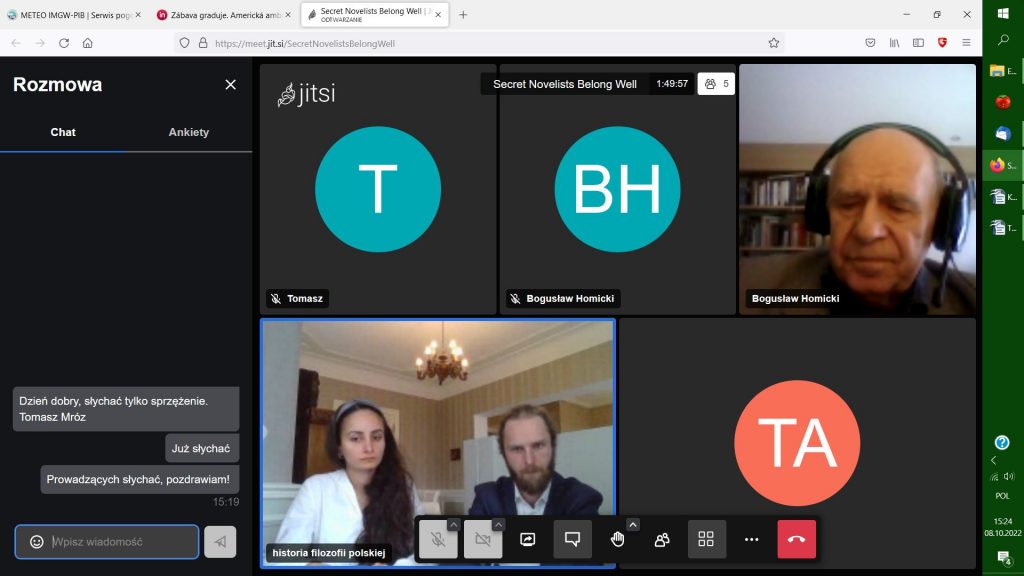
On October 7th-10th 2022 the Second Congress of Polish Philosophy took place in the Palace in Orla. Congress was held both on site and online. The organising institution of the Congress was the Chair of Philosophy (Department of History, University of Opole). The aim of this event was to research and develop Polish philosophical traditions. AΦR group members delivered their papers in the section devoted to the history of Polish philosophy.
The first lecture by an AΦR group member was titled Władysław Tatarkiewicz between Good and Happiness and was delivered by Adrian Habura. His paper was focused on axiological and ethical investigations of Tatarkiewicz in the years 1919-1947, and especially on his inaugural lecture On the Dual Understanding of Moral Act, which was delivered in October 1919 at the Stefan Batory University in Vilnius. Habura’s aim was to sketch the lines of development in Tatarkiewicz’s ethical investigations from the Good, as a topic of his postdoctoral dissertation (1919), to the happiness, from the book Analysis of Happiness (1947).
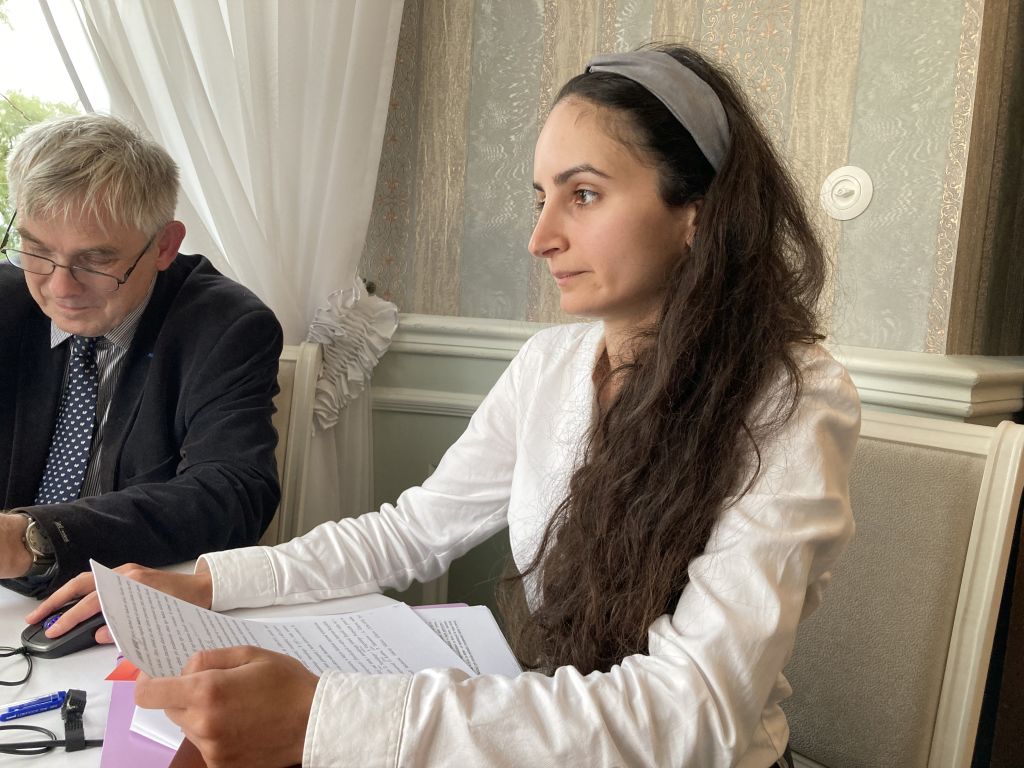
It was, however, only the second paper by an AΦR group member, which was devoted to the reception of ancient philosophy. It was Mariam Sargsyan’s presentation on Henryk Jakubanis, a Polish historian of Greek philosophy. The presentation’s title was Henryk Jakubanis (1879-1949) – a historian of Greek philosophy between Kyiv and Lublin.
The intellectual biography of this historian of philosophy is usually divided into two periods: Kyiv (1897-1922) and Lublin (1922-1949). The aim of Sargsyan’s paper was to present vita of Jakubanis considering both periods of his life and work. Lublin period is quite well known to Polish authors, but the significance of the Kyiv period remains unclear. In Lublin, Jakubanis headed the Department of Classical Philology and then the Department of Philosophy at the University of Lublin, which later became the Catholic University of Lublin.
It was, however, the Kyiv period which was the productive part of Jakubanis’ life, because in Kyiv he wrote his most important works: a book on Empedocles, consisting of a historical and philosophical study and a translation of the collected fragments of this thinker into Russian. Moreover, a series of articles on the significance of ancient philosophy, on the history of syllogism and on the relations between the ideas of Plato and Schiller, were composed by Jakubans in Kyiv. Sargsyan’s paper presented unknown facts from the biography of this historian of philosophy and discussed his works from the Kyiv period, which are usually barely mentioned.
Delivering their papers at the Congress was an important experience for both young researchers and it helped them develop their skills, not to mention social advantages of face to face scholarly meetings.
Recent commentaries