Home » Posts tagged 'harmony'
Tag Archives: harmony
Another Work by H. Jakubanis Available in Polish Translation
Henryk Jakubanis (1879-1948) for over two decades worked in the Catholic University of Lublin, but his most important works were composed in Russian, during his Kyiv period, and were unavailable to Polish audiences. It was only recently that they started to be translated and published by the members and collaborators of the AΦR group. First, his study on Empedocles was translated and published, and now it is the paper titled: The Significance of Ancient Philosophy for the Modern Worldview (1910), accompanied by a commentary from the translator, Mariam Sargsyan.
The translation and the commentary were published in “Studia z Historii Filozofii” 2 (17)/2026, one of the top Polish journals for the history of philosophy. The whole volume in open access can be found here, while the translation – here, and the commentary – here. The original article, based on a lecture, had been published in an university journal in Kyiv in 1910 as Значенiе древней философiи для современнаго мiропониманiя.

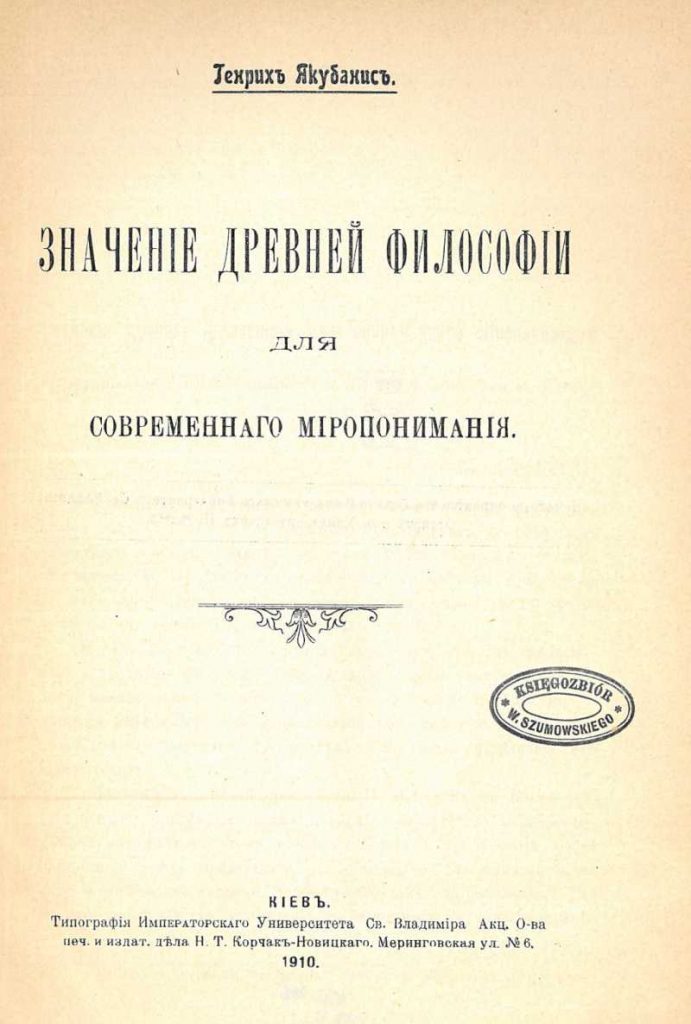
In his article, Jakubanis discussed metaphilosophical issues and presented his views on the then state of philosophy. He emphasised the enduring values of the ancient world, compared ancient and modern approaches to philosophical inquiries, and expressed hopes for the revival of the Hellenic culture. He remarked on the growing interest in antiquity in general, and in philosophy in particular, that had been demonstrated by studies of many scholars. At the same time, however, he noticed a crisis in modern philosophical thought. He took an attempt to identify its reasons: increasing specialisation of sciences, narrowing of intellectual horizons, and the discrepancy between theory and practice. Ancient thought, on the contrary, seemed to embody harmony and other timeless values.
Jakubanis’ aim was to revive ancient Greek culture, he argued that such a revival would contribute to overcoming the then crisis. In his view, such a revival should be based on three principal components: „nationality, antiquity, and Christianity”, in which he followed the ideas of his older colleague, Polish classics scholar, Tadeusz Zieliński (1859-1944). The translation of Jakubanis’ paper provides Polish audiences with an opportunity to become acquainted with the works of a scholar whose methods were moulded in pre-revolutionary Kyiv and who continued teaching in Lublin, in independent Poland.
The translation and commentary were the results of the research project funded by National Science Centre on Henryk Jakubanis (1879-1949) as a classics scholar and historian of ancient philosophy.

Paper on H. Jakubanis as a Promoter of Greek Thought

It is not the first time (and, hopefully, not the last one either) that the Lithunian journal “Logos” publishes a paper composed by a member of Ancient Φilosophy Reception research group. The scope of the journal are scholarly studies in all areas of philosophy.
This time the author is Mariam Sargsyan, who in 2025 defended her Ph.D. thesis cum laude and received her doctoral diploma during a ceremony at the University of Zielona Góra, where AΦR group is affiliated.
Her article was published in vol. 124 of “Logos” and is available here in a bilingual, that is, Lithuanian (translated from English by Tomas Kavaliauskas) and original English version. It is important to remark here that Henryk Jakubanis (1879–1949), whose works are the topic of this paper, and his ancestors had their roots in Lithuania, although their mother tongue was Polish and they spent most of their lives in the Russian Empire. Two language versions of Sargsyan’s paper title are Henrikas Jakubanis kaip graikų mąstymo puoselėtojas and Henryk Jakubanis as a Promoter of Greek Thought.
Sargsyan’s article covers some issues from her previous Polish studies, as for example a short sketch of Jakubanis’ and a presentation of his historical-philosophical works. This is supplemented with archival materials from the Catholic University of Lublin. Additionally, the article delves into the intellectual lineage of Jakubanis, focusing on the influences of Alexei Gilarov (1856–1938) and Tadeusz Zieliński (1859–1944).
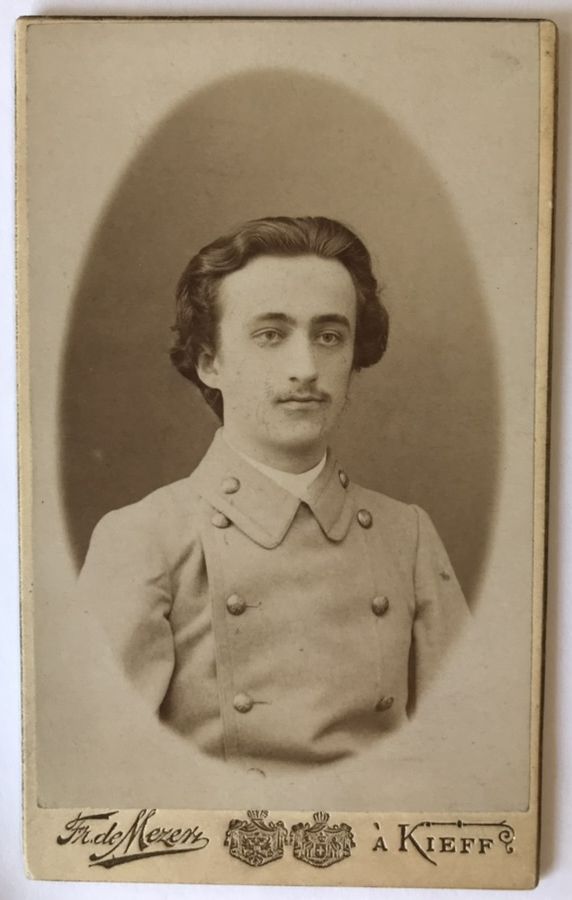
Let us focus only on Jakubanis’ work titled The Importance of Ancient Philosophy for the Modern Worldview (published in Kyiv in 1910) in which he identified the characteristic features of ancient thought with inner harmony on the top of them. Along with harmony, he listed universalism, sincerity, the ability to adopt justified views, and the plasticity of objectivism. He used harmony as an intrument for reviving ancient philosophy at the dawn of the 20th century. According to the him, modern times could undoubtedly be described as an epoch in a state of profound philosophical crisis. The essence of the crisis was the lack of unity in spiritual life and a deep split in its manifestations. This state was described as a threefold disharmony: in the scientific and theoretical sphere, in the discord of mind, feelings, and will, and, finally, in a disunion between theory and practice. In this regard the harmony of Greek thought seemed to him to be an accurate cure. More details can be found in Sargsyan’s paper.
A Guest from Vilnius University
In the last week of November Institute of Philosophy hosted an Erasmus+ visitor from Vilnius University, prof. Jonas Čiurlionis, a long-time collaborator of Ancient Φilosophy Reception research group. It was his second visit in Zielona Góra. One of the tasks of our guest was to consult conclusions of the dissertation by Adrian Habura, the topic of which is a multifaceted reception of Aristotle in Władysław Tatarkiewicz’s oeuvre. It is sufficient to add that prof. J. Čiurlionis is Habura’s auxiliary supervisor.
The most important, however, were Čiurlionis’ lectures and talks for students of philosophy and related fields of study. During the first of them he discussed Aristotle’s Physics. He focused not only on the most significant problems of this work, as, for example, the theory of four elements, but also presented the broader context of Stagirite’s reflection, his fundamental premises and his general view of the world. At the end of the lecture, prof. Čiurlionis referred to Carlo Rovelli, a theoretical physicist, who considers Aristotelian physics to be still topical and not outdated.
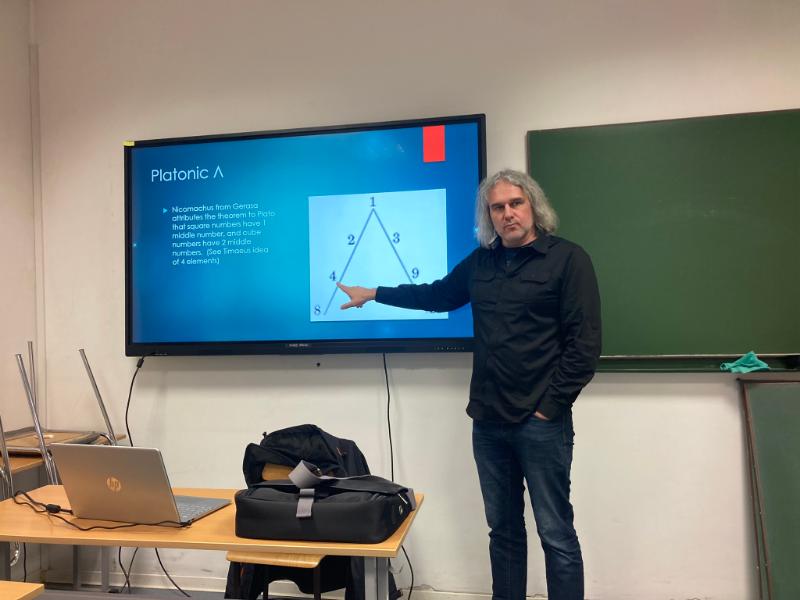
The second lecture on ancient philosophy was devoted to the subject of harmony, broadly considered. Starting with Pythagorean and Platonic concepts, prof. Čiurlionis moved on to other authors dealing with this issue and demonstrated how harmony manifested itself in various aspects of ancient Greek philosophy and, more broadly, in Greek culture, and in subsequent centuries, in music and astrology.
A Visit of a Guest from Vilnius University
Jonas Čiurlionis, Ph.D., who started to co-operate with AΦR research group in the autumn of 2021, has paid us a visit under the Erasmus agreement between Vilnius University (Lithuania) and University of Zielona Góra. Dr. Čiurlionis researches philosophical principles of ancient scientific ideas, including those of Aristotle, their development and reception. More information on his activities can be found here.
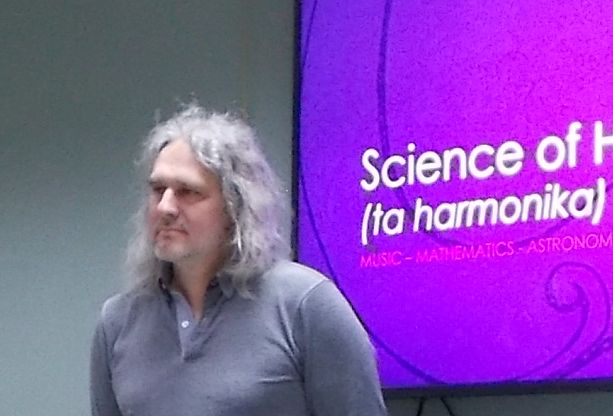
At the University of Zielona Góra dr. Čiurlionis has delivered English lectures for graduate students in the doctoral school, for undergraduate students of philosophy and for students of physics. All his talks were devoted to various aspects of mathematical, harmonical and musical foundations of scientific theories of antiquity, for example, concept of four elements, Platonic theory of creation of the world, or Aristotelian theory of movement and change. What was of special significance for the members of the AΦR group, was that dr Čiurlionis explored extensively reception and development of these concepts later in antiquity, in the middle ages and Renaissance.
One of the aims of dr. Čiurlionis’ visit in Zielona Góra was to take an essential part in doctoral seminar (in Polish) and consult the progress of Adrian Habura, M.A., who is composing his disseration on reception of Aristotle’s philosophy in works of Władysław Tatarkiewicz, for dr. Čiurlionis was appointed as an auxiliary supervisor for A. Habura’s thesis.
Recent commentaries