Home » Posts tagged 'R. Wiśniewski'
Tag Archives: R. Wiśniewski
The Second Doctoral Degree by a Member of AΦR Team
On April 14th, 2026, a public defense of Adrian Habura’s doctoral thesis took place in the Institute of Philosophy, University of Zielona Góra (UZ). The title of his dissertation was Aristotle as a Research Material and Source of Inspirations of Władysław Tatarkiewicz (1886-1980). The whole event was chaired by prof. Justyna Kroczak. At the start of the curriculum, the candidate was presented by the supervisor, Prof. Tomasz Mróz, who gave an overview of the candidate’s research and teaching experience, emphasised Habura’s work in a previous research project on S. Lisiecki, and his successful collaboration with prof. Jonas Čiurlionis of Vilnius University, an auxiliary supervisor of the dissertation.
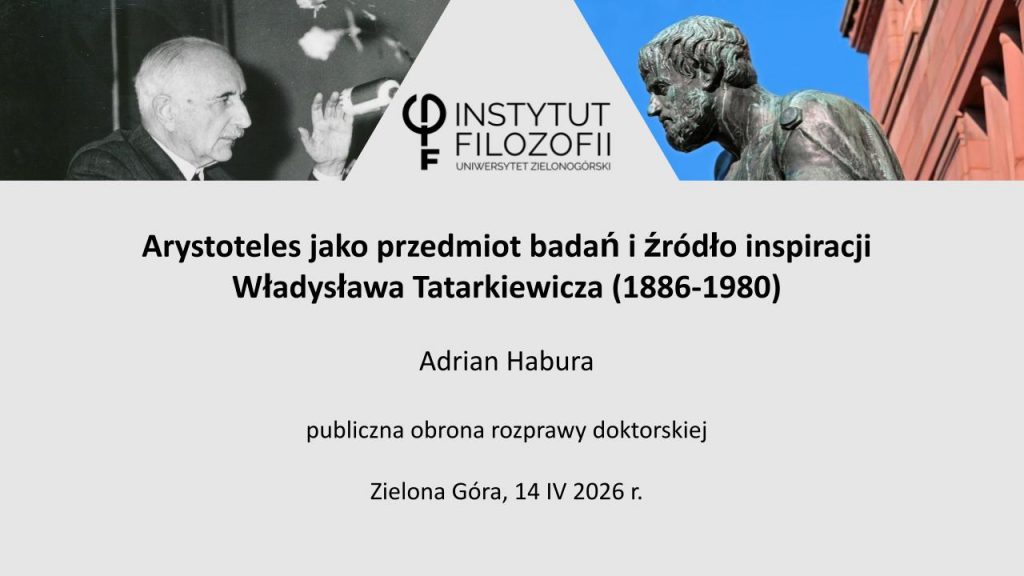
Habura then took the floor and presented the main points of his thesis. His dissertation aimed to answer two questions: 1) how did Tatarkiewicz interpret Aristotle’s philosophy? And 2) how did Aristotle inspire him in his original philosophical reflections? Habura applied Juliusz Domański’s distinction between the researchers and the users of ancient heritage, which helped him to define clearly the conditions of reception process. According to Domański, reception must be preceded by acknowledging and positive evaluation of the subject of study. Habura argued that Tatarkiewicz had met both of these conditions.
To answer the questions of the thesis, Habura focused on chronology of Tatarkiewicz’s life and work and on philosophical problems related to the reception of Aristotle, and applied biographical and comparative methods. His analyses demonstrated that Tatarkiewicz, during his long and fruitful life, developed several interpretations of Aristotle. Therefore, Habura examined relations between these interpretations.
Tatarkiewicz himself stated that during his life, he had developed two “images”, two interpretations of Aristotle, and spoke about him in two different ways. However, as Habura argued, they were not contradictory, but rather complementary. Regarding Aristotle’s research methods, philosophical approach, and philosophical ideas, Tatarkiewicz did not change his position in his later works; he broadened his analyses to include various aspects of Aristotle’s philosophy (from metaphysics to aesthetics). For this reason, Habura concluded that it was fully justified to treat Tatarkiewicz’s interpretations as parts of one coherent image of Aristotle.
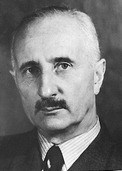
From Tatarkiewicz’s earliest works on Aristotle to his final writings, he consistently regarded the Stagirite’s philosophy as pluralistic and teleological. As comparative analyses demonstrated, Tatarkiewicz’s own philosophical thinking could be attributed with these two adjectives as well, because they describe accurately his position in epistemology, methodology, ethics, and aesthetics.
The dissertation was assessed by three reviewers, they were prof. Marian Wesoły (The Jacob of Paradies Academy in Gorzów Wielkopolski / Adam Mickiewicz University in Poznań ), prof. Przemysław Paczkowski (University of Rzeszów), and prof. Ryszard Wiśniewski (Jan Długosz University in Częstochowa / Nicolaus Copernicus University in Toruń). It should be remarked that prof. Wiśniewski, in 1976, was himself an author of a doctoral dissertation on Tatarkiewicz. All the reviewers arrived in Zielona Góra to present their positive assessments of the dissertation and ask a couple of questions. They were concerned with a very detailed character of Habura’s account of Tatarkiewicz’s career. Removing some minor parts could have given, as a result, a thinner volume and clearer argument. The discussion, that followed, focused on originality of Tatarkiewicz’s philosophy, on the attempt to position him against the 20th century interpreters of Aristotle, and on a lacking chapter on Tatarkiewicz in Enrico Berti’s book Aristotele nel Novecento (1992), that could have been written, had Berti known the works of the Polish author. Moreover, prof. Wiśniewski, who knew Tatarkiewicz personally, shared some memories of the philosopher with the audience.
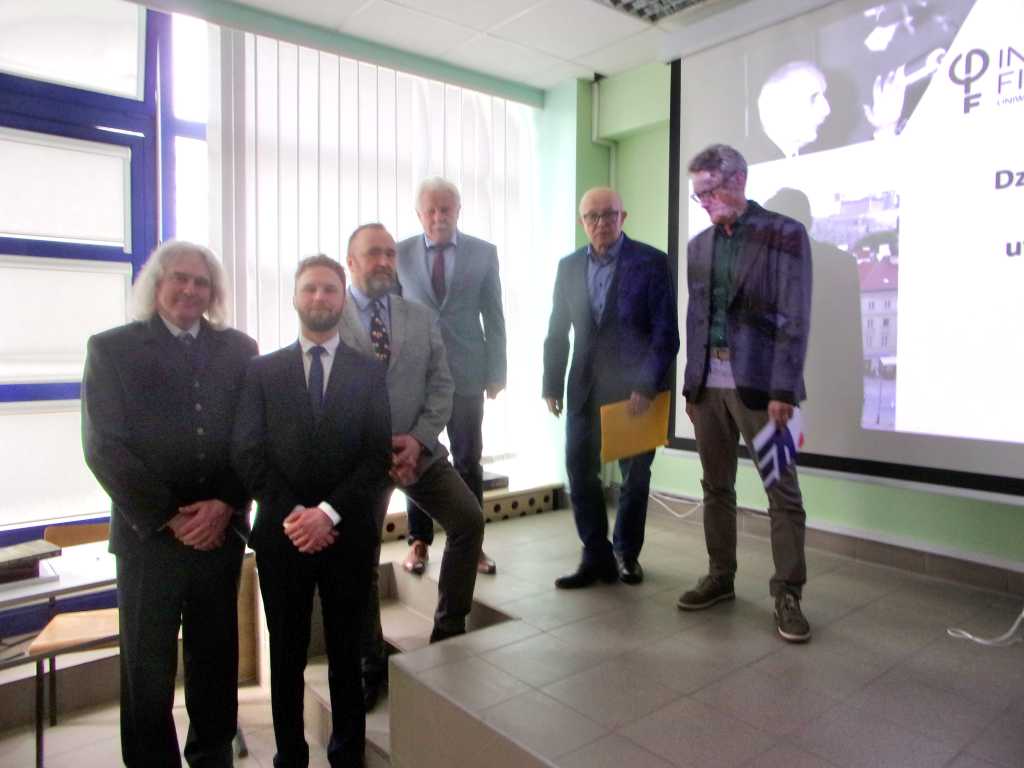
Finally, after hearing the reviews, questions and answers, the commission decided to award A. Habura with a doctoral degree cum laude. His dissertation, no doubt, has broadened the knowledge of the Polish reception of Aristotle and of Tatarkiewicz himself.
Dear Doctor Habura!
Good luck with your research plans!
Recent commentaries