Home » Posts tagged 'University of Kyiv'
Tag Archives: University of Kyiv
Another Work by H. Jakubanis Available in Polish Translation
Henryk Jakubanis (1879-1948) for over two decades worked in the Catholic University of Lublin, but his most important works were composed in Russian, during his Kyiv period, and were unavailable to Polish audiences. It was only recently that they started to be translated and published by the members and collaborators of the AΦR group. First, his study on Empedocles was translated and published, and now it is the paper titled: The Significance of Ancient Philosophy for the Modern Worldview (1910), accompanied by a commentary from the translator, Mariam Sargsyan.
The translation and the commentary were published in “Studia z Historii Filozofii” 2 (17)/2026, one of the top Polish journals for the history of philosophy. The whole volume in open access can be found here, while the translation – here, and the commentary – here. The original article, based on a lecture, had been published in an university journal in Kyiv in 1910 as Значенiе древней философiи для современнаго мiропониманiя.

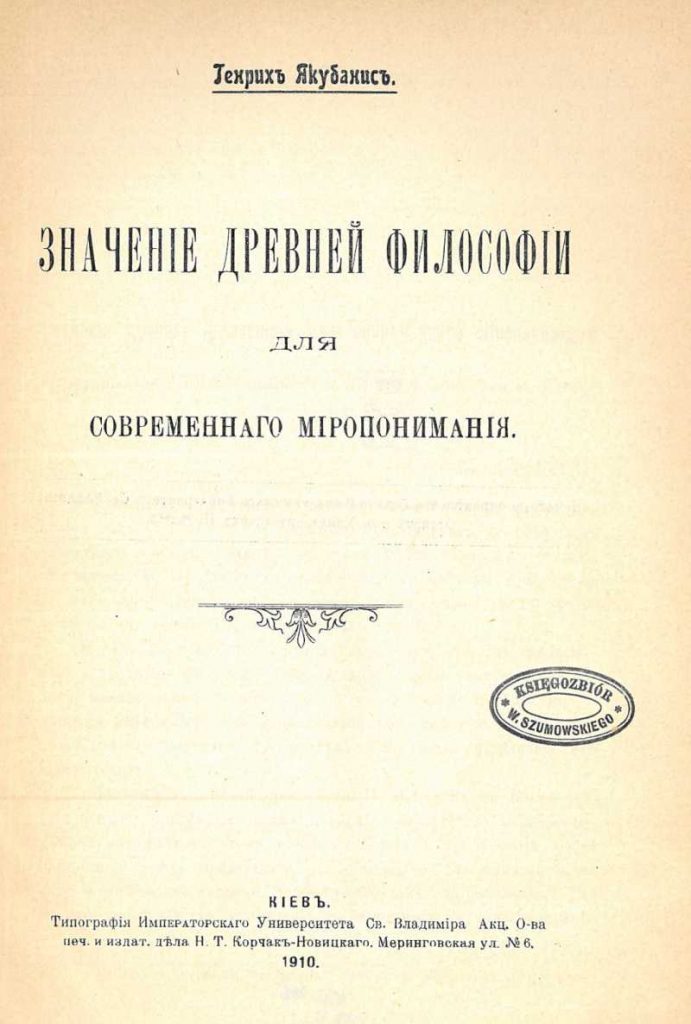
In his article, Jakubanis discussed metaphilosophical issues and presented his views on the then state of philosophy. He emphasised the enduring values of the ancient world, compared ancient and modern approaches to philosophical inquiries, and expressed hopes for the revival of the Hellenic culture. He remarked on the growing interest in antiquity in general, and in philosophy in particular, that had been demonstrated by studies of many scholars. At the same time, however, he noticed a crisis in modern philosophical thought. He took an attempt to identify its reasons: increasing specialisation of sciences, narrowing of intellectual horizons, and the discrepancy between theory and practice. Ancient thought, on the contrary, seemed to embody harmony and other timeless values.
Jakubanis’ aim was to revive ancient Greek culture, he argued that such a revival would contribute to overcoming the then crisis. In his view, such a revival should be based on three principal components: „nationality, antiquity, and Christianity”, in which he followed the ideas of his older colleague, Polish classics scholar, Tadeusz Zieliński (1859-1944). The translation of Jakubanis’ paper provides Polish audiences with an opportunity to become acquainted with the works of a scholar whose methods were moulded in pre-revolutionary Kyiv and who continued teaching in Lublin, in independent Poland.
The translation and commentary were the results of the research project funded by National Science Centre on Henryk Jakubanis (1879-1949) as a classics scholar and historian of ancient philosophy.

The First Doctoral Degree by a Member of AΦR Team
On June 24th, 2025, a public defense of Mariam Sargsyan’s (Մարիամ Սարգսյան) doctoral thesis took place in the Institute of Philosophy, University of Zielona Góra (UZ). The title of her dissertation was Henryk Jakubanis (1879–1949) as a Researcher of Ancient Philosophy and Its Reception. The whole event was chaired by prof. Jacek Uglik and it proceeded in accordance with a regular schedule. At the start he curriculum of the candidate was presented by the supervisor, T. Mróz, who stressed the fact that M. Sargsyan was the first international student in the Doctoral School for Humanities and Social Sciences, and the only beneficiary of the research project NCN Preludium bis (with T. Mróz as a PI) and NAWA Preludium bis in the history of UZ.

Then M. Sargsyan took the floor and delineated the main points of her thesis which aimed at providing a synthetic study of H. Jakubanis as a researcher of ancient philosophy. Her study included a discussion of less-known aspects of H. Jakubanis’ life and work, in particular his academic positions in Kyiv; an analysis of his interpretations of selected Greek philosophers (Empedocles and Plato); and an examination of his methods etc.
A particular emphasis was put on the significance of his national sentiments and identity in motivating his decisions and shaping his career path; and on his contribution to the development of research in ancient philosophy and promotion of Polish culture in Kyiv in the early 20th century and subsequently in Lublin during the interwar period. The second part of the presentation was focused on H. Jakubanis scholarly achievements. His works were divided into three groups: 1) a monograph and translation of Empedocles (1906); 2) various studies on Plato and reception of Platonism, including an incomplete manuscript of his final university thesis (1900); 3) works promoting the value of ancient philosophy for general audiences, not only scholars, in the modern age.
One of the most significant results of Sargsyan’s dissertation was an identification three key influences in Jakubanis’ intellectual genealogy. They were: 1) his supervisor, Alexei Gilarov (1856-1938), whose role in forming Jakubanis’ biographical-genetic method and his interpretation of Plato was crucial; 2) Tadeusz Zieliński (1859-1944) and his conviction in the importance of the ancient legacy for modern culture; 3) the works by Eduard Zeller (1814-1908), which exerted impact on Jakubanis’ views on Empedocles and Plato.

On the whole, as Sargsyan’s dissertation demonstrates, Jakubanis was a historian of ancient thought, with a good background in classical languages, whose primary goal as a lecturer and scholar was to promote ancient thought. Contrary to his methods that can be considered today as outdated, his translation of Empedocles’ fragments still circulates in the Russian-speaking world and seems to be his lasting contribution to disseminating Greek philosophy.
The dissertation was assessed by three reviewers, they were prof. Zbigniew Nerczuk (Nicolaus Copernicus University in Toruń), prof. Steffen Huber (Jagiellonian University), and prof. Wiesława Sajdek (Jan Długosz University in Częstochowa). They all were present to read out loud their positive reviews and ask a couple of questions. They were particularly concerned with some ambiguities in Sargsyan’s account of Jakubanis’ career and academic titles he had obtained, since not all the documents have been preserved. Another key issue concerned some lacking points in broader historical and philosophical context of Jakubanis’ views, as Sargsyan preferred to focus on the direct impact exerted on him by the scholars he had referred to or collaborated with.

Finally, after hearing the reviews, questions and answers, the commission decided to award M. Sargsyan with a doctoral degree cum laude. Her dissertation has, no doubt, broadened and deepend the knowledge of the reception of ancient philosophy in Central and Eastern Europe in general, and of Henryk Jakubanis, a scholar writing on history of philosophy, who left his mark on the intellectual life in Poland, Ukraine and Russia, in particular.
After her successful doctoral defence M. Sargsyan returned to Armenia, her homeland, but we all hope here for further collaboration and for funding opportunities to publish her dissertation.
Dear Doctor Sargsyan!
Good luck with your research plans and see you back soon!
Henryk Jakubanis and His Kyiv Years
Henryk Jakubanis (1879-1949), his life and intellectual legacy, have been in recent years the topic of research pursued by Mariam Sargsyan. In one of her papers, titled Henryka Jakubanisa (1879-1949) kijowski okres życia i twórczości historycznofilozoficznej (H. Jakubanis’ Kyiv Period of Life and Work in the History of Philosophy), she presented Jakubanis’ Kyiv years as fundamental and formative period of his intellectual biography. Her study has been published in Polish and can be downloaded here.
Kyiv period of Jakubanis’ life deserved a separate presentation, because our knowledge of his early career was far from satisfactory, not to mention some inaccurate or even false informations. M. Sargsyan was the first researcher who used Jakubanis’ documents from the University Library of the Catholic University of Lublin to such an extent, what was necessary to complete her task.
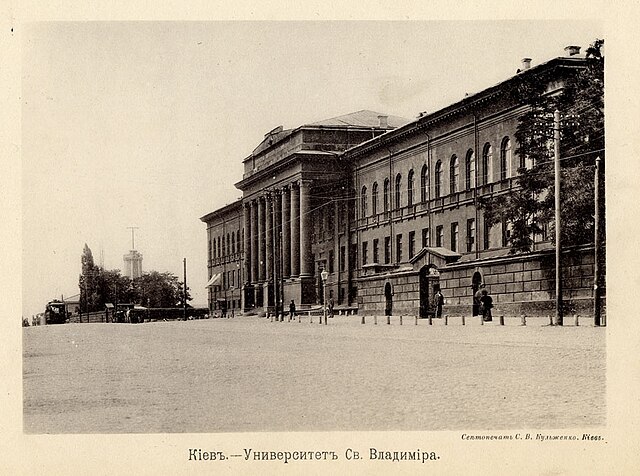
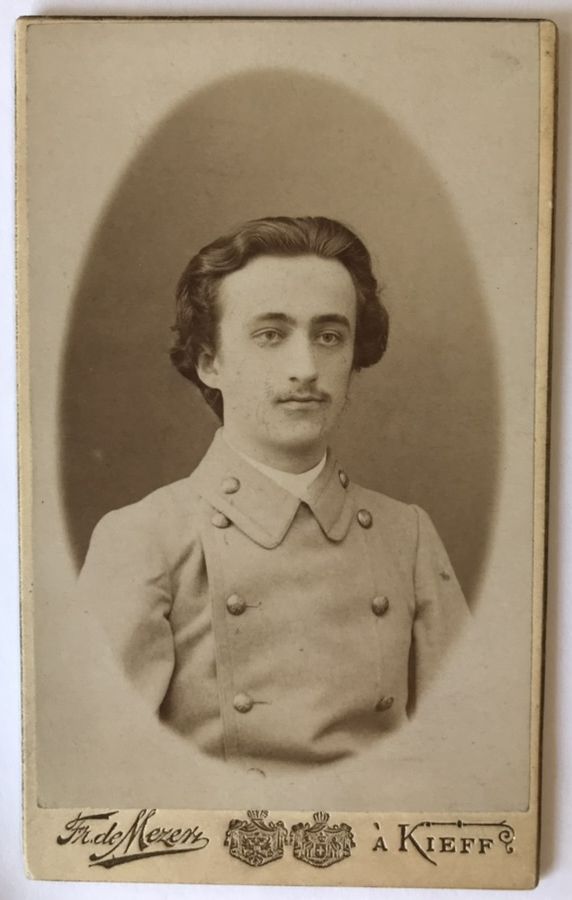
To present the life and academic activity of Jakubanis (on the right) in the Kyiv period in full, Sargsyan starts with his childhood and gymnasium education. Moreover, the history and philosophical traditions in the Saint Vladimir Imperial University of Kyiv are briefly sketched with an emphasis on Jakubanis’ study curriculum, the beginnings of his academic career and the personality of his supervisor, professor Alexei Gilarov. He was the professor who exerted the most significant impact on Jakubanis’ early works in the history of Greek philosophy.
To conclude, it was in Kyiv where Jakubanis’ career as a teacher of classics and a researcher in the history of ancient philosophy started. Some of his achievements from this period are still of significance in the Russian-speaking world, for he is still remembered as the author of a work on Empedocles and one of the pioneers in translating fragments of this ancient thinker into Russian.
A Biographical Sketch on Henryk Jakubanis
Mariam Sargsyan, an AΦR researcher focusing on the legacy of H. Jakubanis, has recently published a paper Henryk Jakubanis (1879–1949) – a Historian of Greek Philosophy Between Kyiv and Lublin, which aims at discussing the entire academic path of this researcher of ancient philosophy, presenting his work in both periods of his life, connected to Kyiv and Lublin. The paper was published in Polish and can be downloaded here.
It is not insignificant to remark that Sargsyan’s paper has been published in an issue devoted to classical philology of “Roczniki Humanistyczne” (“Annals of Arts”, Vol. 72 No. 3, 2024, pp. 79-97), a journal edited at the Catholic University of Lublin (KUL), where Jakubanis used to work for over two decades of his life.
Jakubanis’ life began in the Russian Empire, and Sargsyan presents his family and his initial education it the gymnasium, with a focus on classical languages and humanities. Then the story proceeds to the Kyiv period of his life, including a brief sketch of the history of St Vladimir’s Imperial University of Kyiv and the researchers of the history of philosophy there, with an emphasis on Jakubanis’ academic supervisor, Alexei Gilarov (1856-1938). During his Kyiv period Jakubanis won a scholarship for a study visit in Germany, notably in Berlin, and was active as a university lecturer, teacher at various courses extra muros, and started to develop his academic and research career.
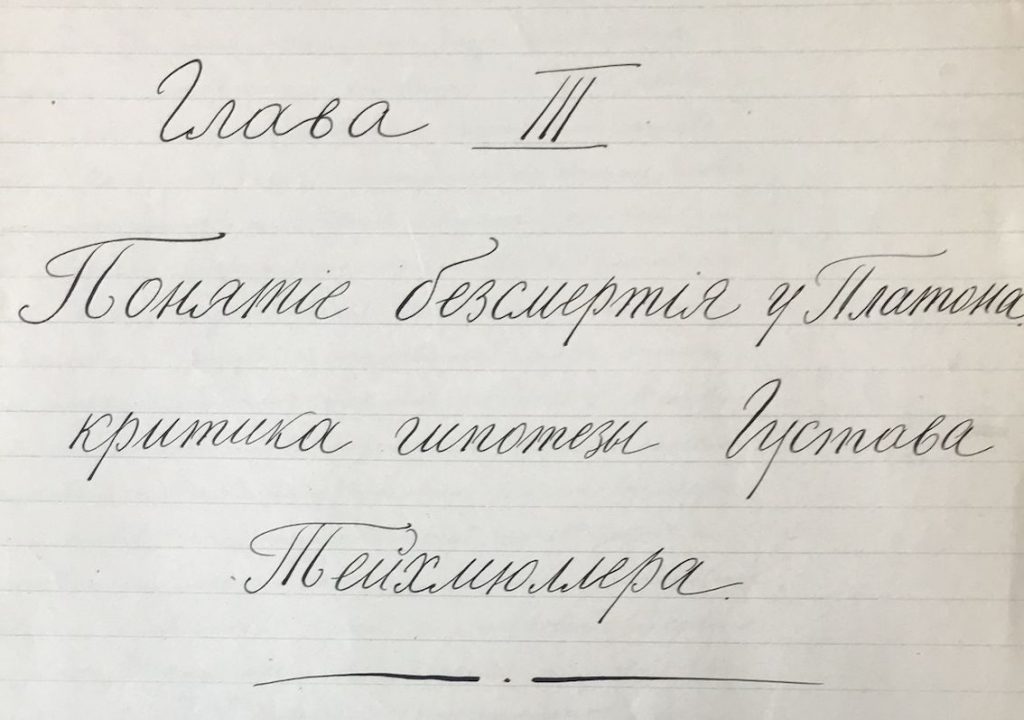
The Lublin period began in 1922 with Jakubanis’ repatriation from the then Soviet Ukraine to Lublin in the independent Republic of Poland. Thanks to the support of Tadeusz Zieliński (1859-1944), his former examiner in Kyiv, Jakubanis was hired at the University of Lublin. His lectures and seminars there, his life during the war, his works and impact are further discussed in the paper.
To sum up: Jakubanis spent 26 years of his life in Kyiv and 27 in Lublin where he died in 1949. These two periods were almost equal in terms of time, yet they were quite different. In Kyiv he composed most of his works and was formed as a researcher and teacher in classics in general and in the history of ancient philosophy in particular, while in Lublin he was rather occupied with university life and lecturing, and it did not allow him to focus on researching and publishing. For his entire life, however, he remained faithful to his interests in ancient philosophy and, according to his students, spared no energy to disseminate his knowledge and expierience in this field.
Recent commentaries