The Second Doctoral Degree by a Member of AΦR Team
On April 14th, 2026, a public defense of Adrian Habura’s doctoral thesis took place in the Institute of Philosophy, University of Zielona Góra (UZ). The title of his dissertation was Aristotle as a Research Material and Source of Inspirations of Władysław Tatarkiewicz (1886-1980). The whole event was chaired by prof. Justyna Kroczak. At the start of the curriculum, the candidate was presented by the supervisor, Prof. Tomasz Mróz, who gave an overview of the candidate’s research and teaching experience, emphasised Habura’s work in a previous research project on S. Lisiecki, and his successful collaboration with prof. Jonas Čiurlionis of Vilnius University, an auxiliary supervisor of the dissertation.
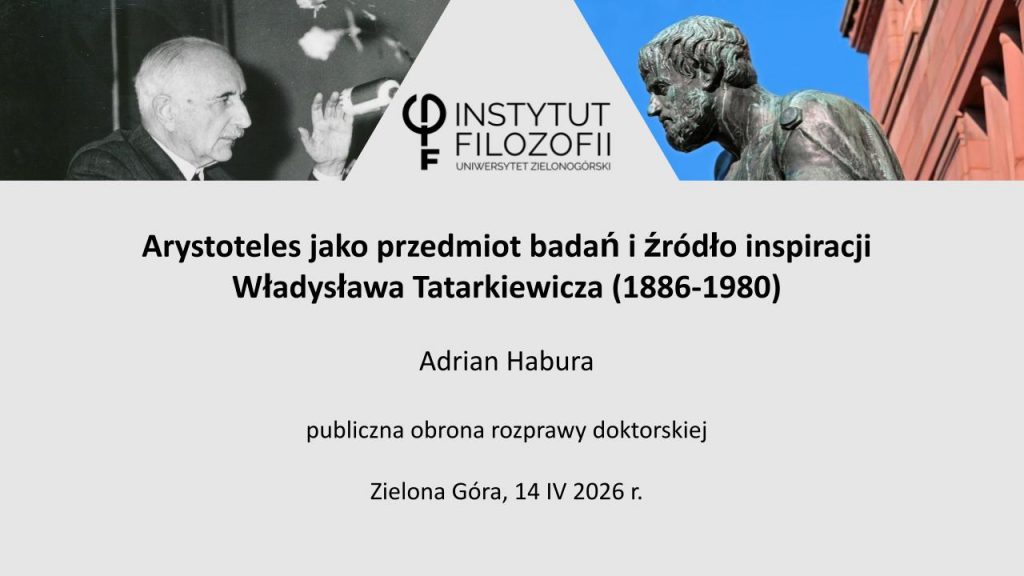
Habura then took the floor and presented the main points of his thesis. His dissertation aimed to answer two questions: 1) how did Tatarkiewicz interpret Aristotle’s philosophy? And 2) how did Aristotle inspire him in his original philosophical reflections? Habura applied Juliusz Domański’s distinction between the researchers and the users of ancient heritage, which helped him to define clearly the conditions of reception process. According to Domański, reception must be preceded by acknowledging and positive evaluation of the subject of study. Habura argued that Tatarkiewicz had met both of these conditions.
To answer the questions of the thesis, Habura focused on chronology of Tatarkiewicz’s life and work and on philosophical problems related to the reception of Aristotle, and applied biographical and comparative methods. His analyses demonstrated that Tatarkiewicz, during his long and fruitful life, developed several interpretations of Aristotle. Therefore, Habura examined relations between these interpretations.
Tatarkiewicz himself stated that during his life, he had developed two “images”, two interpretations of Aristotle, and spoke about him in two different ways. However, as Habura argued, they were not contradictory, but rather complementary. Regarding Aristotle’s research methods, philosophical approach, and philosophical ideas, Tatarkiewicz did not change his position in his later works; he broadened his analyses to include various aspects of Aristotle’s philosophy (from metaphysics to aesthetics). For this reason, Habura concluded that it was fully justified to treat Tatarkiewicz’s interpretations as parts of one coherent image of Aristotle.
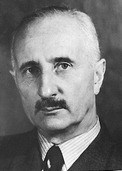
From Tatarkiewicz’s earliest works on Aristotle to his final writings, he consistently regarded the Stagirite’s philosophy as pluralistic and teleological. As comparative analyses demonstrated, Tatarkiewicz’s own philosophical thinking could be attributed with these two adjectives as well, because they describe accurately his position in epistemology, methodology, ethics, and aesthetics.
The dissertation was assessed by three reviewers, they were prof. Marian Wesoły (The Jacob of Paradies Academy in Gorzów Wielkopolski / Adam Mickiewicz University in Poznań ), prof. Przemysław Paczkowski (University of Rzeszów), and prof. Ryszard Wiśniewski (Jan Długosz University in Częstochowa / Nicolaus Copernicus University in Toruń). It should be remarked that prof. Wiśniewski, in 1976, was himself an author of a doctoral dissertation on Tatarkiewicz. All the reviewers arrived in Zielona Góra to present their positive assessments of the dissertation and ask a couple of questions. They were concerned with a very detailed character of Habura’s account of Tatarkiewicz’s career. Removing some minor parts could have given, as a result, a thinner volume and clearer argument. The discussion, that followed, focused on originality of Tatarkiewicz’s philosophy, on the attempt to position him against the 20th century interpreters of Aristotle, and on a lacking chapter on Tatarkiewicz in Enrico Berti’s book Aristotele nel Novecento (1992), that could have been written, had Berti known the works of the Polish author. Moreover, prof. Wiśniewski, who knew Tatarkiewicz personally, shared some memories of the philosopher with the audience.
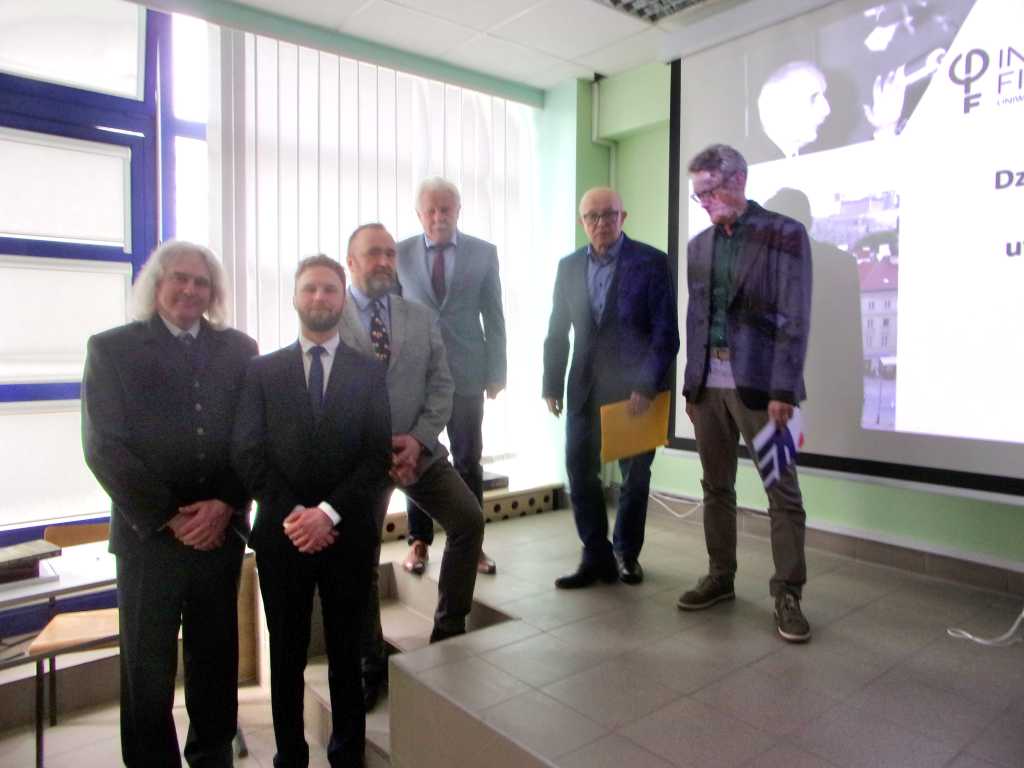
Finally, after hearing the reviews, questions and answers, the commission decided to award A. Habura with a doctoral degree cum laude. His dissertation, no doubt, has broadened the knowledge of the Polish reception of Aristotle and of Tatarkiewicz himself.
Dear Doctor Habura!
Good luck with your research plans!
A Note on “Plato in Poland” in “The Polish Review”
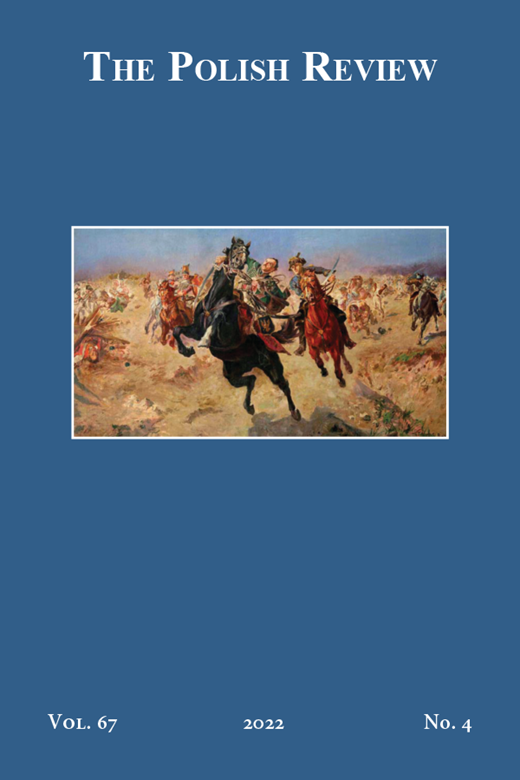
It has been only recently that we have learned about a note on Tomasz Mróz’s book (Plato in Poland 1800-1950: Types of Reception – Authors – Problems, Baden-Baden 2021) that appeared in “The Polish Review” (New York) in 2022 (vol. 67, no. 4, p. 176) in the section: Books Briefly.
A paragraph long note by the journal editors assessed the book as “a valuable addition to the history of Polish philosophy”.
How to Scare International Students with Vitello’s Theory of Demons

In March (23rd-27th) 2026, an Erasmus+ Blended Intensive Programme meeting was held at the University of Zielona Góra. About fifty students representing partner universities from Bulgaria, Croatia, Czechia, Lithuania, Portugal, Romania, Turkey and Vietnam took part in this event. Ancient Φilosophy Reception research group was present there and it was Tomasz Mróz whose presentation inaugurated on-site and offline part of the whole event.
The general topic of this BIP meeting was: Interference Patterns – Science and Culture in Dialogue. Mróz’s lecture – The Philosopher Vitello of Legnica and His Scholarly Theory of Demons – aimed to demonstrate how this 13th century scientist and philosopher, man of the world and a locally engaged scholar, used ancient thinkers (Calcidius and Aristotle) and combined mathematical calculations, natural sciences, philosophy and his own life experience to develop a theory of demons as animals composed mainly of air, the subtle element. He rejected theological concept of demons as a fallen angels and took an attempt to explain various “demonic” phaenomena secundum viam naturalem et possibilem.
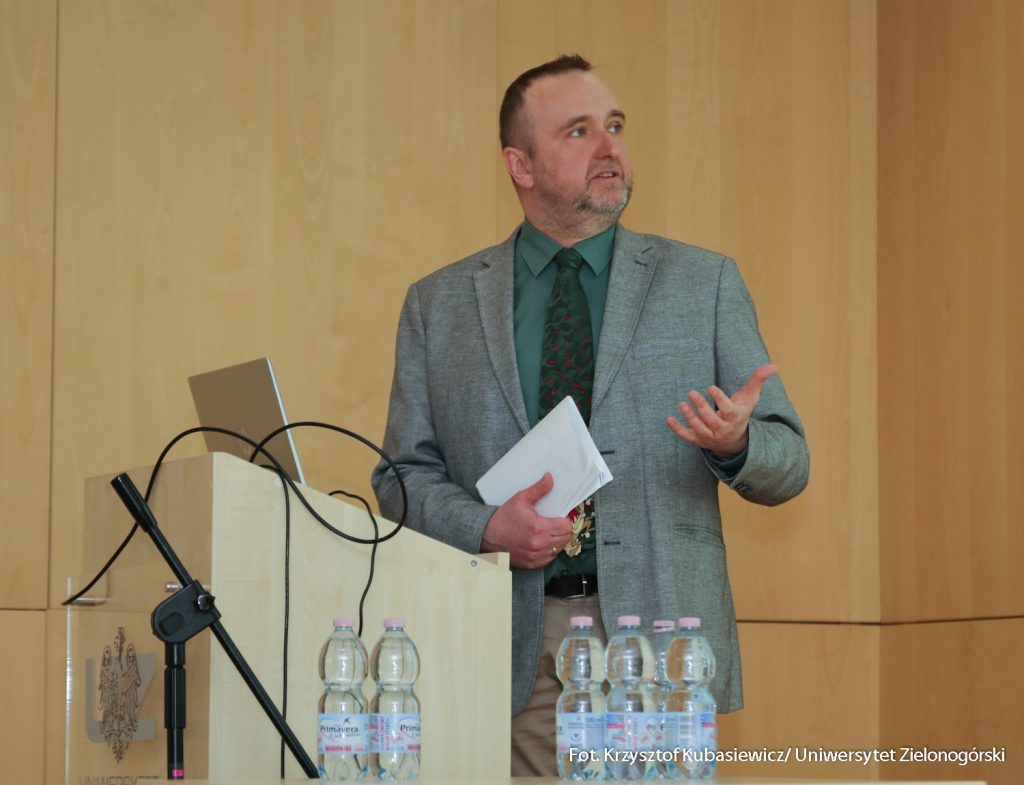
The questions from the audience concerned the problem of Vitello’s method as he departed from theological discourse. The discussion that followed emphasised the convergence of methods of Latin Averroists and Vitello, whose intention may have also been the defence of the autonomous character of philosophy and sciences. Feedback from students was also invaluable as they were surprised that such intriguing topics can be found in (otherwise dull?) history of medieval philosophy. Thank you Moldovan students in Romania!
As a digression in the course of the lecture, Woody Allen’s Everything You Always Wanted to Know About Sex* (*But Were Afraid to Ask appeared. However, since the episode with Daisy, the sheep, is definitely not suitable for all audiences, it will not be developed here 😉
Of course, no one would probably argue today for topicality of Vitello’s theory of demons, but at least some of his considerations should be taken as a serious piece of advice even in the 21st century: if you see demons or angels or hear them talking to you or making sounds, you should immediately consult a doctor!

Thanks to Sylwia Kondej and Magdalena Pokrzyńska
for organising such a great event!
An Erasmus+ Visit of a Guest from Vilnius
A co-operation between Vilnius University and the University of Zielona Góra in philosophy is developing well and a recent (March 9th-13th, 2026) visit of a guest from VU, dr Mindaugas Stoškus, proves this. M. Stoškus is a scholar with whom Ancient Φilosophy Reception research group have recently started a formal collaboration in a project funded by the Research Council of Lithuania on the reception of Greek philosophy among the philosophers in VU in the 20th century. It is here where we have already announced this as well as Stoškus’ previous visits in Zielona Góra.
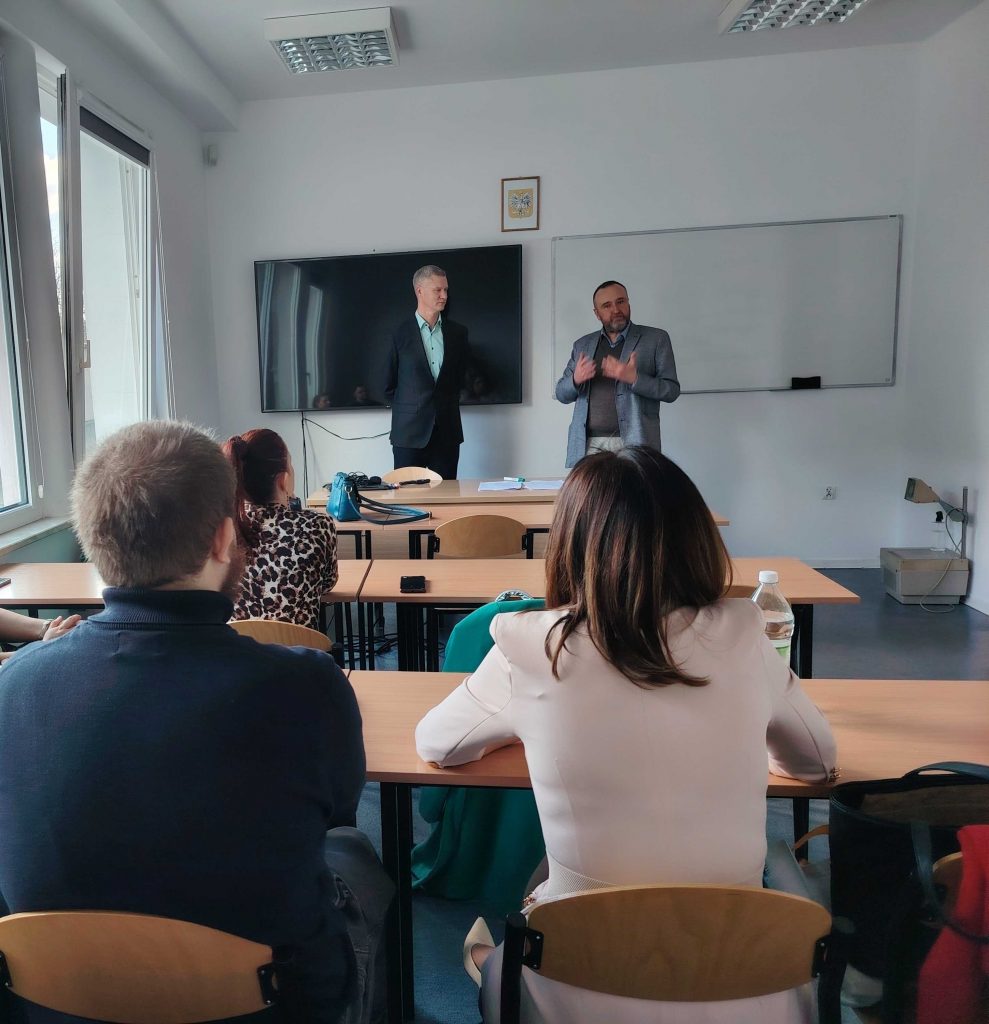
There were two lectures on ancient philosophy (and its application) among the classes of dr Stoškus. They both required students’ engagement and active participation. For philosophy students, he spoke about the ancient Greek idea of philosophy and wisdom, while for the students of doctoral school – about Plato and teaching methods. The photo on the right was taken by Urszula Majdańska-Wachowicz during the class for PhD. students. M. Stoškus (left) is being introduced by T. Mróz (right).
We are looking forward to the next visits of Vilnius scholars!
Paper on H. Jakubanis as a Promoter of Greek Thought
It is not the first time (and, hopefully, not the last one either) that the Lithunian journal “Logos” publishes a paper composed by a member of Ancient Φilosophy Reception research group. The scope of the journal are scholarly studies in all areas of philosophy.
This time the author is Mariam Sargsyan, who in 2025 defended her Ph.D. thesis cum laude and received her doctoral diploma during a ceremony at the University of Zielona Góra, where AΦR group is affiliated.
Her article was published in vol. 124 of “Logos” and is available here in a bilingual, that is, Lithuanian (translated from English by Tomas Kavaliauskas) and original English version. It is important to remark here that Henryk Jakubanis (1879–1949), whose works are the topic of this paper, and his ancestors had their roots in Lithuania, although their mother tongue was Polish and they spent most of their lives in the Russian Empire. Two language versions of Sargsyan’s paper title are Henrikas Jakubanis kaip graikų mąstymo puoselėtojas and Henryk Jakubanis as a Promoter of Greek Thought.
Sargsyan’s article covers some issues from her previous Polish studies, as for example a short sketch of Jakubanis’ and a presentation of his historical-philosophical works. This is supplemented with archival materials from the Catholic University of Lublin. Additionally, the article delves into the intellectual lineage of Jakubanis, focusing on the influences of Alexei Gilarov (1856–1938) and Tadeusz Zieliński (1859–1944).
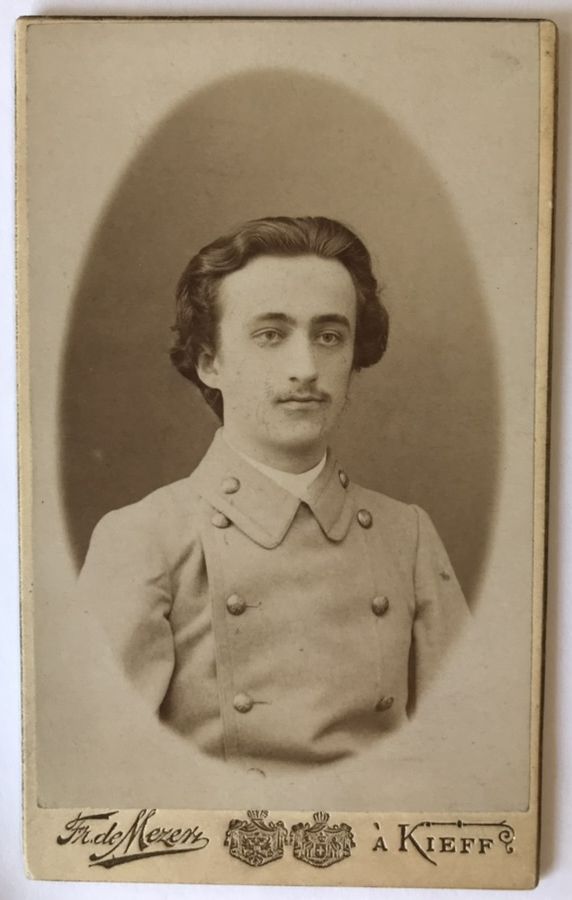
Let us focus only on Jakubanis’ work titled The Importance of Ancient Philosophy for the Modern Worldview (published in Kyiv in 1910) in which he identified the characteristic features of ancient thought with inner harmony on the top of them. Along with harmony, he listed universalism, sincerity, the ability to adopt justified views, and the plasticity of objectivism. He used harmony as an intrument for reviving ancient philosophy at the dawn of the 20th century. According to the him, modern times could undoubtedly be described as an epoch in a state of profound philosophical crisis. The essence of the crisis was the lack of unity in spiritual life and a deep split in its manifestations. This state was described as a threefold disharmony: in the scientific and theoretical sphere, in the discord of mind, feelings, and will, and, finally, in a disunion between theory and practice. In this regard the harmony of Greek thought seemed to him to be an accurate cure. More details can be found in Sargsyan’s paper.
Full Professorship for Tomasz Mróz
We are very glad to announce that Tomasz Mróz, the Head and Initiatior of the Ancient Φilosophy Reception research group at the University of Zielona Góra (Institute of Philosophy), was granted the title of the professor (or full professor, professor ordinarius), the highest academic rank in Poland, by the President of the Republic of Poland, Karol Nawrocki, in December 2025. The ceremony of presenting the nominations to the new professors took place in the Presidential Palace in Warsaw, official residence of the Polish head of the state, on January 7th, 2026.

The whole procedure of obtaining the professorship took almost a year. All the necessary documents were submitted to the Council of Academic Excellence (CAE) in January 2025. CAE appointed five referees to assess quantity and quality of T. Mróz’s scholarly achievements and his entire academic curriculum. The referees were professors: Krzysztof Brzechczyn, Mikołaj Domaradzki, Janina Gajda-Krynicka, Jerzy Kojkoł and Andrzej Wawrzynowicz. After receiving five positive opinions, CAE, at a session in September 2025, unanimously passed a motion to the President to grant the professor title to T. Mróz.
Congratulations!
The Interview with Professor Marian Wesoły Available with English Subtitles
We are very glad to announce that finally, after two years, the interview with Professor Marian Wesoły is available online with English subtitles on the website of the project Oral History and the Classics, here. We have already reported on shooting this interview here.
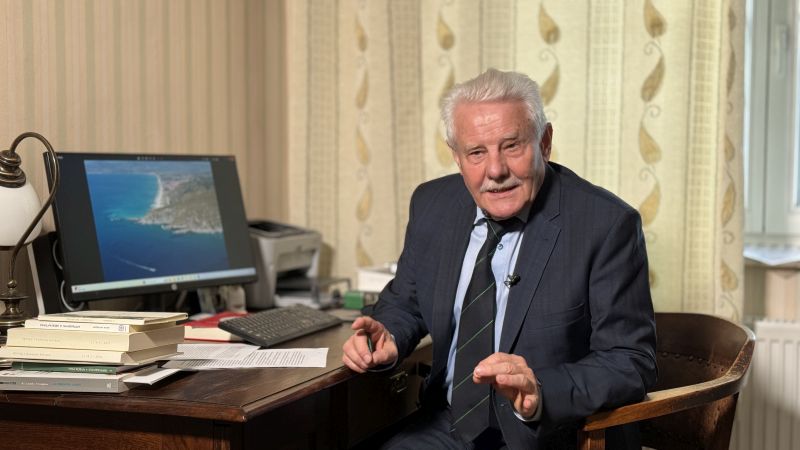
Professor Wesoły, at his desk at home, talked about his intellectual biography, his teachers, collaborators, colleagues, correspondents, about his academic adventures at research centres in Germany (Tübingen) and Italy (Naples), books and editions, and many other fascinating issues. Moreover, he shared his views on prospective developments of research in the field of ancient philosophy.
We want to encourage you, once again, to click here and watch the video.
Recent commentaries