Home » Posts tagged 'T. Mróz' (Page 2)
Tag Archives: T. Mróz
How to Scare International Students with Vitello’s Theory of Demons

In March (23rd-27th) 2026, an Erasmus+ Blended Intensive Programme meeting was held at the University of Zielona Góra. About fifty students representing partner universities from Bulgaria, Croatia, Czechia, Lithuania, Portugal, Romania, Turkey and Vietnam took part in this event. Ancient Φilosophy Reception research group was present there and it was Tomasz Mróz whose presentation inaugurated on-site and offline part of the whole event.
The general topic of this BIP meeting was: Interference Patterns – Science and Culture in Dialogue. Mróz’s lecture – The Philosopher Vitello of Legnica and His Scholarly Theory of Demons – aimed to demonstrate how this 13th century scientist and philosopher, man of the world and a locally engaged scholar, used ancient thinkers (Calcidius and Aristotle) and combined mathematical calculations, natural sciences, philosophy and his own life experience to develop a theory of demons as animals composed mainly of air, the subtle element. He rejected theological concept of demons as a fallen angels and took an attempt to explain various “demonic” phaenomena secundum viam naturalem et possibilem.
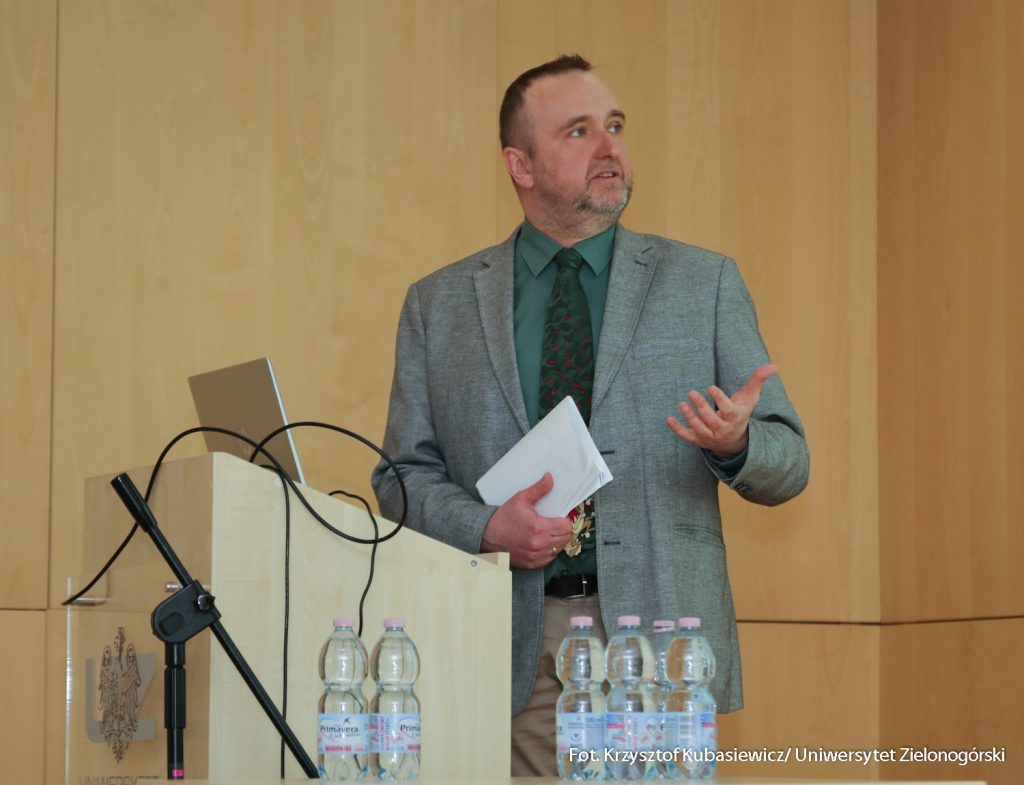
The questions from the audience concerned the problem of Vitello’s method as he departed from theological discourse. The discussion that followed emphasised the convergence of methods of Latin Averroists and Vitello, whose intention may have also been the defence of the autonomous character of philosophy and sciences. Feedback from students was also invaluable as they were surprised that such intriguing topics can be found in (otherwise dull?) history of medieval philosophy. Thank you Moldovan students in Romania!
As a digression in the course of the lecture, Woody Allen’s Everything You Always Wanted to Know About Sex* (*But Were Afraid to Ask appeared. However, since the episode with Daisy, the sheep, is definitely not suitable for all audiences, it will not be developed here 😉
Of course, no one would probably argue today for topicality of Vitello’s theory of demons, but at least some of his considerations should be taken as a serious piece of advice even in the 21st century: if you see demons or angels or hear them talking to you or making sounds, you should immediately consult a doctor!

Thanks to Sylwia Kondej and Magdalena Pokrzyńska
for organising such a great event!
An Erasmus+ Visit of a Guest from Vilnius
A co-operation between Vilnius University and the University of Zielona Góra in philosophy is developing well and a recent (March 9th-13th, 2026) visit of a guest from VU, dr Mindaugas Stoškus, proves this. M. Stoškus is a scholar with whom Ancient Φilosophy Reception research group have recently started a formal collaboration in a project funded by the Research Council of Lithuania on the reception of Greek philosophy among the philosophers in VU in the 20th century. It is here where we have already announced this as well as Stoškus’ previous visits in Zielona Góra.
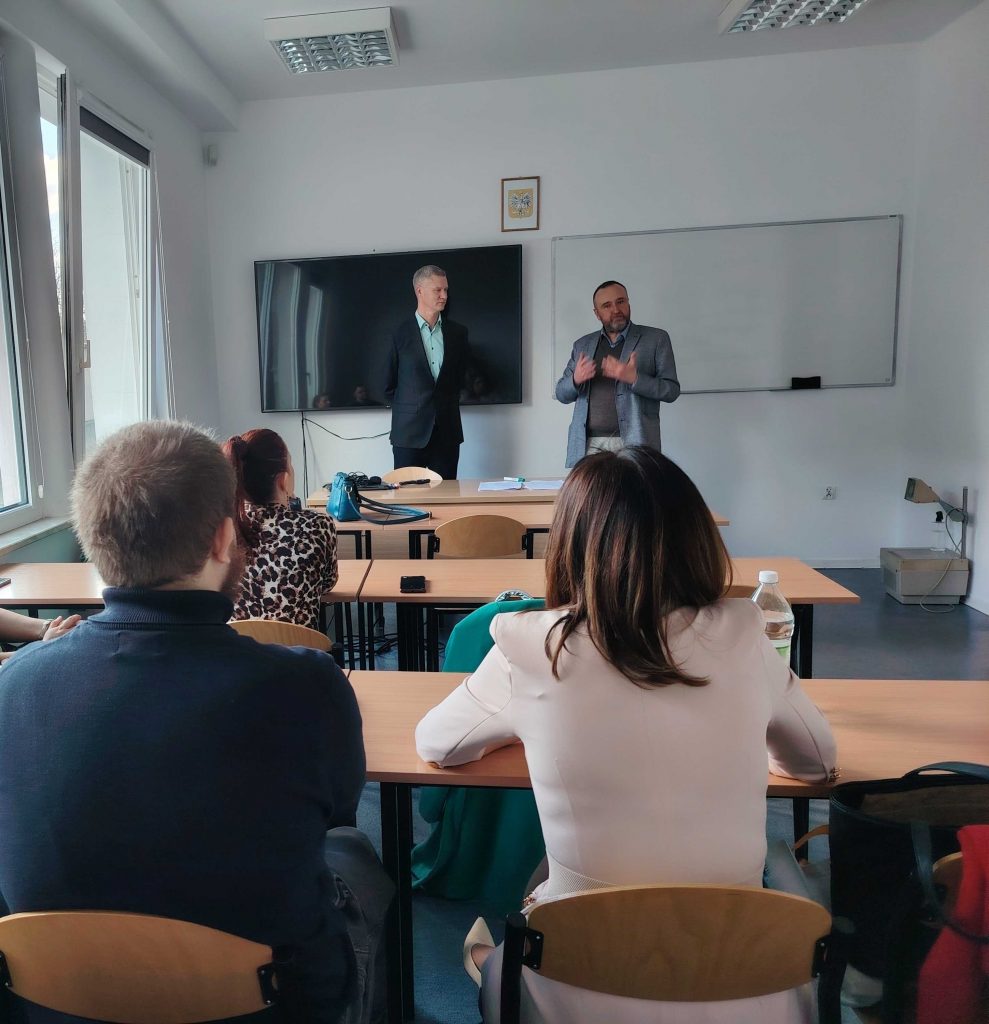
There were two lectures on ancient philosophy (and its application) among the classes of dr Stoškus. They both required students’ engagement and active participation. For philosophy students, he spoke about the ancient Greek idea of philosophy and wisdom, while for the students of doctoral school – about Plato and teaching methods. The photo on the right was taken by Urszula Majdańska-Wachowicz during the class for PhD. students. M. Stoškus (left) is being introduced by T. Mróz (right).
We are looking forward to the next visits of Vilnius scholars!
Full Professorship for Tomasz Mróz
We are very glad to announce that Tomasz Mróz, the Head and Initiatior of the Ancient Φilosophy Reception research group at the University of Zielona Góra (Institute of Philosophy), was granted the title of the professor (or full professor, professor ordinarius), the highest academic rank in Poland, by the President of the Republic of Poland, Karol Nawrocki, in December 2025. The ceremony of presenting the nominations to the new professors took place in the Presidential Palace in Warsaw, official residence of the Polish head of the state, on January 7th, 2026.

The whole procedure of obtaining the professorship took almost a year. All the necessary documents were submitted to the Council of Academic Excellence (CAE) in January 2025. CAE appointed five referees to assess quantity and quality of T. Mróz’s scholarly achievements and his entire academic curriculum. The referees were professors: Krzysztof Brzechczyn, Mikołaj Domaradzki, Janina Gajda-Krynicka, Jerzy Kojkoł and Andrzej Wawrzynowicz. After receiving five positive opinions, CAE, at a session in September 2025, unanimously passed a motion to the President to grant the professor title to T. Mróz.
Congratulations!
The Ceremony of Presenting Doctoral Diplomas
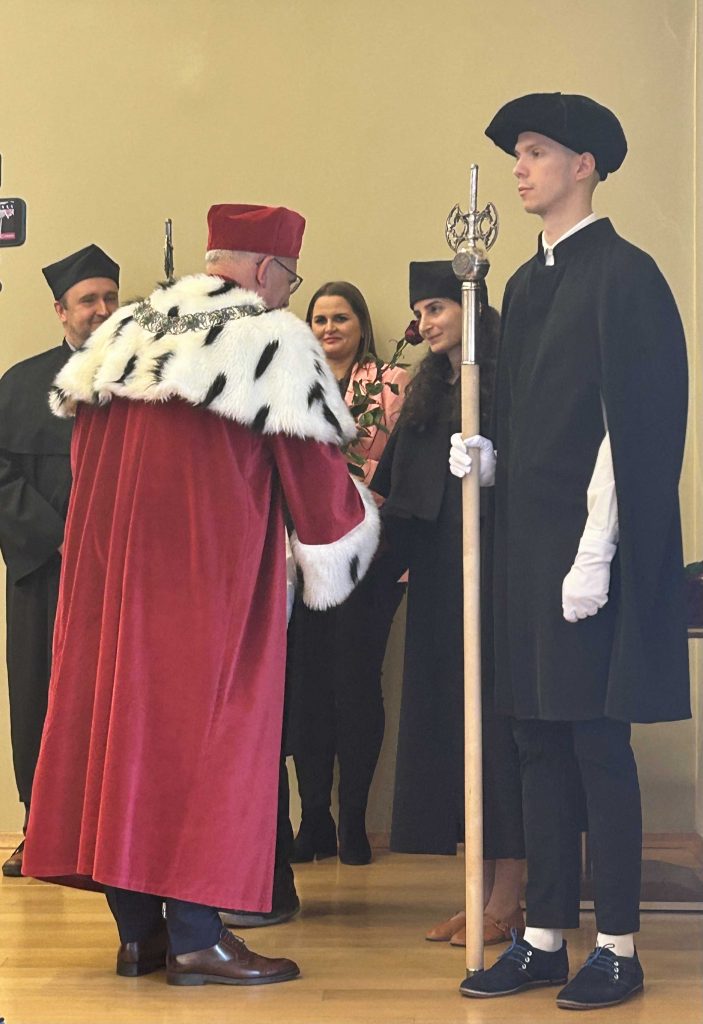
In 2025 there were many important moments for the AΦR group, but one of the most remarkable of them took place on November the 20th. It was the ceremony of presenting the new doctors with their diplomas. The members of the AΦR group took part in such an event for the first time.
The degree holder was Mariam Sargsyan, (now Ph.D.!), who – after taking a traditional doctoral oath in Latin to the Rector Magnificus of the University of Zielona Góra, prof. dr hab. Wojciech Strzyżewski – was officially granted the doctoral title cum laude and the diploma by her academic supervisor, dr hab. Tomasz Mróz.
Some details of Sargsyan’s thesis and a report from her public defence can be found here, while all the information about the projects in which she participated, her activities and achievements can be found on our website tagged with M. Sargsyan or H. Jakubanis, whose life and works were the subject of her dissertation.
A full account of the ceremony on the university’s website, in Polish, can be found here.
Congratulations!
An Interview with our Vilnius Colleagues
As we announced this autumn, Research Council of Lithuania had decided to fund a research project on the reception of ancient philosophy in Vilnius University in the 20th century. Doc. dr Jonas Čiurlionis (Vilnius University) is the PI in this project, who leads the team consisting of dr Mindaugas Stoškus (VU) and dr hab. Tomasz Mróz (University of Zielona Góra).
This post is to advertise the interview with M. Stoškus and J. Čiurlionis, who talked about the project, its premises and objectives. The interview in written form has been recently published on the VU Faculty website in Lithuanian.

Both, J. Čiurlionis and M. Stoškus, focusing on Lithuanian period in the history of VU (1940-now), emphasised the need of philosophers to confront their outlooks, methods, and the very understanding of what philosophy is with ancient philosophers. They both spoke about their lecturers and how they had referred to the Greeks. We cannot agree more with them regarding their views on significance of Greek philosophy for each Western philosopher, philosophical current and national philosophical tradition. Thus it is important to research and assess the impact of Greek ideas on more recent philosophers, for the history of philosophy is not a linear development, but a constant reference to the roots of philosophical thinking. And the core aim of the project is to research who of the VU philosophers in the 20th century, why and how referred to and reflected on ancient philosophers.
A Centenary of the Kosciuszko Foundation
This year a merited institution supporting the development of Polish sciences, arts and humanities, Kosciuszko Foundation, celebrates its centennial anniversary. A decade ago Tomasz Mróz was a Kosciuszko Fellow at the University of Iowa, in the Department of Classics, whose Head at that time was Professor John Finamore.
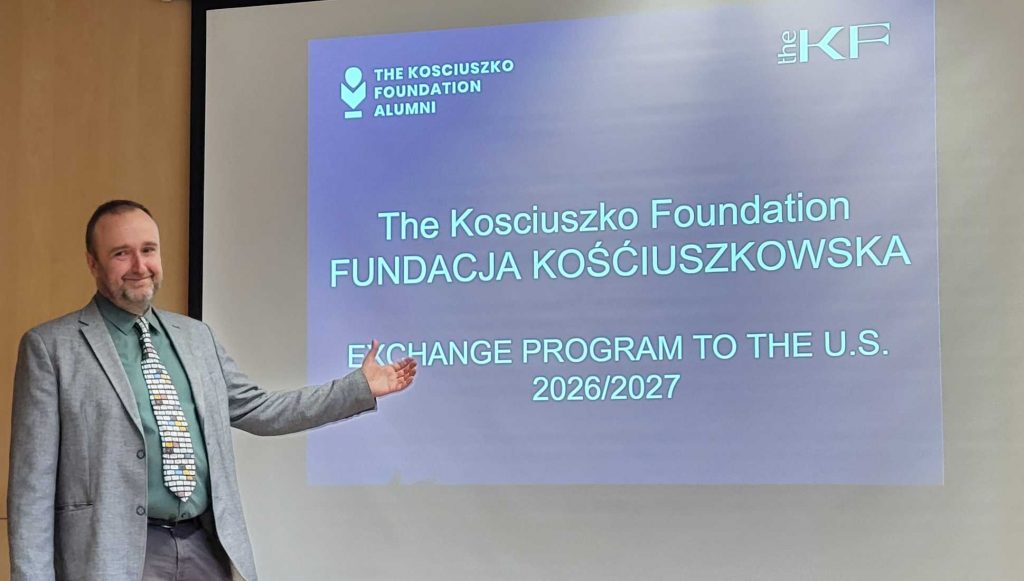
On October 21st, 2025, in lecturing hall of the university’s library in Zielona Góra, T. Mróz delivered a talk about the history of the Kosciuszko Foundation and exchange programs for Polish scholars to pursue research visits in American academic institutions. The talk was based on the presentation provided by The Kosciuszko Foundation Alumni, but its basic aim was to encourage prospective grantees to submit their project proposals and spend a couple of months in American universities. Moreover, Mróz shared his experience of preparing his proposal, of the interview and of many practical details of his 5 months research stay at the University of Iowa. The audience at the meeting was not numerous, yet highly motivated to develop their academic careers with support of the Foundation. A brief report from the meeting was published on the website of the University of Zielona Góra and on social media of the The Kosciuszko Foundation Alumni.
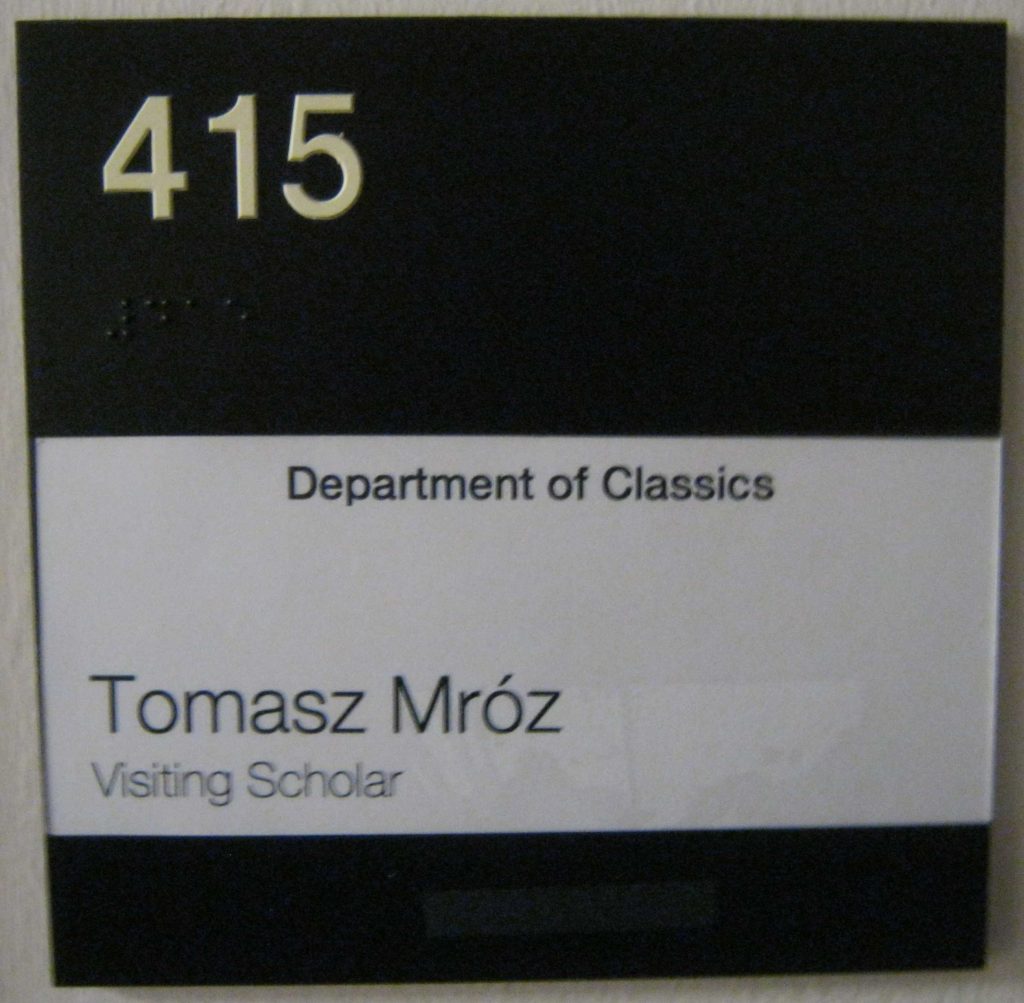
The talk induced Mróz to recall some memories of his stay in Iowa, in the Department of Classics. Financial support from the Foundation allowed him not only to cover flights, accomodation, and daily expenses, but also to undertake a research trip to the University of Chicago and the Joseph Regenstein Library, where essential manuscript collection for his research was preserved, that is, the legacy of Paul Shorey (1857-1934), an American Plato scholar…
…and Mróz’s project was focused, not surprisingly, on the reception of Plato, that is, on the controversy between Shorey and a Polish Plato scholar, Wincenty Lutosławski (1863-1954), over the methods of reading Plato’s dialogues, their chronological order, etc. During his stay Mróz delivered a paper on this topic at a seminar meeting in the Department of Classics.

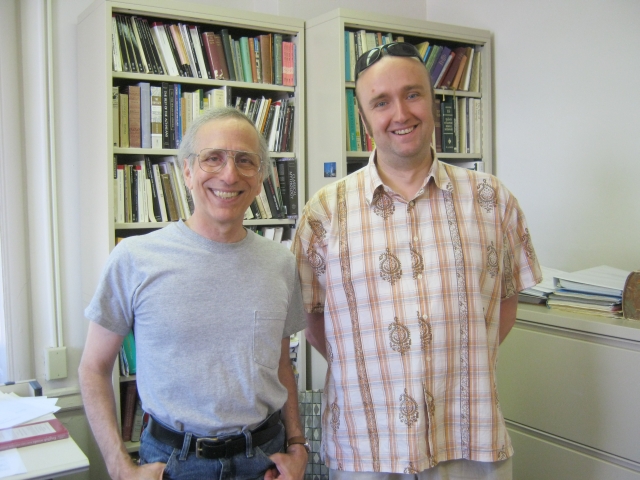
It all would not have been possible without a kind invitation from Professor John Finamore (on the left) who was at that time the Head of the Department of Classics and was very helpful for Mróz to settle in Iowa City, feel comfortable in the Department and do his research work in accordance to the plan. Thank you, John! It was a beneficial semester.
A Successful Project Proposal in Vilnius!
We are very glad to announce that the project proposal submitted by doc. dr Jonas Čiurlionis of Vilnius University to Research Council of Lithuania turned out to be successful! The title of the project in Lithuanian is Antikinės filosofijos recepcija XX a. Vilniaus universitete what translates into English as Reception of Ancient Philosophy in the 20th century Vilnius University.

Project will be pursued at the Faculty of Philosophy, Vilnius University (FsF VU), in 2025-2029. The scope of the project covers reception of ancient philosophy among scholars of Vilnius University, starting with the interwar, Polish period of its history, followed by the Soviet times after the World War II, concluding with research on ancient philosophy in free Republic of Lithuania.
The plan of the project includes organising a mid-term seminar meeting in Zielona Góra, an international conference in Vilnius, not to mention conference presentations and journal papers by all the three researchers employed in the project. And they are doc. dr Jonas Čiurlionis, Ph.D., head of the project and senior researcher, dr Mindaugas Stoškus, Ph.D., researcher, both of FsF VU, accompanied by dr hab. Tomasz Mróz, Ph.D., as senior researcher (UZ).
Recent commentaries