Home » Posts tagged 'J. Ciurlionis'
Tag Archives: J. Ciurlionis
Demons, Calcidius and Vitello at ISNS Symposium

On June 3rd-6th in Leuven, Belgium, the 23rd annual symposium of the International Society for Neoplatonic Studies (ISNS) took place. The programme of the whole event can be downloaded here. AΦR was certainly present there.
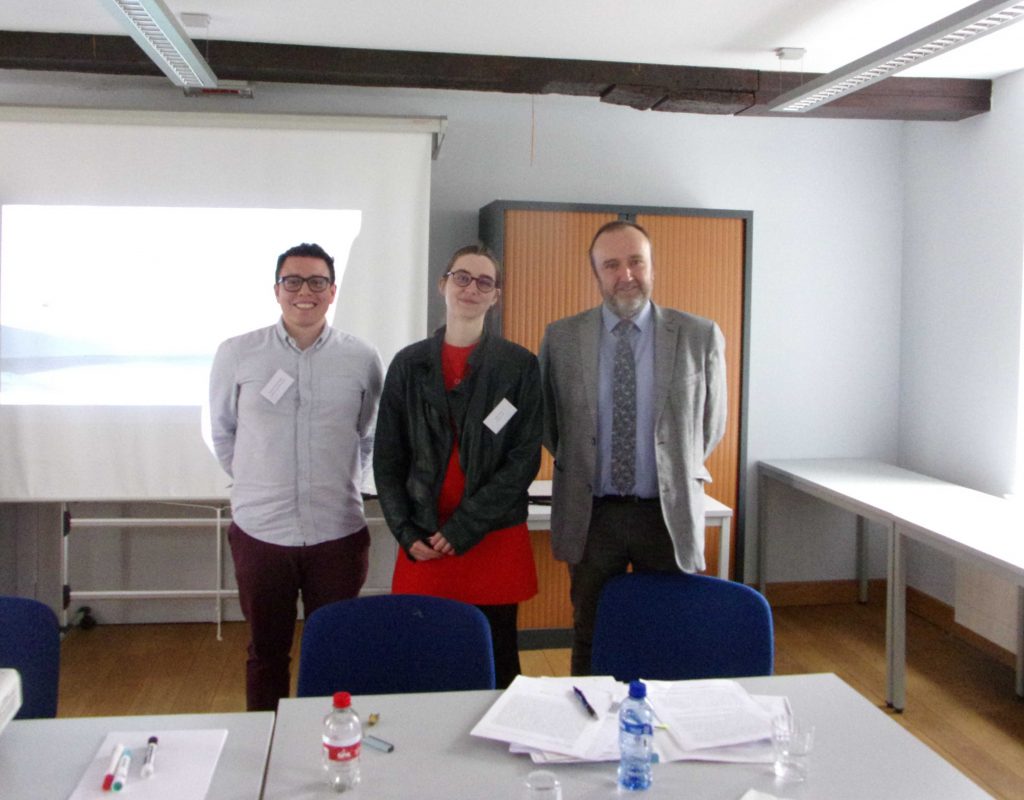
Together with two other panelists, Tomasz Mróz presented his paper in the panel: Medieval Platonism. These panelists were Heide König (LMU Munich) and Ernesto Fuentes Padgett (Notre Dame). Mróz’s paper was titled Vitello’s Theory of Daemons. Platonic Inspirations in a Naturalistic Treatment.

Vitello was a philosopher and a natural scientist of the second half of the 13th century, best known for his treatise in optics. To obtain degrees he travelled to the universities in Paris and Padua, but he also visited Viterbo. Although he gained recognition as the author of Perspectiva, dedicated to Wilhelm of Moerbecke, his interests went beyond optical issues and in a letter titled De causa primaria paenitentiae in hominibus et de natura daemonum he differentiated between the real demons as animals and apparent demons, as the effects of optical illusions or malfunctions of human cognition. He developed a theory of demons, their nature, their position among natural creatures, and investigated a number of detailed issues connected to the life of demons and their various interactions with human beings.
Mróz took an attempt to demonstrate how Vitello started with Plato, Calcidius’ commentary to the Timaeus, mathematical considerations and the Averroists’ theory of double truth to prove the existence of demons as animals and how, subsequently, he took advantage of his experience as a natural scientist and a confessor to supplement the theory with a number of observations and the then common opinions that eventually, in his eyes, reinforced the theory.
The conference in Leuven was, as all ISNS events, a successful meeting, gathering specialist in history of philosophy from antiquity to modern times. It was also an opportunity to see and listen to papers of scholars from all the continents. It was also a pleasure to see there our collaborator from Vilnius University, Jonas Čiurlionis, who delivered a paper Mathematics of Music in Timaeus’ creation of the World Soul.
The Second Doctoral Degree by a Member of AΦR Team
On April 14th, 2026, a public defense of Adrian Habura’s doctoral thesis took place in the Institute of Philosophy, University of Zielona Góra (UZ). The title of his dissertation was Aristotle as a Research Material and Source of Inspirations of Władysław Tatarkiewicz (1886-1980). The whole event was chaired by prof. Justyna Kroczak. At the start of the curriculum, the candidate was presented by the supervisor, Prof. Tomasz Mróz, who gave an overview of the candidate’s research and teaching experience, emphasised Habura’s work in a previous research project on S. Lisiecki, and his successful collaboration with prof. Jonas Čiurlionis of Vilnius University, an auxiliary supervisor of the dissertation.
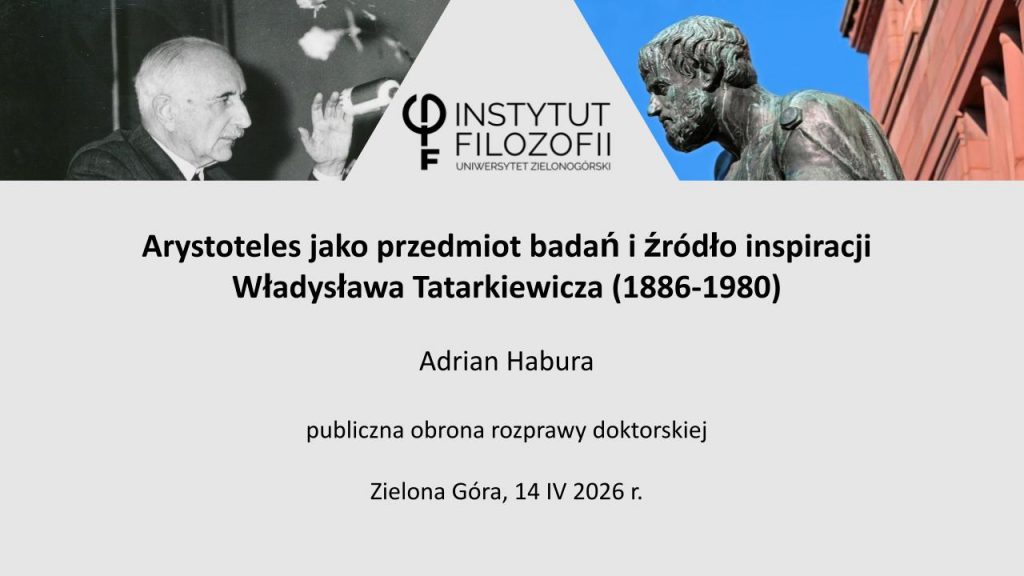
Habura then took the floor and presented the main points of his thesis. His dissertation aimed to answer two questions: 1) how did Tatarkiewicz interpret Aristotle’s philosophy? And 2) how did Aristotle inspire him in his original philosophical reflections? Habura applied Juliusz Domański’s distinction between the researchers and the users of ancient heritage, which helped him to define clearly the conditions of reception process. According to Domański, reception must be preceded by acknowledging and positive evaluation of the subject of study. Habura argued that Tatarkiewicz had met both of these conditions.
To answer the questions of the thesis, Habura focused on chronology of Tatarkiewicz’s life and work and on philosophical problems related to the reception of Aristotle, and applied biographical and comparative methods. His analyses demonstrated that Tatarkiewicz, during his long and fruitful life, developed several interpretations of Aristotle. Therefore, Habura examined relations between these interpretations.
Tatarkiewicz himself stated that during his life, he had developed two “images”, two interpretations of Aristotle, and spoke about him in two different ways. However, as Habura argued, they were not contradictory, but rather complementary. Regarding Aristotle’s research methods, philosophical approach, and philosophical ideas, Tatarkiewicz did not change his position in his later works; he broadened his analyses to include various aspects of Aristotle’s philosophy (from metaphysics to aesthetics). For this reason, Habura concluded that it was fully justified to treat Tatarkiewicz’s interpretations as parts of one coherent image of Aristotle.
From Tatarkiewicz’s earliest works on Aristotle to his final writings, he consistently regarded the Stagirite’s philosophy as pluralistic and teleological. As comparative analyses demonstrated, Tatarkiewicz’s own philosophical thinking could be attributed with these two adjectives as well, because they describe accurately his position in epistemology, methodology, ethics, and aesthetics.
The dissertation was assessed by three reviewers, they were prof. Marian Wesoły (The Jacob of Paradies Academy in Gorzów Wielkopolski / Adam Mickiewicz University in Poznań ), prof. Przemysław Paczkowski (University of Rzeszów), and prof. Ryszard Wiśniewski (Jan Długosz University in Częstochowa / Nicolaus Copernicus University in Toruń). It should be remarked that prof. Wiśniewski, in 1976, was himself an author of a doctoral dissertation on Tatarkiewicz. All the reviewers arrived in Zielona Góra to present their positive assessments of the dissertation and ask a couple of questions. They were concerned with a very detailed character of Habura’s account of Tatarkiewicz’s career. Removing some minor parts could have given, as a result, a thinner volume and clearer argument. The discussion, that followed, focused on originality of Tatarkiewicz’s philosophy, on the attempt to position him against the 20th century interpreters of Aristotle, and on a lacking chapter on Tatarkiewicz in Enrico Berti’s book Aristotele nel Novecento (1992), that could have been written, had Berti known the works of the Polish author. Moreover, prof. Wiśniewski, who knew Tatarkiewicz personally, shared some memories of the philosopher with the audience.
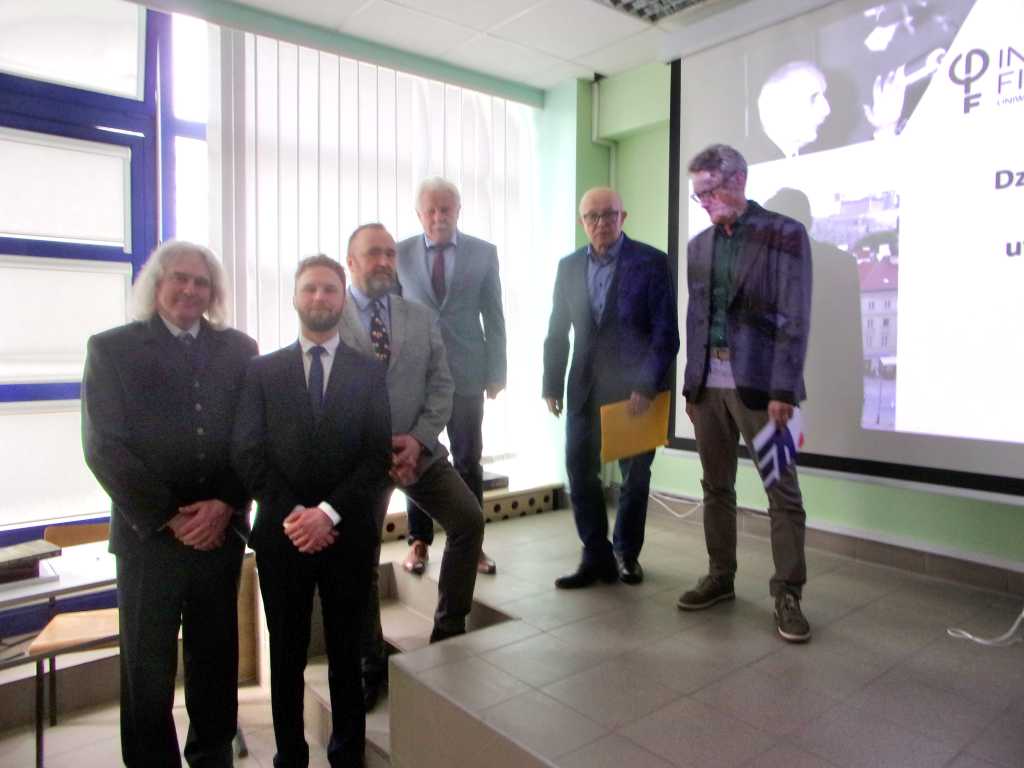
Finally, after hearing the reviews, questions and answers, the commission decided to award A. Habura with a doctoral degree cum laude. His dissertation, no doubt, has broadened the knowledge of the Polish reception of Aristotle and of Tatarkiewicz himself.
Dear Doctor Habura!
Good luck with your research plans!
An Interview with our Vilnius Colleagues
As we announced this autumn, Research Council of Lithuania had decided to fund a research project on the reception of ancient philosophy in Vilnius University in the 20th century. Doc. dr Jonas Čiurlionis (Vilnius University) is the PI in this project, who leads the team consisting of dr Mindaugas Stoškus (VU) and dr hab. Tomasz Mróz (University of Zielona Góra).
This post is to advertise the interview with M. Stoškus and J. Čiurlionis, who talked about the project, its premises and objectives. The interview in written form has been recently published on the VU Faculty website in Lithuanian.

Both, J. Čiurlionis and M. Stoškus, focusing on Lithuanian period in the history of VU (1940-now), emphasised the need of philosophers to confront their outlooks, methods, and the very understanding of what philosophy is with ancient philosophers. They both spoke about their lecturers and how they had referred to the Greeks. We cannot agree more with them regarding their views on significance of Greek philosophy for each Western philosopher, philosophical current and national philosophical tradition. Thus it is important to research and assess the impact of Greek ideas on more recent philosophers, for the history of philosophy is not a linear development, but a constant reference to the roots of philosophical thinking. And the core aim of the project is to research who of the VU philosophers in the 20th century, why and how referred to and reflected on ancient philosophers.

A Successful Project Proposal in Vilnius!
We are very glad to announce that the project proposal submitted by doc. dr Jonas Čiurlionis of Vilnius University to Research Council of Lithuania turned out to be successful! The title of the project in Lithuanian is Antikinės filosofijos recepcija XX a. Vilniaus universitete what translates into English as Reception of Ancient Philosophy in the 20th century Vilnius University.

Project will be pursued at the Faculty of Philosophy, Vilnius University (FsF VU), in 2025-2029. The scope of the project covers reception of ancient philosophy among scholars of Vilnius University, starting with the interwar, Polish period of its history, followed by the Soviet times after the World War II, concluding with research on ancient philosophy in free Republic of Lithuania.
The plan of the project includes organising a mid-term seminar meeting in Zielona Góra, an international conference in Vilnius, not to mention conference presentations and journal papers by all the three researchers employed in the project. And they are doc. dr Jonas Čiurlionis, Ph.D., head of the project and senior researcher, dr Mindaugas Stoškus, Ph.D., researcher, both of FsF VU, accompanied by dr hab. Tomasz Mróz, Ph.D., as senior researcher (UZ).
A Guest from Vilnius University
In the last week of November Institute of Philosophy hosted an Erasmus+ visitor from Vilnius University, prof. Jonas Čiurlionis, a long-time collaborator of Ancient Φilosophy Reception research group. It was his second visit in Zielona Góra. One of the tasks of our guest was to consult conclusions of the dissertation by Adrian Habura, the topic of which is a multifaceted reception of Aristotle in Władysław Tatarkiewicz’s oeuvre. It is sufficient to add that prof. J. Čiurlionis is Habura’s auxiliary supervisor.
The most important, however, were Čiurlionis’ lectures and talks for students of philosophy and related fields of study. During the first of them he discussed Aristotle’s Physics. He focused not only on the most significant problems of this work, as, for example, the theory of four elements, but also presented the broader context of Stagirite’s reflection, his fundamental premises and his general view of the world. At the end of the lecture, prof. Čiurlionis referred to Carlo Rovelli, a theoretical physicist, who considers Aristotelian physics to be still topical and not outdated.
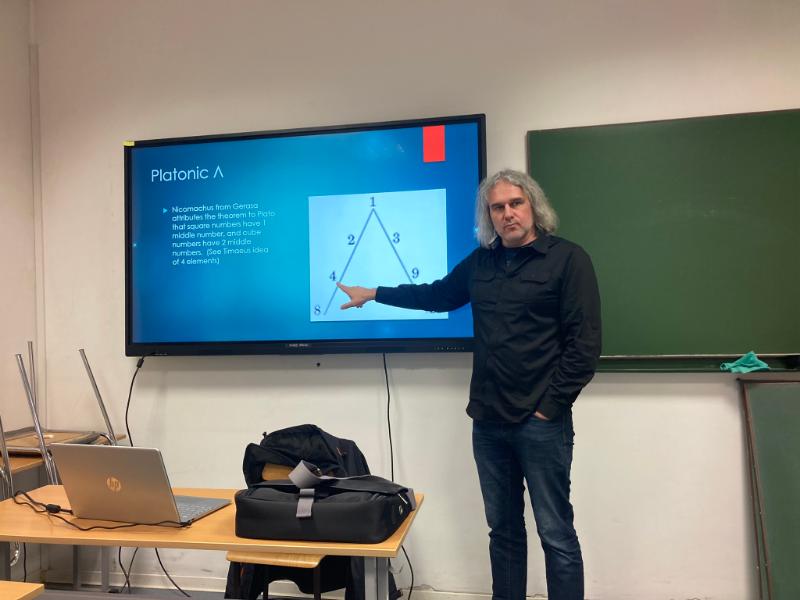
The second lecture on ancient philosophy was devoted to the subject of harmony, broadly considered. Starting with Pythagorean and Platonic concepts, prof. Čiurlionis moved on to other authors dealing with this issue and demonstrated how harmony manifested itself in various aspects of ancient Greek philosophy and, more broadly, in Greek culture, and in subsequent centuries, in music and astrology.
A Visit of a Guest from Vilnius University
Jonas Čiurlionis, Ph.D., who started to co-operate with AΦR research group in the autumn of 2021, has paid us a visit under the Erasmus agreement between Vilnius University (Lithuania) and University of Zielona Góra. Dr. Čiurlionis researches philosophical principles of ancient scientific ideas, including those of Aristotle, their development and reception. More information on his activities can be found here.
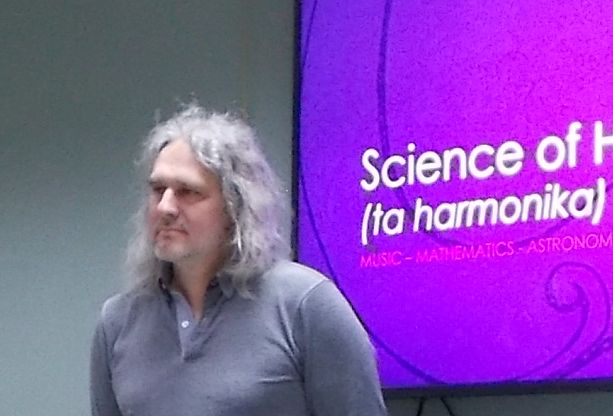
At the University of Zielona Góra dr. Čiurlionis has delivered English lectures for graduate students in the doctoral school, for undergraduate students of philosophy and for students of physics. All his talks were devoted to various aspects of mathematical, harmonical and musical foundations of scientific theories of antiquity, for example, concept of four elements, Platonic theory of creation of the world, or Aristotelian theory of movement and change. What was of special significance for the members of the AΦR group, was that dr Čiurlionis explored extensively reception and development of these concepts later in antiquity, in the middle ages and Renaissance.
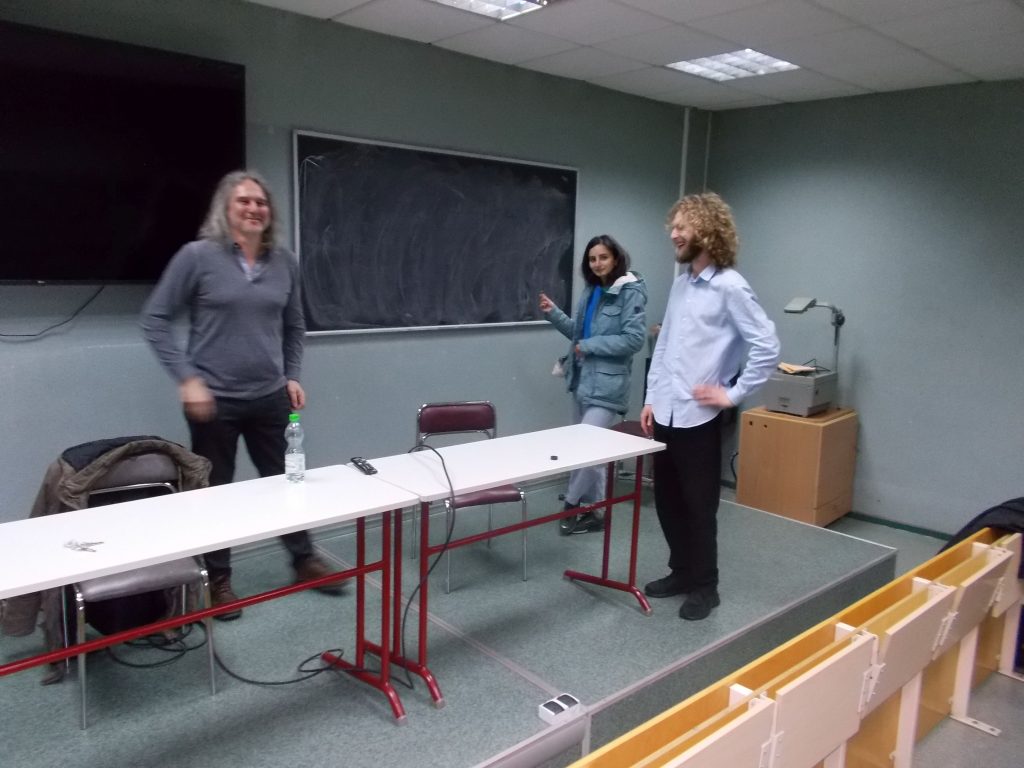
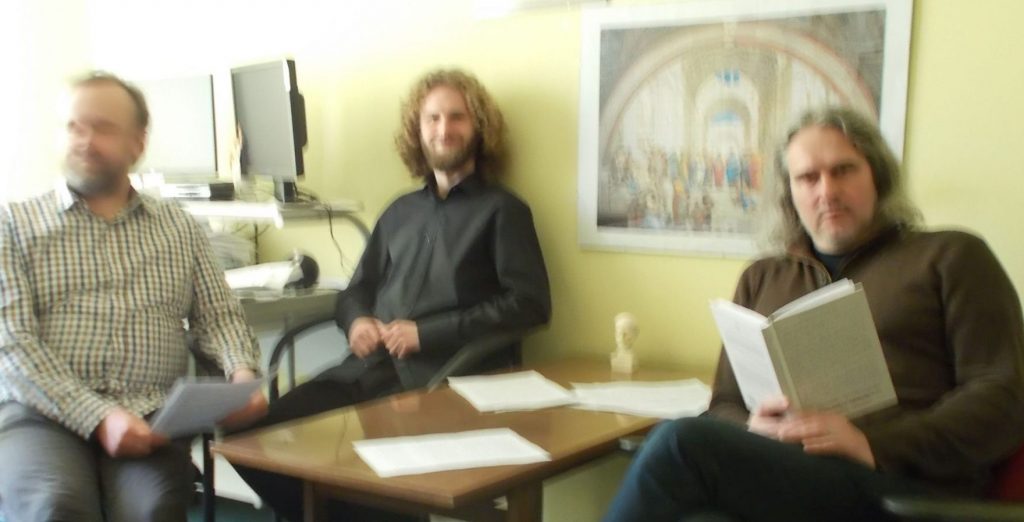
One of the aims of dr. Čiurlionis’ visit in Zielona Góra was to take an essential part in doctoral seminar (in Polish) and consult the progress of Adrian Habura, M.A., who is composing his disseration on reception of Aristotle’s philosophy in works of Władysław Tatarkiewicz, for dr. Čiurlionis was appointed as an auxiliary supervisor for A. Habura’s thesis.
Recent commentaries