Home » Posts tagged 'Plato' (Page 2)
Tag Archives: Plato
A Centenary of the Kosciuszko Foundation
This year a merited institution supporting the development of Polish sciences, arts and humanities, Kosciuszko Foundation, celebrates its centennial anniversary. A decade ago Tomasz Mróz was a Kosciuszko Fellow at the University of Iowa, in the Department of Classics, whose Head at that time was Professor John Finamore.
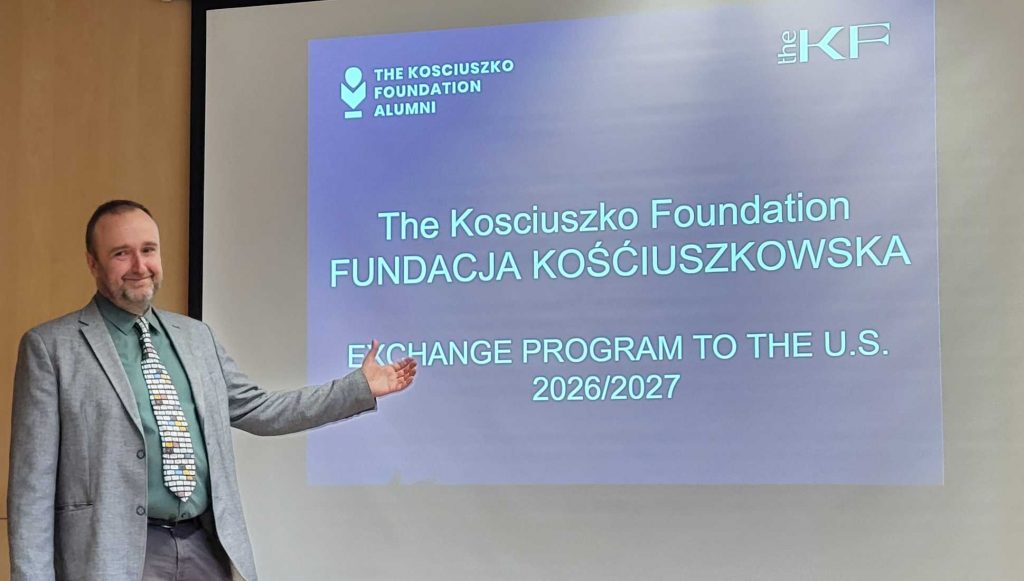
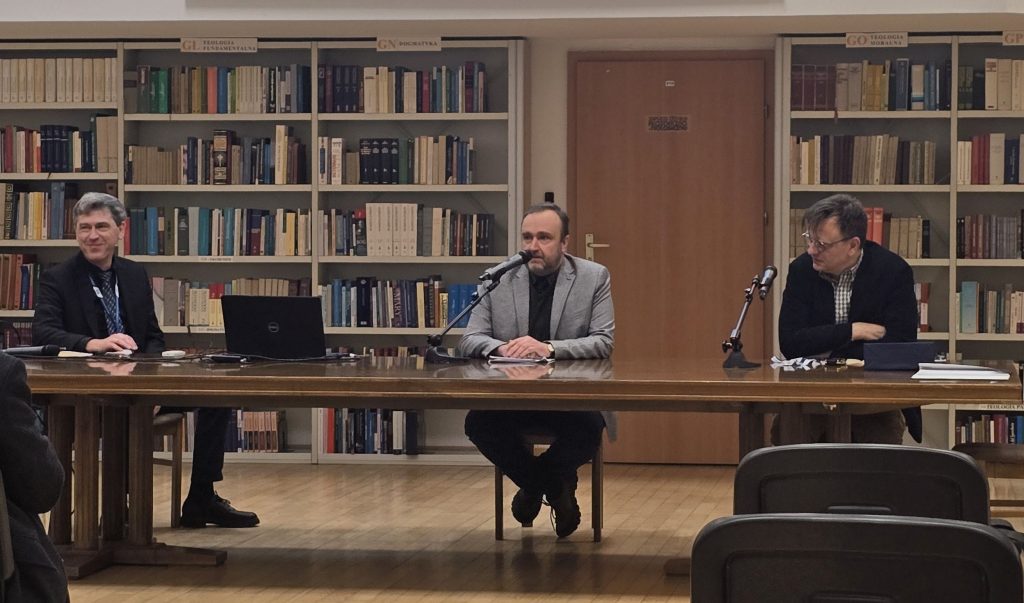
On October 21st, 2025, in lecturing hall of the university’s library in Zielona Góra, T. Mróz delivered a talk about the history of the Kosciuszko Foundation and exchange programs for Polish scholars to pursue research visits in American academic institutions. The talk was based on the presentation provided by The Kosciuszko Foundation Alumni, but its basic aim was to encourage prospective grantees to submit their project proposals and spend a couple of months in American universities. Moreover, Mróz shared his experience of preparing his proposal, of the interview and of many practical details of his 5 months research stay at the University of Iowa. The audience at the meeting was not numerous, yet highly motivated to develop their academic careers with support of the Foundation. A brief report from the meeting was published on the website of the University of Zielona Góra and on social media of the The Kosciuszko Foundation Alumni.
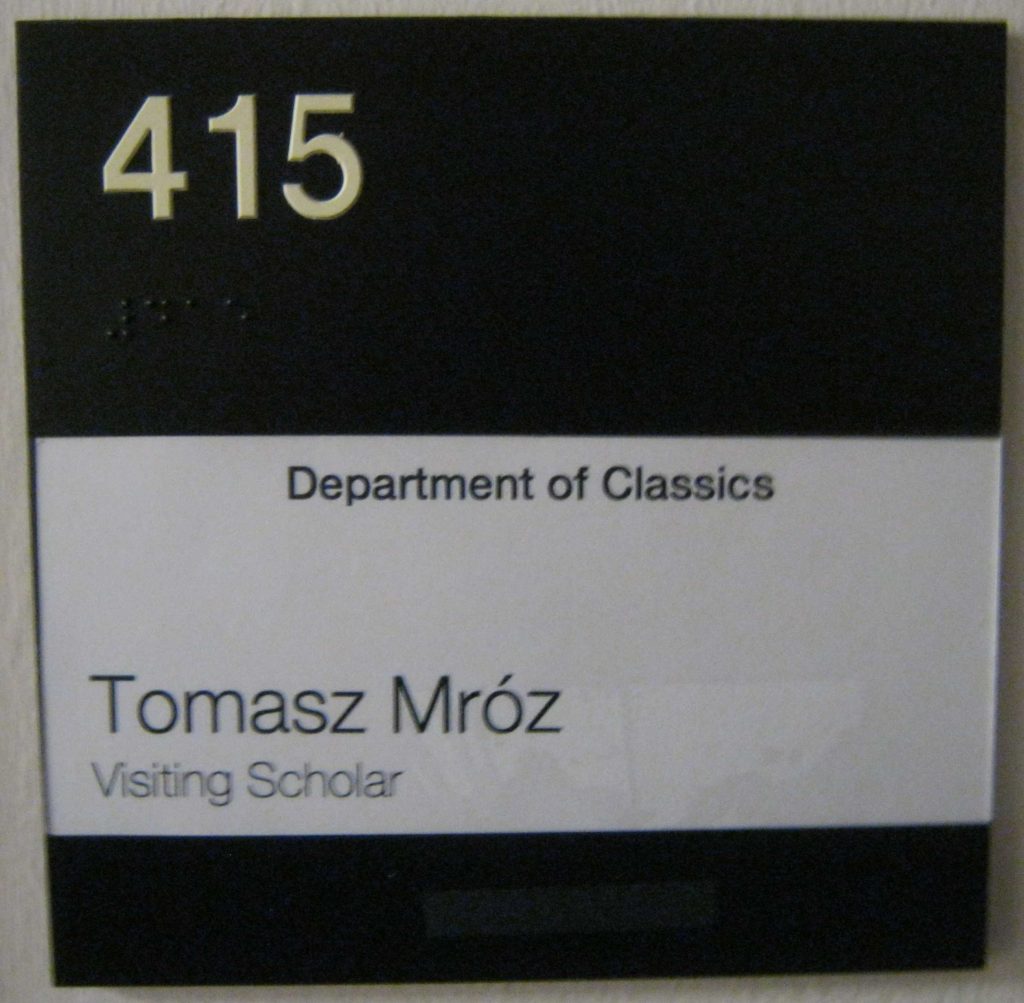
The talk induced Mróz to recall some memories of his stay in Iowa, in the Department of Classics. Financial support from the Foundation allowed him not only to cover flights, accomodation, and daily expenses, but also to undertake a research trip to the University of Chicago and the Joseph Regenstein Library, where essential manuscript collection for his research was preserved, that is, the legacy of Paul Shorey (1857-1934), an American Plato scholar…
…and Mróz’s project was focused, not surprisingly, on the reception of Plato, that is, on the controversy between Shorey and a Polish Plato scholar, Wincenty Lutosławski (1863-1954), over the methods of reading Plato’s dialogues, their chronological order, etc. During his stay Mróz delivered a paper on this topic at a seminar meeting in the Department of Classics.

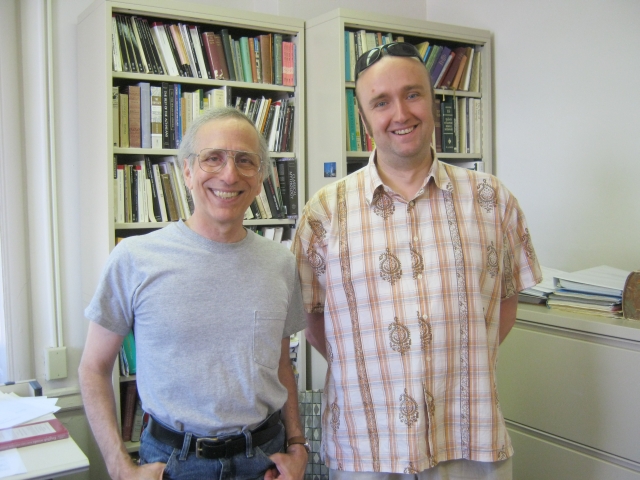
It all would not have been possible without a kind invitation from Professor John Finamore (on the left) who was at that time the Head of the Department of Classics and was very helpful for Mróz to settle in Iowa City, feel comfortable in the Department and do his research work in accordance to the plan. Thank you, John! It was a beneficial semester.
Polish Political Platos in Brill’s Companion
Brill’s Companion to the Legacy of Greek Political Thought edited by David Carter, Rachel Foxley, and Liz Sawyer is one of the latest volumes in the series (vol. 8, Leiden-Boston 2024). Contributors to this volume investigated a range of responses to issues surrounding the legacy of Greek political thought, exploring the ways in which political thinking has evolved from antiquity to the present day.
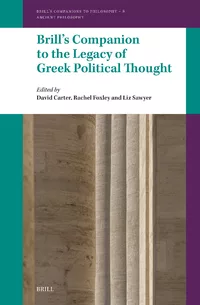
One of the chapters in this book was authored by Tomasz Mróz who discussed variety of Polish interpretations of Plato’s political works in studies written by nineteenth-century Polish authors (Plato’s Political Works in Nineteenth-Century Polish Thought, pp. 335-363), including historians of philosophy, philosophers and social thinkers. Their diverse views on the Republic of Plato reflected the wealth of ideas which are present in Plato’s opus. In spite of their various intellectual backgrounds and goals, all these authors found inspiration in Plato’s work for the implementation of his political ideas into their own arguments touching upon contemporary social or political issues, including the questions of democracy, socialism and gender equality.
Let’s say a few words about the authors presented in Mróz’s chapter to give a glance of its content: Bolesław Limanowski (1835-1935), a socialist thinker, regarder Plato as a progressive philosopher, despite his disregard for democracy. For Wojciech Dzieduszycki (1848-1909), a conservative politician, Plato’s socialist and feminist ideas were too destructive for society to be implemented. Wincenty Lutosławski (1863-1954), a famous Plato scholar, considered Plato’s socialism as a natural consequence of his metaphysics and only a transitional step in his development. Stefan Pawlicki (1839-1916), a neo-Scholastic philosopher, claimed that even Plato’s most controversial political ideas (communism and feminism) had stemmed from his deep moral beliefs, but all their shortcomings were later to be corrected by Christianity. Eventually, Eugeniusz Jarra (1881-1973), a historian of legal philosophy, emphasised gender equality and the possibility of social promotion as progressive ideas supporting democracy.
PS.: this chapter was edited and improved by Una Maclean-Hańćkowiak and is presented on Kudos platform.
The First Doctoral Degree by a Member of AΦR Team
On June 24th, 2025, a public defense of Mariam Sargsyan’s (Մարիամ Սարգսյան) doctoral thesis took place in the Institute of Philosophy, University of Zielona Góra (UZ). The title of her dissertation was Henryk Jakubanis (1879–1949) as a Researcher of Ancient Philosophy and Its Reception. The whole event was chaired by prof. Jacek Uglik and it proceeded in accordance with a regular schedule. At the start he curriculum of the candidate was presented by the supervisor, T. Mróz, who stressed the fact that M. Sargsyan was the first international student in the Doctoral School for Humanities and Social Sciences, and the only beneficiary of the research project NCN Preludium bis (with T. Mróz as a PI) and NAWA Preludium bis in the history of UZ.

Then M. Sargsyan took the floor and delineated the main points of her thesis which aimed at providing a synthetic study of H. Jakubanis as a researcher of ancient philosophy. Her study included a discussion of less-known aspects of H. Jakubanis’ life and work, in particular his academic positions in Kyiv; an analysis of his interpretations of selected Greek philosophers (Empedocles and Plato); and an examination of his methods etc.
A particular emphasis was put on the significance of his national sentiments and identity in motivating his decisions and shaping his career path; and on his contribution to the development of research in ancient philosophy and promotion of Polish culture in Kyiv in the early 20th century and subsequently in Lublin during the interwar period. The second part of the presentation was focused on H. Jakubanis scholarly achievements. His works were divided into three groups: 1) a monograph and translation of Empedocles (1906); 2) various studies on Plato and reception of Platonism, including an incomplete manuscript of his final university thesis (1900); 3) works promoting the value of ancient philosophy for general audiences, not only scholars, in the modern age.
One of the most significant results of Sargsyan’s dissertation was an identification three key influences in Jakubanis’ intellectual genealogy. They were: 1) his supervisor, Alexei Gilarov (1856-1938), whose role in forming Jakubanis’ biographical-genetic method and his interpretation of Plato was crucial; 2) Tadeusz Zieliński (1859-1944) and his conviction in the importance of the ancient legacy for modern culture; 3) the works by Eduard Zeller (1814-1908), which exerted impact on Jakubanis’ views on Empedocles and Plato.

On the whole, as Sargsyan’s dissertation demonstrates, Jakubanis was a historian of ancient thought, with a good background in classical languages, whose primary goal as a lecturer and scholar was to promote ancient thought. Contrary to his methods that can be considered today as outdated, his translation of Empedocles’ fragments still circulates in the Russian-speaking world and seems to be his lasting contribution to disseminating Greek philosophy.
The dissertation was assessed by three reviewers, they were prof. Zbigniew Nerczuk (Nicolaus Copernicus University in Toruń), prof. Steffen Huber (Jagiellonian University), and prof. Wiesława Sajdek (Jan Długosz University in Częstochowa). They all were present to read out loud their positive reviews and ask a couple of questions. They were particularly concerned with some ambiguities in Sargsyan’s account of Jakubanis’ career and academic titles he had obtained, since not all the documents have been preserved. Another key issue concerned some lacking points in broader historical and philosophical context of Jakubanis’ views, as Sargsyan preferred to focus on the direct impact exerted on him by the scholars he had referred to or collaborated with.

Finally, after hearing the reviews, questions and answers, the commission decided to award M. Sargsyan with a doctoral degree cum laude. Her dissertation has, no doubt, broadened and deepend the knowledge of the reception of ancient philosophy in Central and Eastern Europe in general, and of Henryk Jakubanis, a scholar writing on history of philosophy, who left his mark on the intellectual life in Poland, Ukraine and Russia, in particular.
After her successful doctoral defence M. Sargsyan returned to Armenia, her homeland, but we all hope here for further collaboration and for funding opportunities to publish her dissertation.
Dear Doctor Sargsyan!
Good luck with your research plans and see you back soon!
Neverending Story of… Plato in Poland
This time it was at the University of Hradec Králové where the word about Plato reception in Poland was spread. Tomasz Mróz, among his activities in accordance with Erasmus+ Teaching Assignment, delivered a talk on political aspects of Plato reception in Poland. The focus was, naturally, on Plato’s Republic and on the connections between the interpretations of Plato’s political philosophy and the political situation of Poland from the 19th century to the post World War II era. This talk was delivered for international students enrolled in a course: Ancient Greek Democracy and Its Legacy taught in UHK by professor Jaroslav Daneš, with whom AΦR research group has successfully co-operated for many years.
The topics covered in this talk included a brief overview of how political situation of Poland changed and how various researchers of Plato interpreted his political ideas. The lecture started with Bolesław Limanowski (1835-1935), an advocate of socialism, who used Plato’s ideas as an evidence that socialism had been present in European thought from its very beginning. The next was Wojciech Dzieduszycki (1848-1909), a conservative politician, who ridiculed gender equality and socialism as political phantasies. Wincenty Lutosławski (1863-1954) considered totalitarian character of Plato’s polis as a natural consequence of his idealism, but after the World War II emphasised Plato’s evolution and his affinity to Christianity. Stefan Pawlicki (1839-1916), a Christian thinker rejected the connection between socialism and Plato, but praised the idea of preventive censorship. At the dawn of Polish independence after World War I Eugeniusz Jarra (1881-1973) welcomed the idea that social promotion or demotion in the state should depend on personal capabilities, and that the elites should no longer consist of the members of aristocracy but of the most gifted individuals. After World War II, in the Stalinist period, the criticism of Plato stemmed from various premises. Tadeusz Kroński (1907-1958), on the one hand, a Marxist thinker, considered Plato’s political philosophy as an aristocratic reaction to democratic changes in Athens, and in general as an expression of obscurantism and religiosity. Władysław Witwicki (1878-1948), on the other hand, was apparently critical towards Plato’s political project, assessing it as a monastery, concentration camp and a totalitarian state, but actually it was a criticism in disguise of the then political system.
In spite of the fact that the history of Poland or Polish philosophy was completely new for the members of the audience, their questions and remarks demonstrated that they were able to see the relations between the views of Plato’s interpreters and their interpretations of Plato’s Republic. Moreover, as usually, the discussion was the evidence that more general issues related to Plato’s legacy remain topical and stimulating as, for example, the chronology of Plato’s dialogues or reliability of image of Socrates.
Stefan Pawlicki on Greek Concepts of Human Soul
On March 15th-16th 2025 the first conference of the Academic Club for Ancient Philosophy (Koło Naukowe Filozofii Starożytnej) at the University of Warsaw took place. This academic event was organised by young enthusiasts of ancient thought and gathered scholars from various Polish universitites, and students interested generally in the topic of body and soul or in the subjects of individual papers, the list of which can be found here.
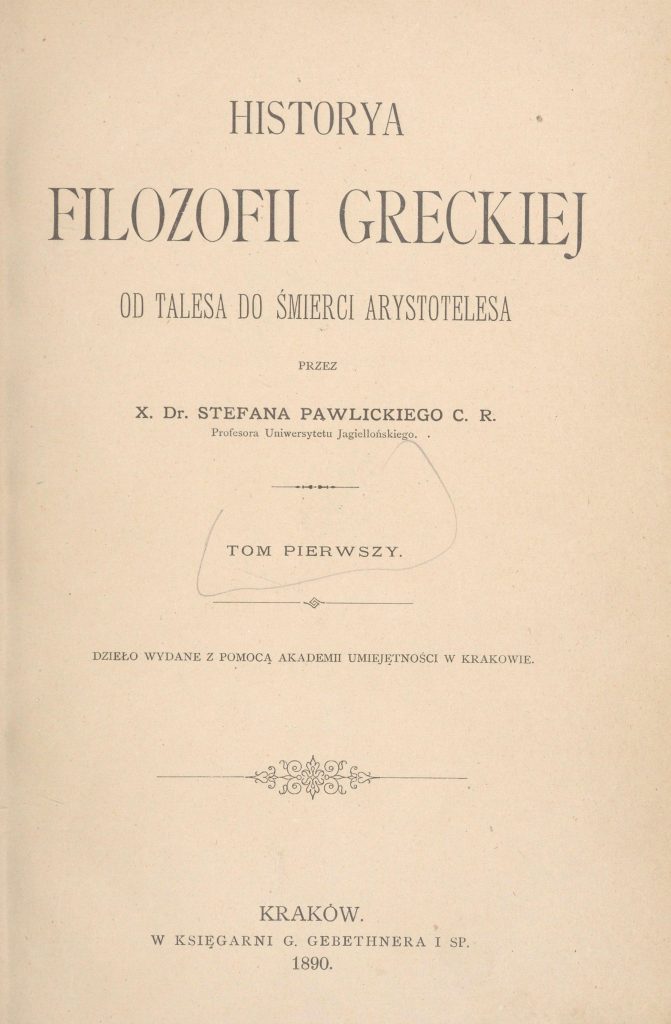
AΦR, naturally, was present at the conference. Tomasz Mróz delivered a paper titled Stefan Pawlicki on the concepts of soul in Greek philosophy. Pawlicki (1839-1916) was once in his career a professor of philosophy in Warsaw, but Mróz’s paper was focused on mature period of his career, when he was a respected professor in Cracow and the author of History of Greek Philosophy. Volume I of this book appeared in print in 1890 (front page on the right) and was the first Polish handbook for ancient philosophy, while the volume III, meant to be devoted to Aristotle, was not finished by the author.
Pawlicki was an admirer of Plato, but instead of presenting well-known opinions of Pawlicki on Plato, Mróz discussed Pawlicki’s criticism of the pre-Socratic thinkers. Pawlicki was a historian of philosophy who aimed not only to provide the readers with an account of the ideas of Greek thinkers, but considered the needs of the Polish reading audiences and supplemented his discussion of the Greeks with assessments and evaluations presented from the Catholic standpoint.
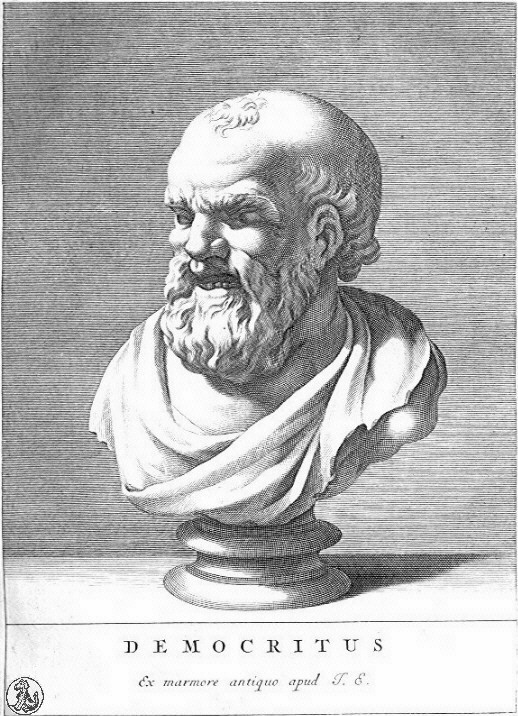
One of Pawlicki’s methods was to draw far reaching conclusions from the fragments of the pre-Socratic thinkers, especially materialist philosophers like Democritus, and then present them as unacceptable. For example, he stressed pantheist traces in Heraclitus and pessimism of Democritus, while at the same time he seemed to appreciate the concept of reincarnation and Pythagorean ethics, as encouraging human beings to improve themselves.
His arguments against most of the Greek concepts of human soul allow to structure them in order of perfection, starting with Aristotle (whom Pawlicki did not manage to present), followed by Plato and Socrates, with Pythagoreanism below, and ending with Heraclitus and Democritean materialism, which was – just like 19th century materialists – a constant subject of Pawlicki’s critical remarks.
A Biographical Sketch on Henryk Jakubanis
Mariam Sargsyan, an AΦR researcher focusing on the legacy of H. Jakubanis, has recently published a paper Henryk Jakubanis (1879–1949) – a Historian of Greek Philosophy Between Kyiv and Lublin, which aims at discussing the entire academic path of this researcher of ancient philosophy, presenting his work in both periods of his life, connected to Kyiv and Lublin. The paper was published in Polish and can be downloaded here.
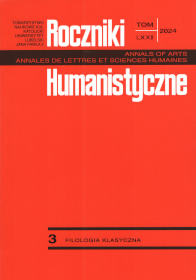
It is not insignificant to remark that Sargsyan’s paper has been published in an issue devoted to classical philology of “Roczniki Humanistyczne” (“Annals of Arts”, Vol. 72 No. 3, 2024, pp. 79-97), a journal edited at the Catholic University of Lublin (KUL), where Jakubanis used to work for over two decades of his life.
Jakubanis’ life began in the Russian Empire, and Sargsyan presents his family and his initial education it the gymnasium, with a focus on classical languages and humanities. Then the story proceeds to the Kyiv period of his life, including a brief sketch of the history of St Vladimir’s Imperial University of Kyiv and the researchers of the history of philosophy there, with an emphasis on Jakubanis’ academic supervisor, Alexei Gilarov (1856-1938). During his Kyiv period Jakubanis won a scholarship for a study visit in Germany, notably in Berlin, and was active as a university lecturer, teacher at various courses extra muros, and started to develop his academic and research career.
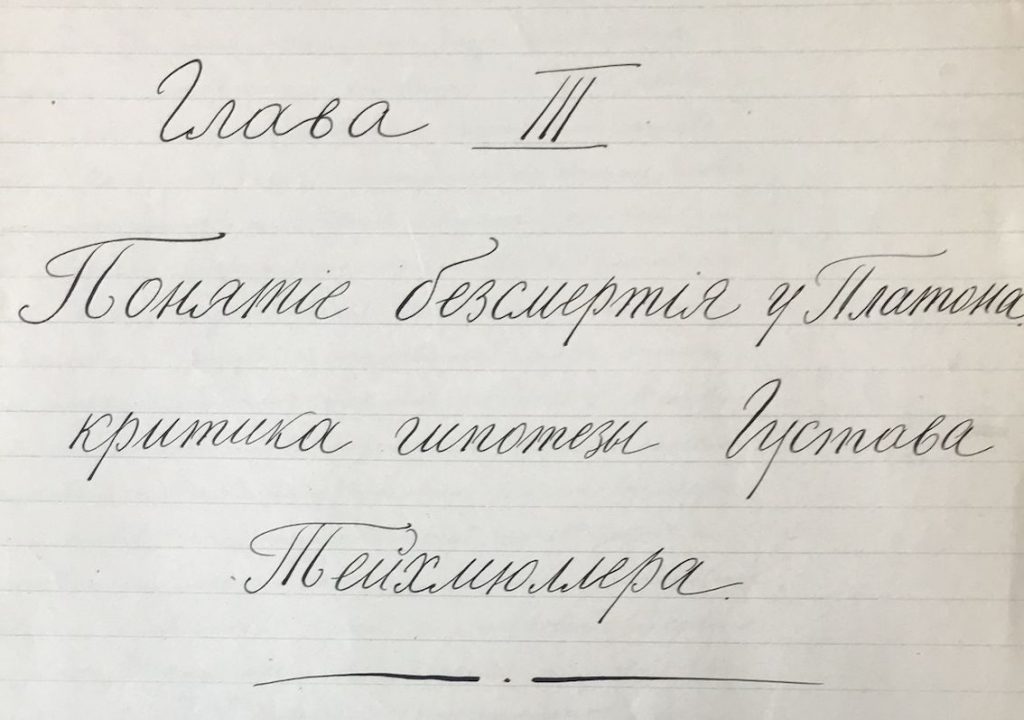
The Lublin period began in 1922 with Jakubanis’ repatriation from the then Soviet Ukraine to Lublin in the independent Republic of Poland. Thanks to the support of Tadeusz Zieliński (1859-1944), his former examiner in Kyiv, Jakubanis was hired at the University of Lublin. His lectures and seminars there, his life during the war, his works and impact are further discussed in the paper.
To sum up: Jakubanis spent 26 years of his life in Kyiv and 27 in Lublin where he died in 1949. These two periods were almost equal in terms of time, yet they were quite different. In Kyiv he composed most of his works and was formed as a researcher and teacher in classics in general and in the history of ancient philosophy in particular, while in Lublin he was rather occupied with university life and lecturing, and it did not allow him to focus on researching and publishing. For his entire life, however, he remained faithful to his interests in ancient philosophy and, according to his students, spared no energy to disseminate his knowledge and expierience in this field.
Platonism in Polish Romantic Poetry
On November 18th-19th an interdisciplinary conference took place in the Catholic University of Lublin (KUL), with the University of Warsaw (UW) as a coorganising institution. The title of the event was: The Romantic Tradition. Poetry, Community, Sources. Most of the papers presented during the meeting were focused on Polish poetry and literature of the 19th century Romanticism, nevertheless papers on various philosophical aspects of the epoch constituted a significant contribution to the conference topic.
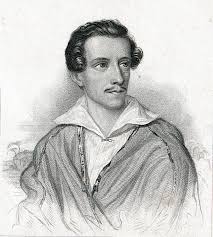
A member of AΦR research group, Tomasz Mróz, took part in the conference and delivered a talk titled Plato in the Works of Słowacki. Some Observations. Mróz discussed references to Plato in the works by Juliusz Słowacki (1809-1849), a major figure in the period of Polish Romanticism, one of the three poets considered as the National Bards.
The speaker aimed to demonstrate that most of Słowacki’s references to Plato were incidental, that the poet mixed up Plato’s dialogues (the Phaedrus and the Phaedo) and his knowledge of Plato’s works was limited to their French translations or paraphrases. It was the idea of reincarnation that seemed appealing to Słowacki, but he could have learned it from other sources. The poet used and transformed, however, Plato’s myths and it was the myth of Er from the Republic that became the metaphysical foundation of Słowacki’s great poetic work The Spirit-King. The conclusion of the paper was that in spite of the fact that the name of Plato is present in Słowacki’s legacy, Platonism as a system of philosophical ideas is absent there.
Recent commentaries