Home » Posts tagged 'In English' (Page 3)
Tag Archives: In English
Plato in Poland book available in OA
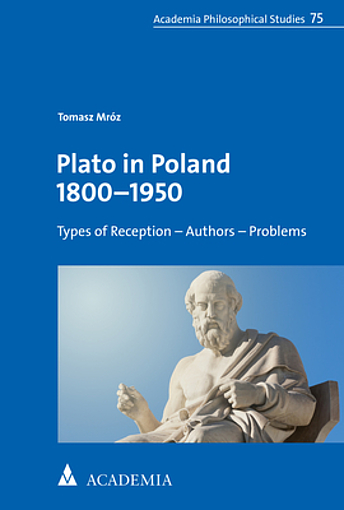
This post is only to announce that the book by T. Mróz, Plato in Poland 1800-1950. Types of Reception – Authors – Problems (Academia Verlag/Nomos Verlagsgesellschaft, Baden Baden 2021), as a result of the agreement with the publisher, is now available free in open access on the Nomos Verlag website here and in the repository of the University of Zielona Góra, here. Enjoy!
(Another) Erasmus+ Teaching Visit in Vilnius
In April, 15th-19th, 2024, Tomasz Mróz enjoyed his fourth Erasmus teaching visit in Faculty of Philosophy, Vilnius University.
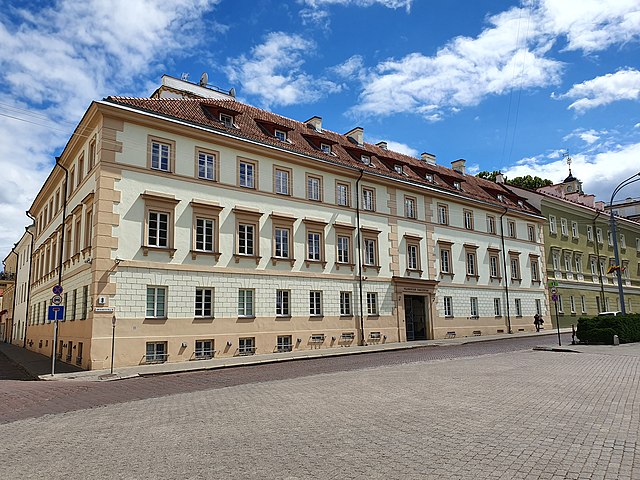
This year, some issues connected to the reception of ancient philosophy were addressed during the lecture on Władysław Tatarkiewicz (1886-1980) and his History of Philosophy. It was ancient philosophy as a subject of various problems in historiography of philosophy.
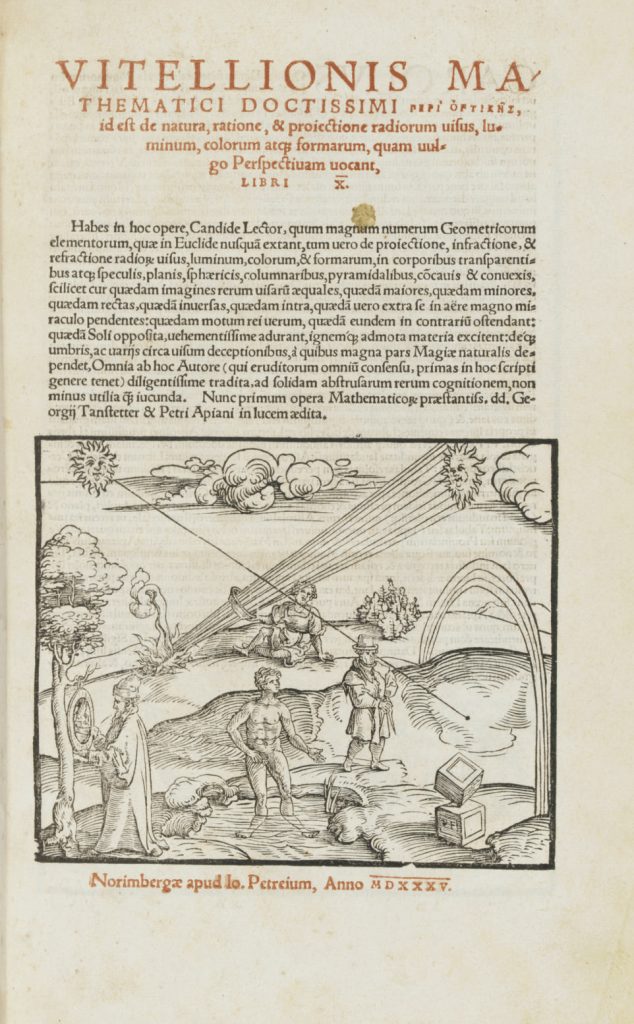
More important, however, was a talk devoted to Vitello (ca. 1230-1300) and his theoretical reflection on the nature of the daemons. Vitello’s demonology stemmed from his research in natural sciences and it employed neo-Platonic and Aristotelian elements, such as a belief in a mathematical structure of the universe, the theory of four elements and natural creatures. Vitello’s philosophical investigations were presented against the background of the 13th century developments in philosophy, especially the Averroist controversy.
Teaching duties were supplemented with meetings with the Faculty members and discussions with students extra universitatis muros. Hopefully, this was not the final chord in the co-operation between Vilnius University and the University of Zielona Góra.
A Visitor from Vilnius and Plato as a Teaching Subject
In March 4th-8th an Erasmus exchange visitor from Vilnius University stayed at the University of Zielona Góra and delivered some talks here. Our guest was dr. Mindaugas Stoškus who is an assistant professor at the Department of Theoretical Philosophy and Philosophy of Science, Faculty of Philosophy, VU.
Among M. Stoškus’ presentations there was one on the methods of teaching ancient philosophy, as a part the reception of ancient philosophy, and it was delivered to the students in the Doctoral School of Humanities and Social Sciences and to invited guests. The central topic of his lecture was Plato’s Republic and Plato’s political project which, resulting from Stoškus’ interactive co-operation with the audience, turned out to be a tricky and problematic issue. The lecturer demonstrated to the audience, consisting mostly of non-philosophers, how superficial reading of Plato’s opus magnum may lead to misunderstanding of the true nature of his political aims, one of which was disjoining wealth and personal success from political power and responsibility.
We hope that M. Stoškus’ visit at UZ is not the final chord of the co-operation between our two partner institutions and that our mutual collaboration will develop.
A paper on Polish translations of Plato
The latest issue of the “Revue de philosophie ancienne” (2023/2, vol. XLI) includes a paper by T. Mróz: Polish Translations of Plato’s Dialogues from the Beginnings to the Mid-Twentieth Century.
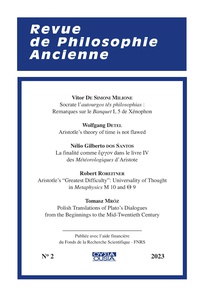
In his paper T. Mróz focuses on four most significant translators of Plato’s dialogues in Poland. They were: Felicjan Antoni Kozłowski (1805-1870), who was the first translator of Plato into Polish; Antoni Bronikowski (1817-1884), who was the most productive in the 19th century and kept on working on Plato in spite of unfavourable reviews; Stanisław Lisiecki (1872-1960), whose numerous translations remained unpublished; and finally Władysław Witwicki (1878-1948), whose renderings of the dialogues are still widely read. The paper presents their achievements and discusses the reception of their works.
Anyone whishing to receive an offprint should feel free to request it from the author via email.
“Small Grant” from the University of Zielona Góra
Prof. Marcin Mrugalski, the Deputy Rector for Science and International Cooperationof of the University of Zielona Góra (UZ), home institution of the AΦR, awarded Tomasz Mróz with a “Small Grant” of a maximum possible value. These internal grants are distributed by the Rector annually among those researchers of UZ, who had submitted their proposals to the National Science Centre (NCN), received positive assessements from the experts, yet finally had not been granted funding. Aim of the “Small Grants” is to increase the chances of the researches in future granting competitions.
“Small Grant” funds for AΦR will be spent on developing and strenghtening a co-operation between AΦR members and the Institute of Philosophy (UZ) with colleagues from the Faculty of Philosophy, Vilnius University (VU), on the topic of the history of research on ancient philosophy in VU during its complex history.
Bertrand Russell, His Views on Ancient Philosophy and Critical Reaction on Them in Poland
In August 17-18th T. Mróz took part in the sixth annual History of Analytic Philosophy Workshop organised by Tilburg Center for Moral Philosophy, Epistemology and
Philosophy of Science. This year’s meeting was devoted to Global Reception of Russell’s Scientific Philosophy.

T. Mróz’s paper was prepared in co-operation with Paweł Polak (The Pontifical University of John Paul II in Kraków), who presented his part in an on-line form. The title of their presentation was The Early Reception of Russell’s Philosophy among Polish Philosophers – a Diversity of Perspectives. P. Polak focused in particular on reception of Russell’s ideas among the representatives of the Lvov-Warsaw School, while T. Mróz discussed two cases of reception of Russell’s History of Western Philosophy (1945) among Polish historians of philosophy, and some other issues, e.g. the censorship of Russell’s texts in Poland.
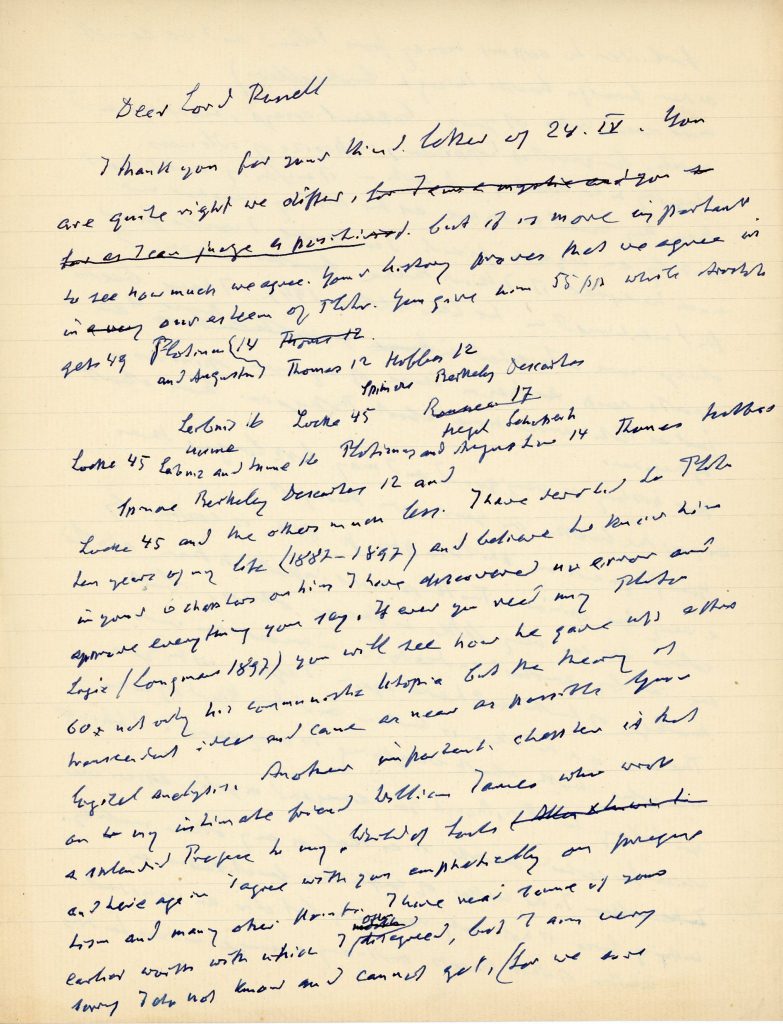
What matters here is ancient philosophy. The first Polish critic of Russell’s History was Wincenty Lutosławski (1863-1954), who expressed his views on Russell’s Plato in a letter (Lutosławski’s draft on the left) to the author (a paper in “Russell” on the letters between the two philosophers has been announced here). Despite the differences between them, Lutosławski declared in his letter: “Your History proves that we agree in our esteem of Plato”. Moreover, he praised Russell, “In your six chapters on him [=Plato] I did not discover a single error and I agree with everything you say”. In fact, both authors set themselves different goals in discussing Plato and this resulted in disparate methods in their presentations of Platonism, yet Lutosławski’s opinion was so important for Russell that he passed it immediately to his publisher.
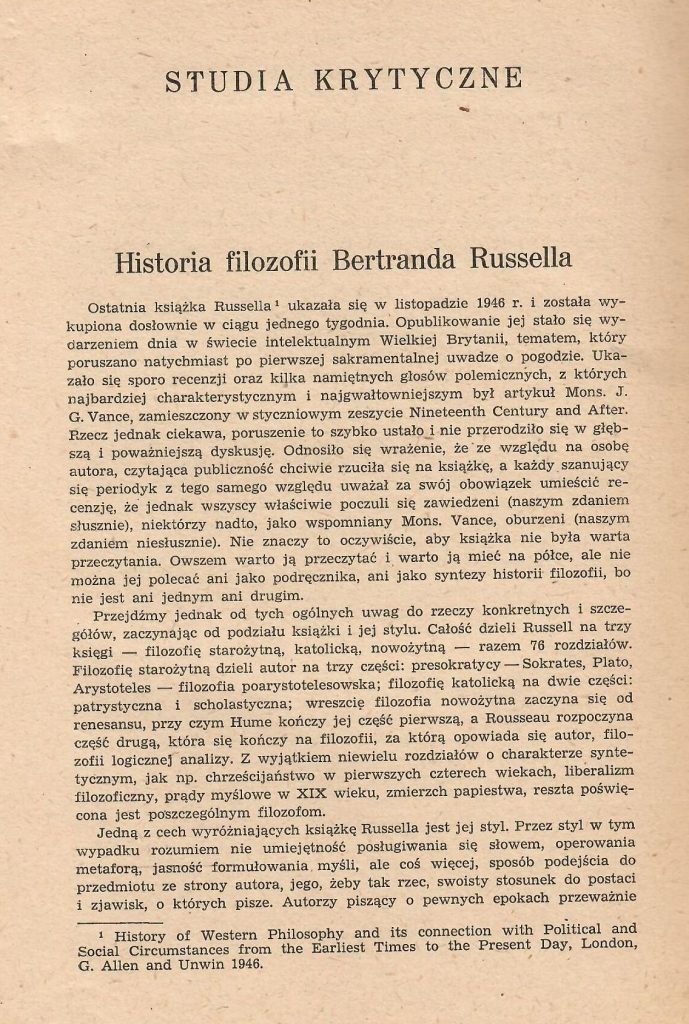
Marian Heitzman (1899-1964) was not a philosopher of a similar recognition to Lutosławski, he was an expert in Renaissance philosophy and in F. Bacon. His views on Russell’s History were published as an extensive review study in the oldest Polish philosophical journal „Philosophical Review” [Przegląd Filozoficzny]. His general opinion on Russell’s book was the following: “it is worth to read the book and it is worth to have it on a bookshelf, but it cannot be recommended as a handbook or a synthetic study of the history of philosophy”. He appreciated Russell’s style and his „humour coloured by a bit of Volterian scepticism”. His focus was Renaissance philosophy, but he remarked on many deficiences in Russell’s chapters on ancient topics. For example, the missing or too shortly discussed subjects, according to Heitzman, included Gorgias, Zeno and the logic of the Stoics. Although Russell intended to emphasise issues in political and social philosophies, in Heitzman’s eyes he missed the cosmopolitanism of the Cynics and misrepresented the problem of the Sophists and democracy. Finally, Russell aimed to present various philosophers as the effects of their social conditions, but he failed to illustrate this with Antisthenes of Athens (not an Athenian citizen) and his philosophy of cynicism.
20th Annual Conference of the International Society for Neoplatonic Studies
International Society for Neoplatonic Studies (ISNS) has for decades been a forum for scholars researching various phaenomena in the history of Neoplatonism, including even the latest developments of the reception of Platonism. In June 14th-17th, 2023, ISNS conference was held at the foot of Etna, in Catania, in co-operation with Università degli Studi di Catania.
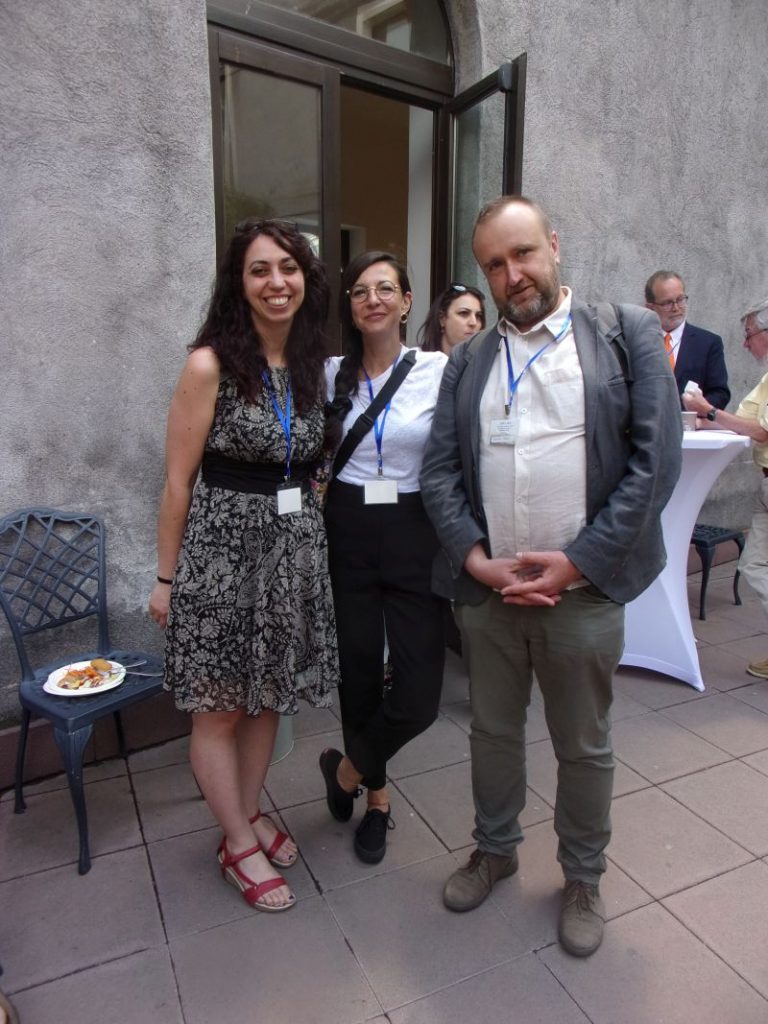
One of the numerous panels at the conference was devoted to Plato’s Timaeus, the concept of time and its influence on various thinkers across the history of philosophy up to recent times. The panel was organised by the two professors, Laura Marongiu and Laura Follesa, both of University of Milan. Although this panel focused on relatively narrow topic, the response from scholars was impressive and thus the list of speakers in this successful panel demonstrated incessant interest of generations of scholars in the Timaeus, the late dialogue of Plato. The topics ranged from Speusippus, Aristotle, Xenocrates, Numenius, Plotinus, Iamblichus, Proclus, Simplicius and Philoponus to M. Ficino, L. Bruno, F.W.J. Schelling, G.W.F. Hegel, H. Bergson and E. Husserl (on the photo: L. Follesa, L. Marongiu & T. Mróz).
T. Mróz presented a paper titled The Timaeus and Three Scholars of One Generation: P. Natorp, P. Shorey and W. Lutosławski. Mróz discussed various interpretations of the Timaeus by the three scholars, focusing on their general methods in reading Plato and their views on Plato’s concept of the time, although none of them considered the time to be the central issue in the dialogue.
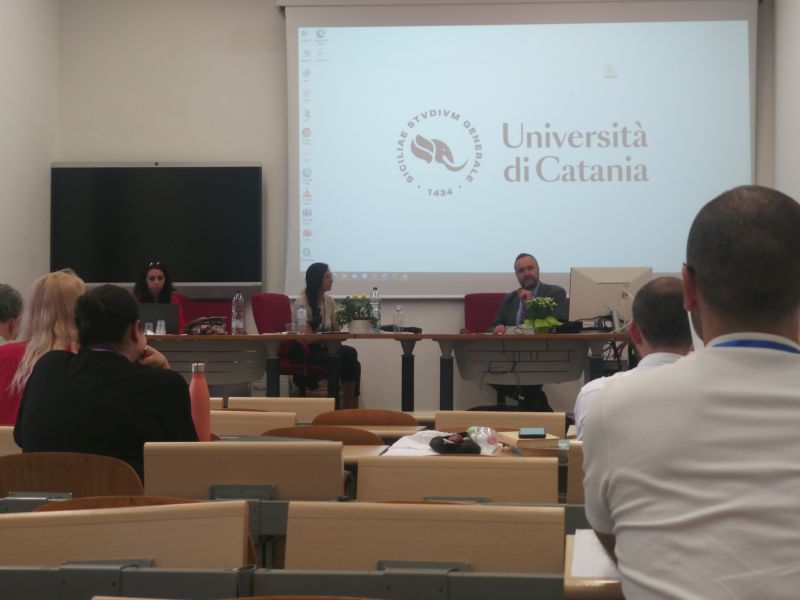
ISNS conferences have always been a forum for scholars who explore various aspects of Platonism, Neoplatonism and Plato reception from antiquity up to contemporary times. Professor John Finamore, spiritus movens of all of ISNS symposia, spares no efforts to hold ISNS events in various academic centres and to provide opportunity for scholars throughout the world to take part in them. He has recently announced that next year’s ISNS conference will take place in Dublin, in co-operation with Trinity College.
Recent commentaries