Home » Posts tagged 'I. Dąmbska'
Tag Archives: I. Dąmbska
A Conference in Częstochowa: Polish Studies on Plato
Ancient Φilosophy Reception research group couldn’t have been absent at the conference on Polish Studies on Plato, which was held in Jan Długosz University (UJD) in Częstochowa on May 18-19th, 2026.
The conference was organised by the Chair of Philosophy of UJD, and prof. Wiesława Sajdek was the head of the whole event. Tomasz Mróz delivered his paper in the opening panel, after the introductory talk by prof. Marian Wesoły. Reports from the first day of the conference (in Polish) were published on the websites of UJD and a local radio station. It should be emphasised that both professors, Sajdek and Wesoły, have already collaborated in various activities of AΦR.
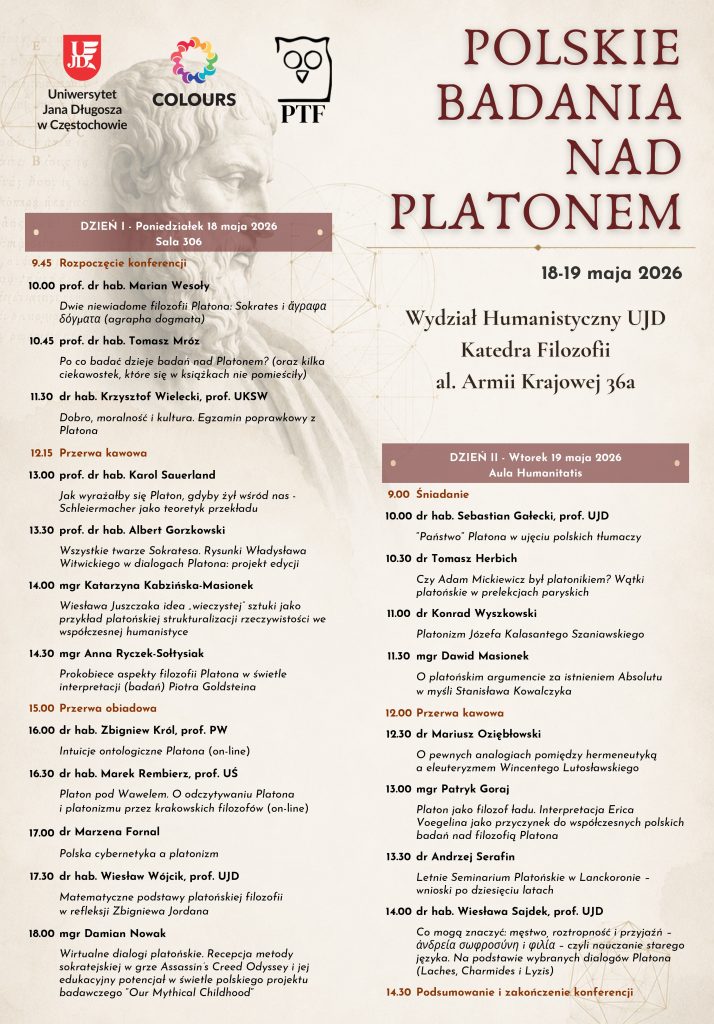
The paper by Mróz had a long title: Why study the history of studies on Plato? (and a couple of interesting pieces that were not included in the books). He argued, certainly, for the positive answer to the question in the title, since – for example – discussions about Plato’s legacy and various interpretations of his philosophy reflect philosophical trends of their times and commenting on Plato’s dialogues provides a convenient opportunity to express one’s own views. Moreover, Mróz discussed peculiar history of the texts that had “Plato” and “Poland” in their titles, starting with an English report, published by Lewis Campbell (1830-1908), Plato in Poland (1893), on the then recent studies on Plato’s logic by Wincenty Lutosławski (1863-1954). Then, the history of Polish texts by Irena Pannenkowa (1879-1969), Izydora Dąmbska (1904-1983), Zbigniew Nerczuk (another collaborator of AΦR), and Mróz himself followed.
Mróz discussed briefly some issues related to his decades long studies on Polish traditions in researching and translating Plato that were unsuitable for publishing in scholarly works. They were e.g. his reminiscences from his meetings with Lutosławski’s daughter, Janina Lutosławska (1922-2006), and the archival discoveries he had made in the legacies of Lutosławski, Stefan Pawlicki (1839-1916), Stanisław Lisiecki (1872-1960), and Henryk Jakubanis (1879-1949), many of which he was able to edit and publish.
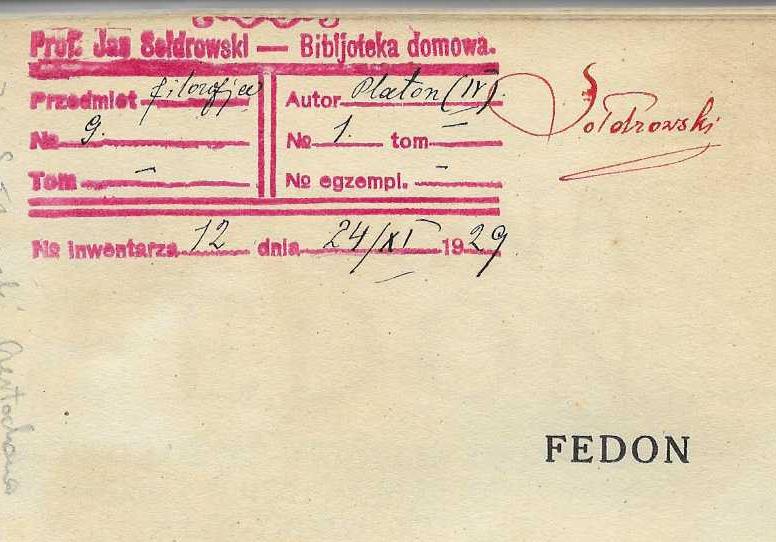
In the final parts of his talk, Mróz presented a small detail related to the location of the conference, the city of Częstochowa. Once in his research he came across a copy of the Phaedo in Władysław Witwicki’s (1878-1948) translation (Warsaw 1925) which had been owned by Jan Sołdrowski (1889-1970), a teacher of various subjects (including classics) and a Catholic activist from Częstochowa. His notes on the margins of the book revealed his thoughts and impressions from reading the dialogue.
AΦR at the 3rd Congress on Polish Philosophy
The 3rd Congress on Polish Philosophy took place in October (18th-20th) in the Rydzyna Palace. It gathered scholars interested in researching the tradition of Polish philosophy and developing it. Two members of the Ancient Φilosophy Reception research group took part in this philosophical event: Adrian Habura – online, and Tomasz Mróz – onsite. The first of them spoke about the concept of love in the works of Władysław Tatarkiewicz (1886-1980), while the latter – on the history of studies on the reception of ancient philosophy in Poland.
Mróz’s paper was directly concerned with problems related to the reception of ancient philosophy and started with quotes of diverse opinions of two eminent Polish researchers in the history of Greek philosophy, that is, Stefan Pawlicki (1839-1916) and Wincenty Lutosławski (1863-1954). Lutosławski, when composing his works on Plato, searched for Polish authors and their studies to provide references to them, while Pawlicki paid no interest to the works of his compatriots on Greek philosophy.
In more recent decades it was Izydora Dąmbska (1904-1983), a philosopher and historian of philosophy, who published a study on the reception of Plato in Poland (1972), but nowadays many books and papers on this topic were published by the members of the AΦR research group. Concluding his talk Mróz briefly presented research projects of the members of the AΦR and the books they had published, to start with the latest one:
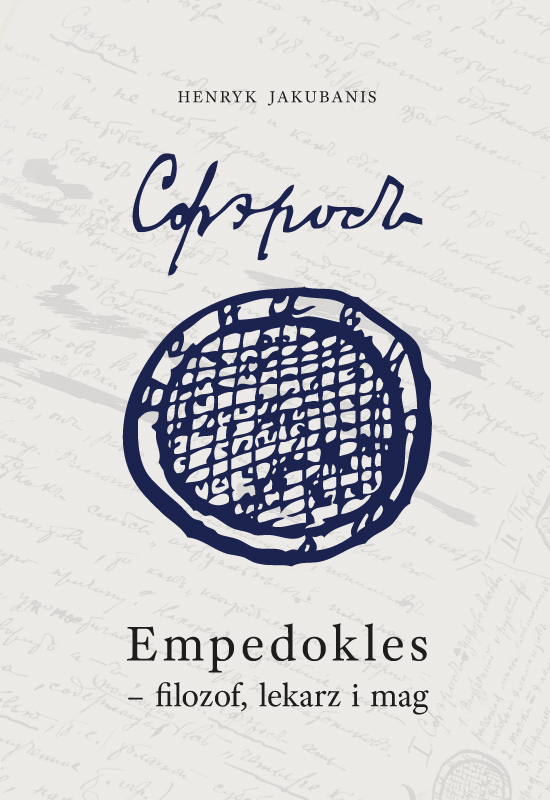
Henryk Jakubanis, Empedokles – filozof, lekarz i mag: Przyczynek do jego zrozumienia i oceny (Empedocles: a Philosopher, a Doctor and a Magus. Materials for Understanding and Assessing Him), transl. from Russian and ed. Mariam Sargsyan, A. Habura, Wydawnictwo Marek Derewiecki, Kęty 2024, 104 pp. (Studies and Texts in the History of Reception of Ancient Philosophy, vol. 3).
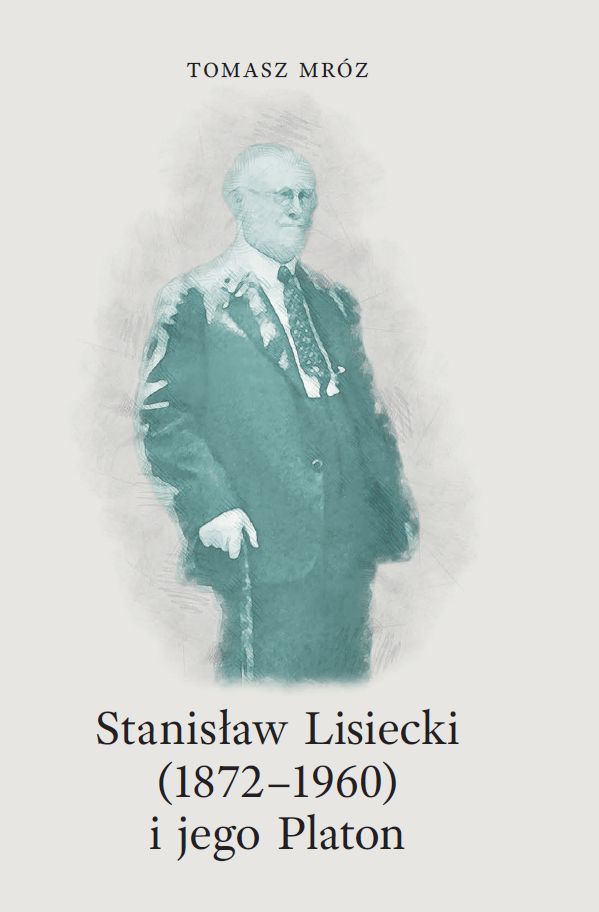
T. Mróz, Stanisław Lisiecki (1872-1960) i jego Platon (Stanisław Lisiecki (1872-1960) and His Plato), Wydawnictwo Marek Derewiecki, Kęty 2022, 150 pp. (Studies and Texts in the History of Reception of Ancient Philosophy, vol. 2).
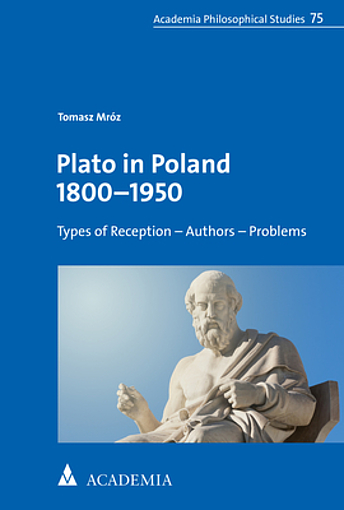
T. Mróz, Plato in Poland 1800-1950: Types of Reception – Authors – Problems, Academia Verlag / Nomos Verlagsgesellschaft, Baden Baden 2021, 480 pp. (Academia Philosophical Studies, vol. 75).
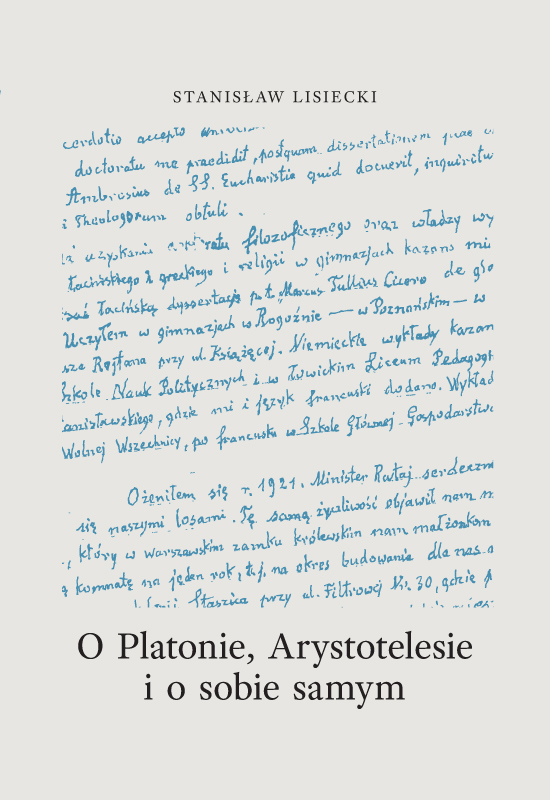
S. Lisiecki, O Platonie, Arystotelesie i o sobie samym (On Plato, Aristotle and on Himself), ed. T. Mróz, Wydawnictwo Marek Derewiecki, Kęty 2021, 367 pp. (Studies and Texts in the History of Reception of Ancient Philosophy, vol. 1).
and some earlier ones…
Recent commentaries