Home » Posts tagged 'W. Witwicki' (Page 2)
Tag Archives: W. Witwicki
Plato’s Adventures with Censorship in Poland
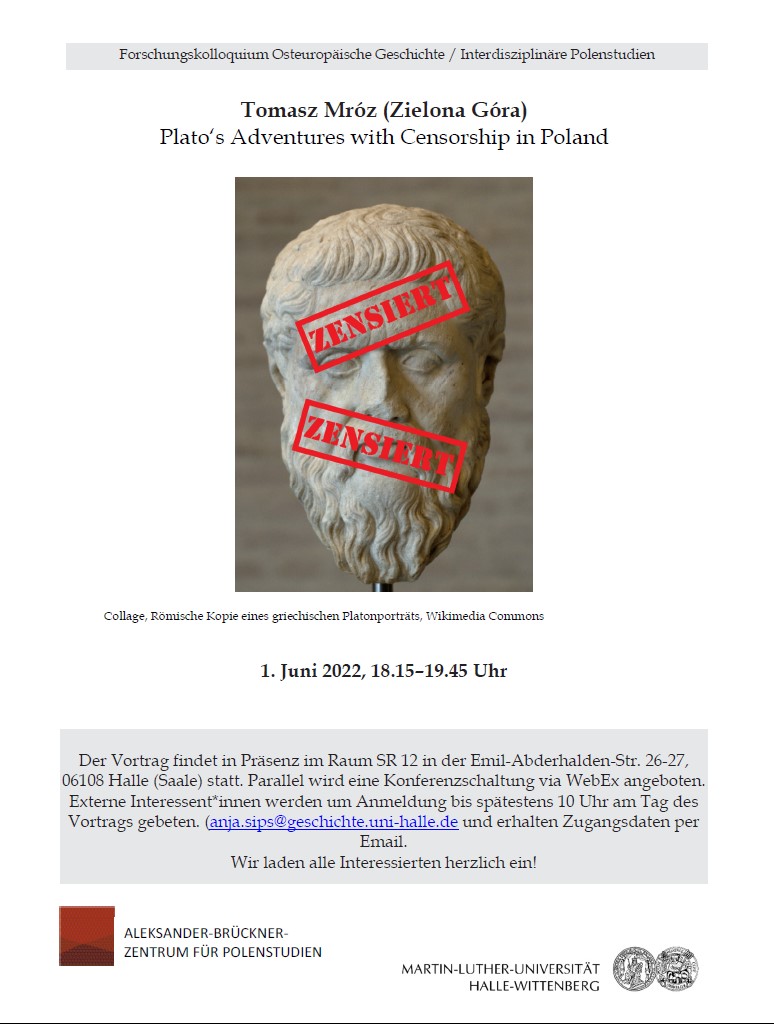
On June, 1st, a talk by Tomasz Mróz was delivered at the Interdisziplinäre Kolloquium Osteuropäische Geschichte / Polenstudien (Martin-Luther-Universität Halle). The topic of the presentation was the interference of various types of (broadly understood) censorship with Plato scholars and research on Plato in Poland. T. Mróz discussed three (and a half) cases of such interference. The talk was a supplemented and developed version of one of Mróz’s previous papers.
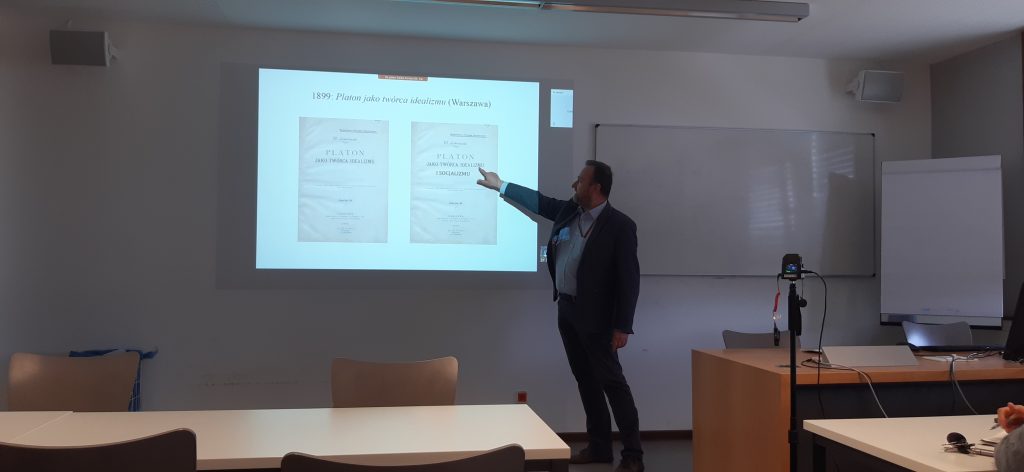
The first case of censorship was relatively harmless, for only one word, namely: socialism, was removed from the title of Wincenty Lutosławski’s book, Plato as a Creator of Idealism [and Socialism], (Warsaw 1899). Imperial Russian authorities in Warsaw removed the word “socialism” from the title and from the table of contents, without even looking into the text of his book on Plato, for “socialism” occurs on many pages, being – in Lutosławski’s view, a natural consequence of idealism.
Stanisław Lisiecki represented another case of broadly understood censorship. He was an enthusiast of Plato and a translator of his dialogues, but only his Republic saw the light of day in the interwar period, while all the remaining dialogues were left unpublished in the manuscripts. His leaving the clergy and Roman Catholic church was the most probable the reason of his difficult situation in Polish academia, for some scholars were unable to accept him as a colleague and assess his works without religious prejudice. As a result, his works were not published, but some justice in this regard has been recently done by the members of the AΦR research group.
Władysław Witwicki was more succesful in his translations of Plato’s works. Soon after the Word War II he managed to publish a small book on Plato (Plato as an Educationalist, 1947) and a translation of Plato’s Republic (1948). In the book and in his commentaries to Plato’s text, he compared the post-war reality of Poland and Plato’s political project to a concentration camp, great monastery, or a totalitarian state. Some of his remarks were censored and the second edition of the Republic (1958) appeared in print in an ideologically “corrected” version.
As the additional “half” of the censorship cases, Witwicki’s struggle with his sister, who was a Catholic nun, were presented. She tried to convince him not to criticize Catholicism in his commentaries, but he replied to her with a short comic story depicting his and Plato’s imaginary meeting with her, and Plato’s escape from holy water.
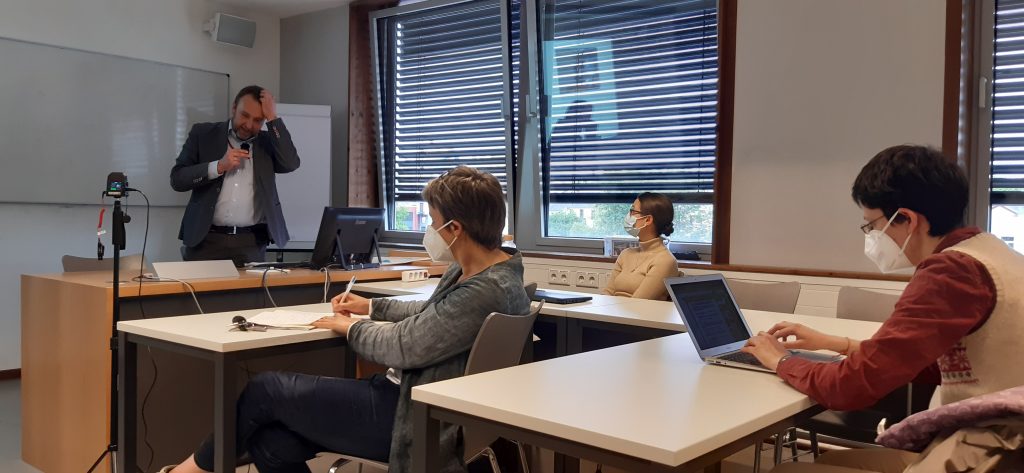
Thanks to the fact that the audience consisted of specialists in East-European history, in philosophy and in the historiography of philosophy, a wide spectrum of questions appeared and the author did his best to satisfy multi-oriented demands of the public.
T. Mróz’s stay in Halle was sponsored by Aleksander-Brückner-Zentrum für Polenstudien from the funds of Deutscher Akademischer Austauschdienst (DAAD).
A Biography of a Classics Scholar: Stanisław Lisiecki (1872-1960)
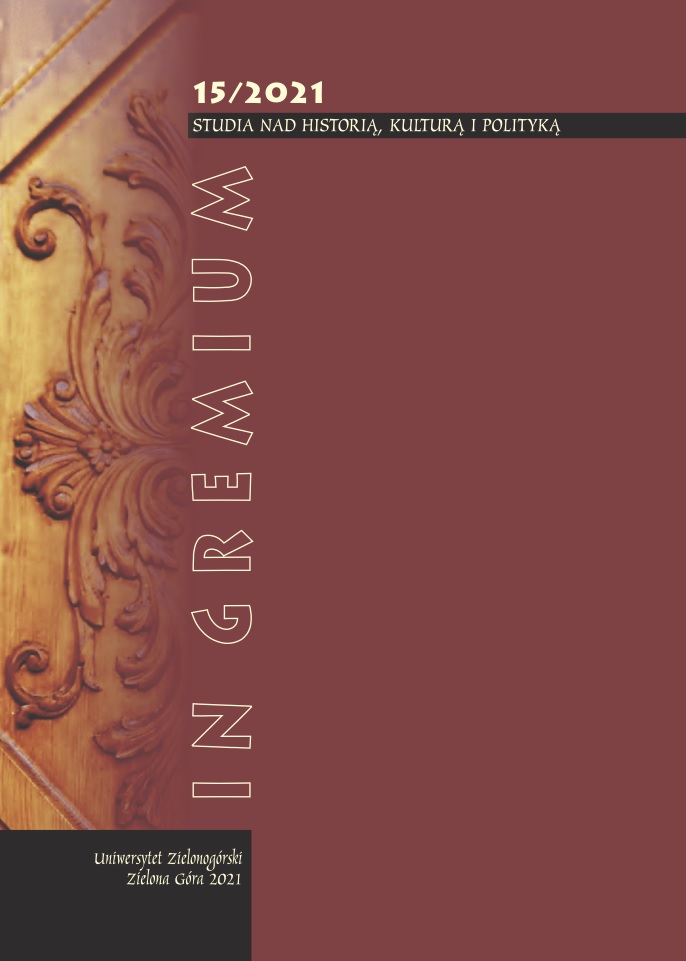
The latest issue of “In Gremium” annual journal (15/2021) includes a paper by Tomasz Mróz who took an attempt to compose a biographical sketch of Stanisław Lisiecki (1872-1960). The course of his life can be reconstructed from scraps of information in letters, official documents and only few printed materials.
This is the most extensive biography of Lisiecki so far and it was based on handwritten documents from the Archive of Polish Academy of Sciences, the Manuscript Section of the Jagiellonian Library, and from private collections. A turning point in his life was his decision to abandon his church career and start living as a layperson. In the interwar Poland his choice was not met with acceptance of the members of the then academia.
Although he cannot be counted among the top Polish historians of ancient philosophy or classics scholars, he was unjustly disregarded as a historical figure with a considerable, though unpublished legacy, coinsisting of translations of and commentaries to a number of Plato’s and Aristotle’s works.
The paper (in Polish) can be downloaded from the journal’s website here.
AΦR at Classical Studies Workshop in Greece
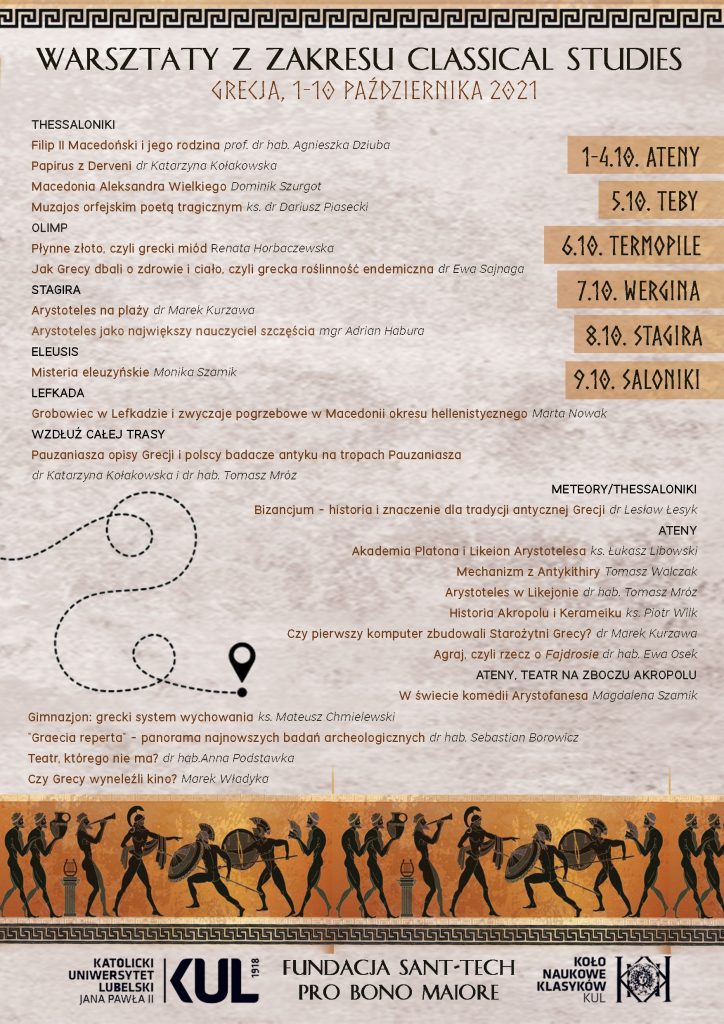
Two members of AΦR Group, together with an AΦR friend, took part in Classical Studies Workshop in Greece. This tour event took place in the first ten days of October and was organised by The Sant-Tech Foundation in co-operation with Catholic University of Lublin (KUL).
It was an unforgettable tour of Greece from Athens to Thessaloniki, including Delphi, Marathon, Meteora, Pella, Stageira and many more places of archeological interest, many of which being extremely important for philosophers and historians of philosophy, e.g. Plato’s Academy, Aristotle’s Lycaeum, ancient Stageira or Nymphaeum in Mieza. The whole stay and the journey were carefully planned by Katarzyna Kołakowska and Lesław Lesyk (both of KUL and Sant-Tech Foundation), who smoothly adapted the workshop’s schedule to unexpected conditions.
The chronological order of the papers delivered by participants from Zielona Góra is: 1) Was the First Computer Designed by the Greeks? (M. Kurzawa, at the footsteps of the National Archaeological Museum of Athens; third from the left in the photo below). The speaker focused on the history of research on the Antikythera mechanism, which is preserved in this Museum, and its unbelievable construction. 2) Aristotle in the Lycaeum (T. Mróz, in the archeological site of… Aristotle’s Lycaeum; first on the right) discussed briefly the excavations in this location and presented the outlines of the history of the Philosopher’s school.
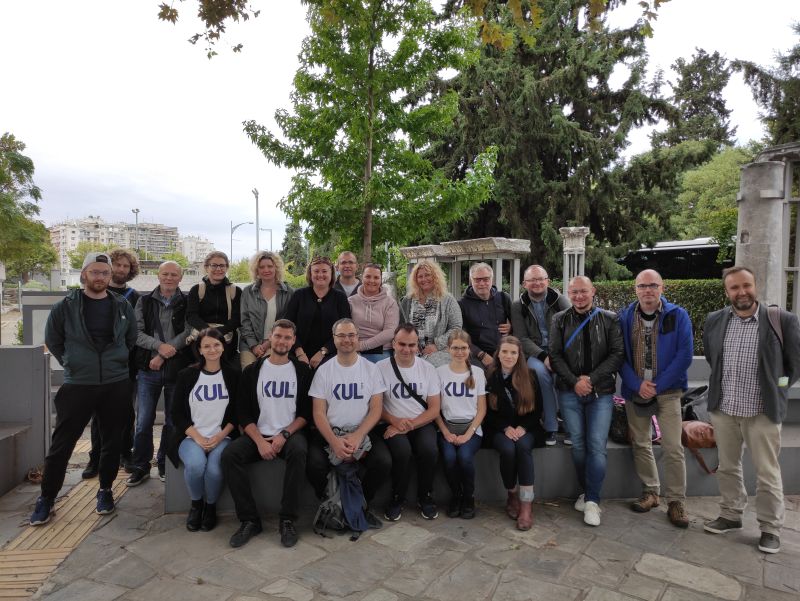
Due to unfavourable weather conditions the following presentations were delivered en route to Thessaloniki, that is, on the bus: 3) Aristotle on the Beach (M. Kurzawa) was a paper devoted to Aristotle’s works in natural sciences and focused on his anecdotal scientific curiosity which gave rise to his theories, which still amaze us to this day. 4) Aristotle as the Greatest Teacher of Happiness (A. Habura; second from the left in the photo). The speaker presented the most essential Aristotle’s instructions on achieving happiness from the Nicomachean Ethics and highlighted their universal character, which was additionally substantiated by the studies of W. Tatarkiewicz, a recognised Polish historian of philosophy and ethician, on the same subject. 5) Polish Historians of Philosophy and Classics Scholars on Their Journeys to Greece (T. Mróz). This was rather a loose speech than academic paper and it presented three Polish scholars (W. Dzieduszycki, T. Sinko, W. Witwicki) and their memories of visiting historical places, some of which at the times of their journeys looked differently then they do today, and their observations on modern Greeks, which in turn appear sometimes to tally with today’s impressions of Greece.
A View of Plato’s Paths in Poland
A lengthy, 480 pages, monograph book by T. Mróz was published in Academia Verlag’s series “Academia Philosophical Studies” as vol. 75. The title of the book is Plato in Poland 1800-1950. Types of Reception – Authors – Problems.
Some material from the book, including table of contents, is available on publisher’s website. The book attempts to make Polish Plato reception available to non-Polish readers. The years 1800-1950 cover essential phaenomena in modern Polish philosophy, for they encompass periods of reception of Western philosophical trends and the development of the Lvov-Warsaw school, neo-Messianism and neo-Scholasticism. The book discusses how each of these phaenomena contributed to interpreting Plato. The material is divided into three main parts focused on various types of reception.
The book is a final outcome of a project sponsored by Polish government within the National Programme for the Development of Humanities funding scheme. An essential collaborator in this project was Una Maclean-Hańćkowiak, who patiently edited the author’s style.
Censorship against Plato Scholars and Plato Himself

A volume on various aspects of relations between censorship, politics and oppression was published in 2018 by Gdańsk University Press. The book was a result of an international conference which took place in Gdańsk in 2017.
A paper by T. Mróz, included in this collective volume, discusses three cases of censorship on works of Polish Plato scholars who were active in three various periods of Polish history. First, the title of W. Lutosławski’s book on Plato was shortened by Imperial Russian authorities in Warsaw, they removed the word “socialism” from the title of his book on Plato. Its final version was then reduced to “Plato as the Creator of Idealism”.
S. Lisiecki, in turn, translated dialogues and wrote extensive introductions to them, but only his Republic saw the light of day in the interwar period, while all the remaining dialogues were left unpublished (but some of them, fortunately, will be published this year!). His leaving the clergy and Roman Catholic church might have been one of the reasons of his difficult situation in Polish academia.
Finally, W. Witwicki’s translation of the Republic with his commentaries appeared in print in 1948. After his death, the second edition was published in 1958, but some of his ironic and critical remarks on totalitarian system were removed.
Paper by T. Mróz can be downloaded from the University’s repository here.
Polish historians of Greek philosophy and their journeys to Athens
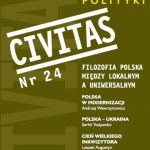
It comes as no surprise that experts in Greek philosophy and literature, classic scholars, or historians of the ancient world ache to visit the monuments of ancient history and to touch the relics of the Greek past. Many scholars were able to fulfill this dream and to undertake a journey to visit Athens and dwell the streets to search for Socrates or to have a discussion with the spirit of Plato in Academic garden.
Such journeys resulted very frequently in books or papers, memoirs or historical guides, that included their authors’ noble hopes and high expectations, but also their disappointments and grievances that Greek and Athenian reality at the turn of the 20th century could not meet their image of classical beauty and spiritual harmony.
In his paper in Polish, T. Mróz presented the works of four Polish authors who were experts in Greek literature and philosophy, who published extensively on this subject and who were sufficiently wealthy to travel to Greece, and to Athens in particular. In chronological order of their journeys, they are: Wojciech Dzieduszycki, Wincenty Lutosławski, Tadeusz Sinko and Władysław Witwicki. Their journeys took place between 1874 and 1937.
The paper can be downloaded here, and “Civitas” table of contents is here in English and here in Polish.
2019: the last talk (before the 2020 pandemic)
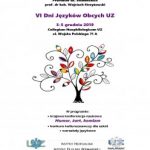
The Days of Foreign Languages at the University of Zielona Góra have already become an annual tradition. In 2019 they were devoted to humour, joke and comedy, and AΦR was there too. A talk on the examples of Plato’s humour in various Polish translations was delivered by Tomasz Mróz.
Selected passages from the Eutyphro, Apology, Republic, and Cratylus in various Polish translations were compared, with occasional help of Plato translations into other languages, that is, German (F. Schleiermacher, W.S. Teuffel), English (H.N. Fowler, H. Tredennick, G. Grube, P. Shorey, W.H.D. Rouse, A.D. Lindsay, D. Lee, F. M. Cornford), Russian (M.S. Solovyov, A.N. Yegunov), Italian (G. Giardini) and, last but not least, Ukrainian (Y. Kobiv).
The stress was laid on the issue of who of the translators was able to discover Plato’s humour and to render it properly into Polish. Not to mention the more general conclusion on Plato’s comic talents, for philosophy has never been an exclusive bussiness of sad and old men with beards 😉
Recent commentaries